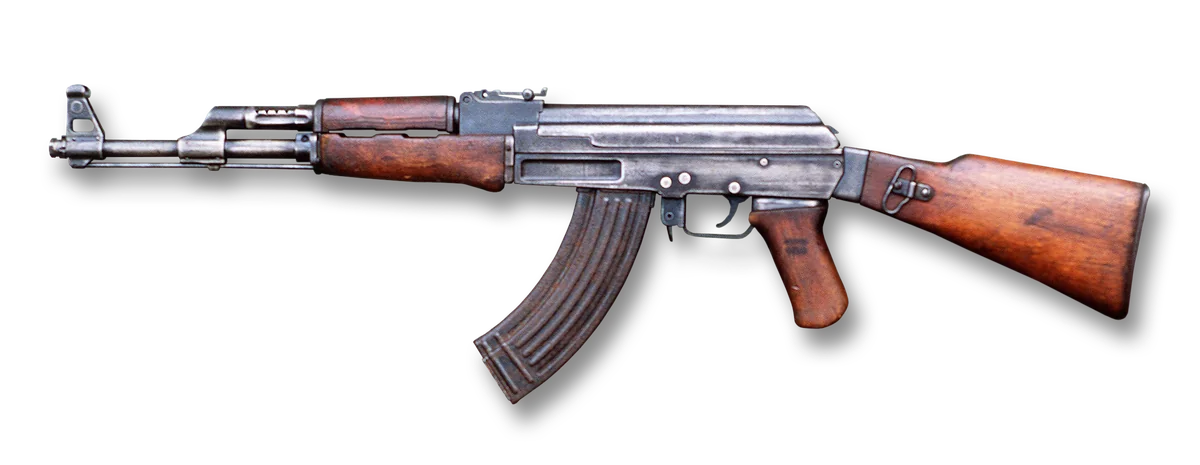
There are an estimated 75 to 100 million Kalashnikov-pattern rifles in circulation worldwide. They have been manufactured in at least thirty countries, used by every major military power and most minor ones, and carried in nearly every armed conflict of the second half of the 20th century. Whatever else can be said about the AK-47, it has done more shaping of the modern world than almost any other piece of small-arms hardware ever made.
Mikhail Kalashnikov
The rifle was designed by Mikhail Timofeyevich Kalashnikov, a Soviet tank sergeant who was wounded at the Battle of Bryansk in 1941 and convalesced in a hospital where he reportedly began sketching small-arms designs. Kalashnikov had no formal engineering training. He was a gifted tinkerer with a strong intuitive sense for how things should work, and he was working in a Soviet design system that valued ruggedness and manufacturability above almost any other quality.
His design — submitted to the Red Army's small-arms competition in 1946 and adopted in 1949 as the Avtomat Kalashnikova obrazets 1947 goda — was not the most accurate rifle entered. It was not the lightest. It did not have the best sights or the best trigger. What it had was an action that worked, reliably, in conditions that would jam almost any other rifle: mud, sand, snow, sea spray, and decades of service neglect.
Why it works
The AK-47 fires the 7.62×39mm cartridge — an intermediate round, less powerful than a full-size rifle cartridge but more powerful than a pistol round, allowing controllable automatic fire from a relatively light weapon. The action is a long-stroke gas piston driving a rotating bolt, with extraordinarily generous internal tolerances that allow the weapon to keep functioning even when its parts are dirty, worn, or slightly bent.
This is the AK's central design choice and its central virtue. Most military rifles are built to close tolerances and fail when those tolerances are violated. The AK is built loose. It rattles when you shake it. The bolt has visible play in its carrier. None of this matters, because the gas system has so much more energy than it needs that it will cycle the action regardless. The cost is reduced accuracy at long ranges. The benefit is a rifle that a conscript with a rag and a bottle of gun oil can keep running indefinitely.
"I would prefer to have invented a machine that people could use and that would help farmers with their work — for example, a lawnmower." Mikhail Kalashnikov, late in life
- TypeSelective-fire assault rifle
- OriginSoviet Union
- DesignerMikhail T. Kalashnikov
- In Service1949 – Present
- Cartridge7.62 × 39 mm
- ActionGas-operated, rotating bolt
- Magazine30-round detachable box
- Length34.6 in
- Weight~9.5 lb loaded
- Cyclic Rate~600 rounds / min
- Effective Range~300 m
The Cold War's signature export
The Soviet Union freely shared the AK-47 design with its allies and client states, and the rifle was manufactured under license in Eastern Europe, China (the Type 56), North Korea, Egypt, and dozens of other places. Where it could not be manufactured, it was supplied directly. Soviet and Chinese AK-pattern rifles flowed to nearly every Communist or Communist-aligned movement of the second half of the 20th century — Vietnam, the various African liberation wars, Latin American insurgencies, Afghan mujahideen later turned against Soviet troops, and on, and on.
The result is a rifle that has saturated the planet. AK-pattern weapons appear on the flags of Mozambique and Hezbollah, in the hands of Somali pirates and Mexican cartels, in the ceremonial guards of dozens of nations, and in the personal collections of American shooters who buy semi-automatic civilian copies imported from Romania and Bulgaria. Few designs have ever escaped their origin so thoroughly.
Kalashnikov's regret
Mikhail Kalashnikov lived until 2013 and was, in his later years, a celebrated figure in Russia — a Hero of the Russian Federation, a Lieutenant General, the subject of statues and stamps. He also expressed, repeatedly, an ambivalence about what his rifle had done in the world. Six months before his death, he wrote a letter to the Patriarch of the Russian Orthodox Church asking whether he bore moral responsibility for the deaths his weapon had caused. The Patriarch responded that the responsibility lay with the men who used the weapon, not with the man who designed it.
It is the question every weapons designer eventually has to face, and few do as openly as Kalashnikov did. The AK-47 was made to defend the Soviet Union from invasion. It has, in practice, been used for that purpose less than for almost any other. Whether that is the designer's responsibility or the world's is a question this archive cannot answer. But it is the right question to keep asking.