A pugio was a small thing — barely longer than a hand. It was the last weapon a soldier reached for, the one he hoped he would not need. And yet over four centuries it became one of the most distinctive pieces of Roman military equipment, decorated with more care and skill than any other item the average legionary owned.
Origins
Like the gladius, the pugio came to Rome from Spain. Iberian warriors had carried short daggers as sidearms since the Iron Age, and Roman legionaries serving in the Punic Wars and the long Spanish campaigns of the 2nd century BC adopted the design wholesale. By the time of Caesar's Gallic Wars, the pugio was standard issue across the legions.
Description
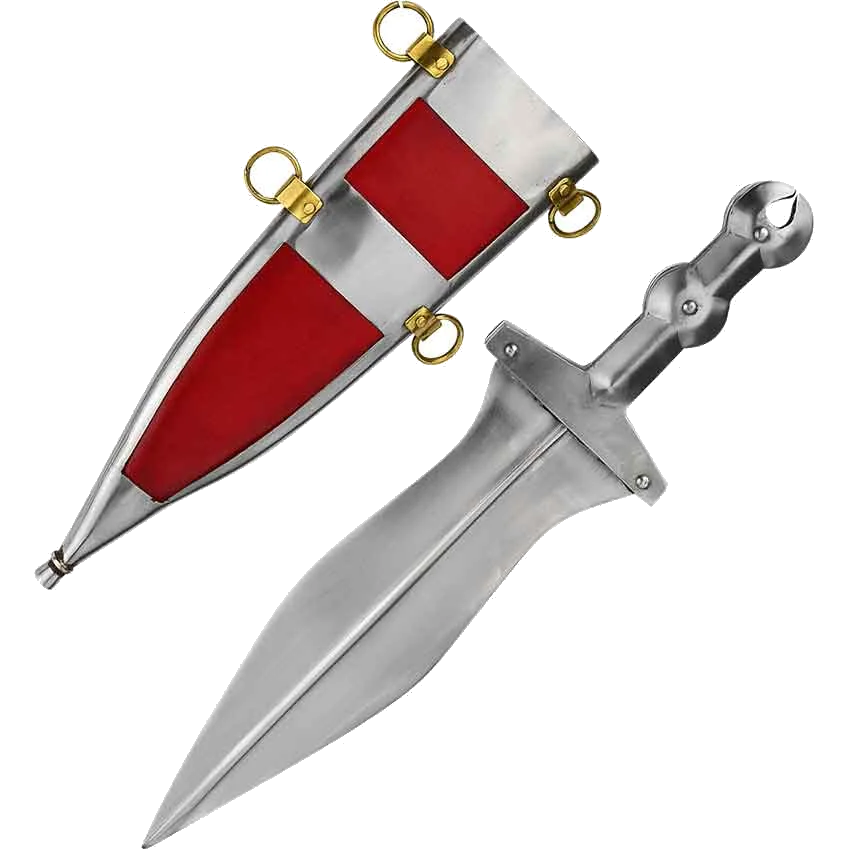
The pugio was small — typically 8 to 10 inches in total length, with a blade between 7 and 9 inches. The blade had a distinctive form: broad at the hilt, narrowing through a pronounced waist, then broadening again before tapering to a sharp point. This "leaf shape" gave the weapon both stabbing and cutting capability despite its short length.
The cross-guard was heavy and curved, often nearly as wide as the soldier's hand. The hilt was constructed from layered pieces — bone, wood, horn, or metal — riveted together onto the blade's tang and finished with a circular pommel disc. The whole thing was solid, deliberately oversized at the grip end, designed to give a sweating man a reliable hold under bad conditions.
- TypeMilitary dagger, leaf-shaped blade
- OriginIberian, adopted by Rome
- In Servicec. 1st C. BC – 3rd C. AD
- Blade Length7–9 in
- Total Length8–10 in
- Weight~5–10 oz
- Blade MaterialForged iron, later steel
- Primary UseSidearm and camp tool
A weapon and a tool
In tactical terms, the pugio was a weapon of last resort. A soldier whose gladius had been lost, broken, or stuck in an enemy's body would draw the pugio. But day to day, it was a tool. Romans used their pugios for cutting rope, cutting food, stripping bark, prying boards, scraping leather, sharpening stakes, and the thousand small jobs of camp life. Most legionaries killed exactly zero people with their pugios but used them every single day.
This double function shows in the wear patterns on surviving examples. Pugio blades are frequently resharpened, often reground asymmetrically from years of being touched up against whetstones. They are tools that have been worked. The gladius might sit in its scabbard for months. The pugio came out at every meal.
Decoration and identity
Unlike the gladius — which was relatively plain because it was meant to be used, broken, and replaced — the pugio was almost always decorated. The scabbard, in particular, became a canvas. Surviving examples show silver and brass inlay, gold filigree, niello (a black enamel-like compound) work, geometric patterns, mythological scenes, and increasingly through the Empire, markers of specific legions and units.
Soldiers seem to have invested in their pugios in a way they did not invest in any other piece of standard kit. Scabbards were upgraded, grips replaced, decoration refinished. They were personal. A Roman legionary carrying a beautifully ornamented pugio was, in modern terms, the same kind of person who has his initials engraved on his pocket knife — the gear was utilitarian, but it was also him.
Status and rank
Roman officers wore decorated pugios as marks of authority. A centurion's pugio would typically be more elaborate than a legionary's. The Praetorian Guard — the imperial bodyguard — carried particularly fine versions, with scabbards in silver and gold. By the early Empire, the pugio had become as much a uniform element as a weapon: a way to signal Roman military identity even when off-duty, a piece of formal equipment as well as a fighting tool.
The Ides of March
The pugio's most famous moment is also one of its most ambiguous. The senators who killed Julius Caesar on March 15, 44 BC are usually depicted carrying pugios — and some of them probably were. But the ancient sources describe the weapons used simply as "daggers," and Roman senators were not necessarily armed with military-issue equipment. Whatever the actual weapons, the image of the pugio has been bound to Caesar's assassination ever since — the small, nearly hidden blade that ended the Republic.
Decline
Like much of the standard early-Empire kit, the pugio fades from the archaeological record during the 3rd century AD. As the army restructured under Diocletian and Constantine, equipment standardization shifted. Daggers continued in use throughout the late Empire, but they were no longer the elaborate, distinctive pugios of the first two centuries. The form — with its leaf-shaped blade and ornate scabbard — was effectively extinct by 300 AD.
Legacy
The pugio is one of the most prized Roman military finds in archaeology. Its decoration makes individual examples identifiable to specific units, dates, and even workshops. Modern museums hold hundreds of recovered pugios, and reproduction examples are popular among reenactors. As a military object, the pugio matters less for what it did than for what it shows: a soldier's investment in his own gear, in his own identity, even in something he hoped never to draw.