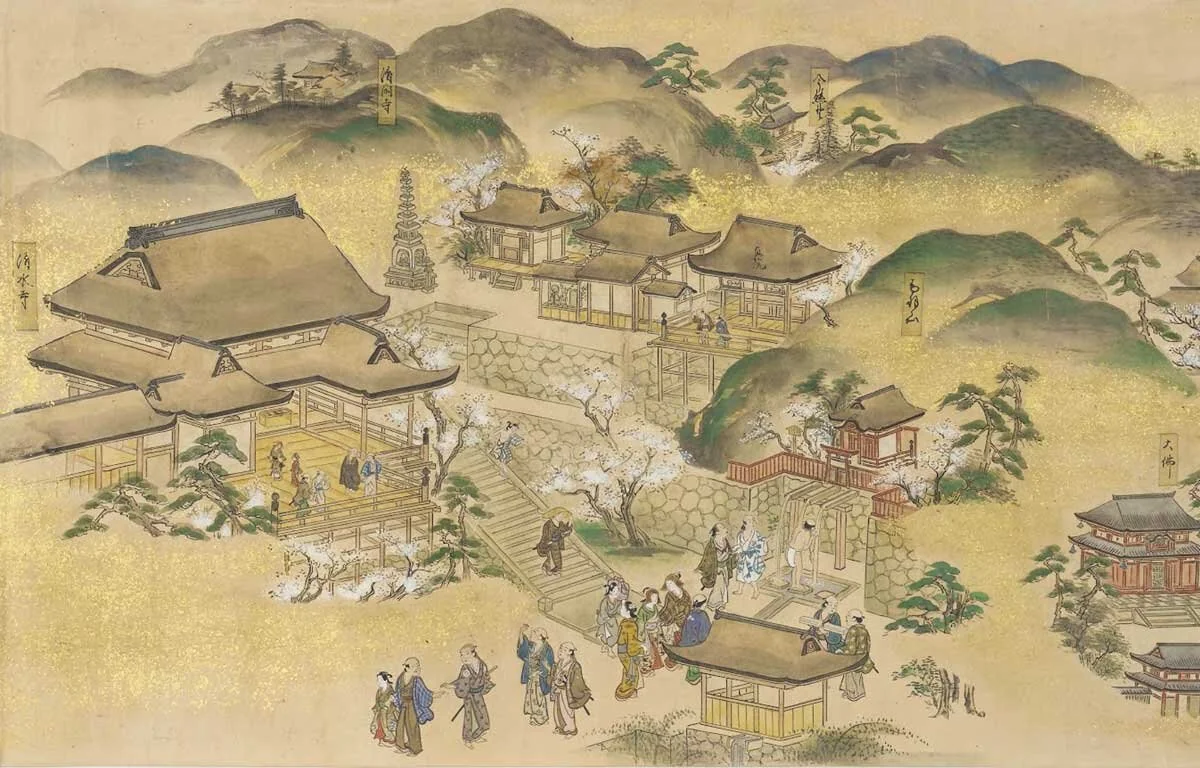
Japan's medieval weapons traditions are unique among major military cultures. A single warrior class — the samurai — dominated the political and military life of the islands for nearly seven hundred years. Weapons evolved within a closed cultural context with limited foreign influence. And design refinement, especially in sword-making, reached technical heights that few other civilizations matched. The result is one of the most distinctive and aesthetically coherent military equipment traditions in world history.
The rise of the samurai
Japan's samurai class emerged during the Heian period (794–1185), originally as provincial warriors retained by aristocratic landowners and by the imperial court. The early samurai fought primarily as mounted archers — the bow, not the sword, was their iconic weapon. Their armor was heavy laminar lacquered scale armor (the ō-yoroi), built around the demands of horseback combat against similarly armored opponents. The katana as we know it didn't yet exist; the curved sword of the period was the longer tachi, slung edge-down from the belt of a mounted warrior.
Kamakura and the Mongol invasions
The Kamakura period (1185–1333) saw the samurai consolidate political power under the shogunate. The Mongol invasions of 1274 and 1281 — both repelled, partly by storms (the kamikaze, "divine wind") and partly by samurai resistance — tested Japanese tactics against a fundamentally different military system. The Mongols fought in tight infantry formations with massed archery and explosive weapons; the samurai, accustomed to single-combat duels, had to adapt rapidly. Surviving accounts and the Mōko Shūrai Ekotoba (the "Mongol Invasion Scrolls") capture the cultural shock of encountering a totally different way of war.
The Sengoku period and total warfare
The Sengoku period (1467–1615) — the "Warring States" era — was a century and a half of nearly continuous civil war. As the scale of warfare expanded, infantry armies of ashigaru (foot soldiers) became more important than cavalry, and weapons evolved accordingly. The katana developed its famous form in this period; the yari (spear) became the primary battlefield weapon for ashigaru; and the introduction of European firearms in the 1540s eventually changed everything. The Battle of Nagashino in 1575 saw Oda Nobunaga's matchlock-armed troops destroy a traditional samurai cavalry charge — a turning point in Japanese warfare comparable to anything in European history.
The katana tradition
Japanese sword-making during this period reached technical heights almost unmatched anywhere else. The folded-and-laminated construction technique — combining a hard cutting edge with a springy core, in repeated layers — produced blades of legendary quality. Master smiths were named, their work signed and dated, and their swords passed through generations as both weapons and cultural artifacts. Surviving Kamakura and Muromachi blades remain functional weapons and revered art objects centuries later.
Tokugawa peace and the end of the era
The Tokugawa shogunate (1603–1868) ended the warring period and began nearly 250 years of internal peace. Samurai remained the warrior class but increasingly became a bureaucratic and ceremonial elite rather than active soldiers. The katana was still worn — paired with the wakizashi as the daishō ("big-little") — but as a symbol of class and identity rather than as primary battlefield equipment. The end of the medieval era in Japan, when Western pressure forced the country open in the mid-19th century, also ended the samurai tradition. The katana retired from war and became a museum object.
Legacy
Japanese medieval weapons have had an outsized influence on global culture, far beyond their direct military significance. The katana in particular has become one of the most recognizable weapons in human history, despite Japan being a relatively small participant in global military events. Japanese sword-making techniques have influenced metallurgy and design worldwide. And the samurai tradition itself — its codes, aesthetics, and equipment — has been a continuous source of fascination since Japan reopened to the world in the 19th century.