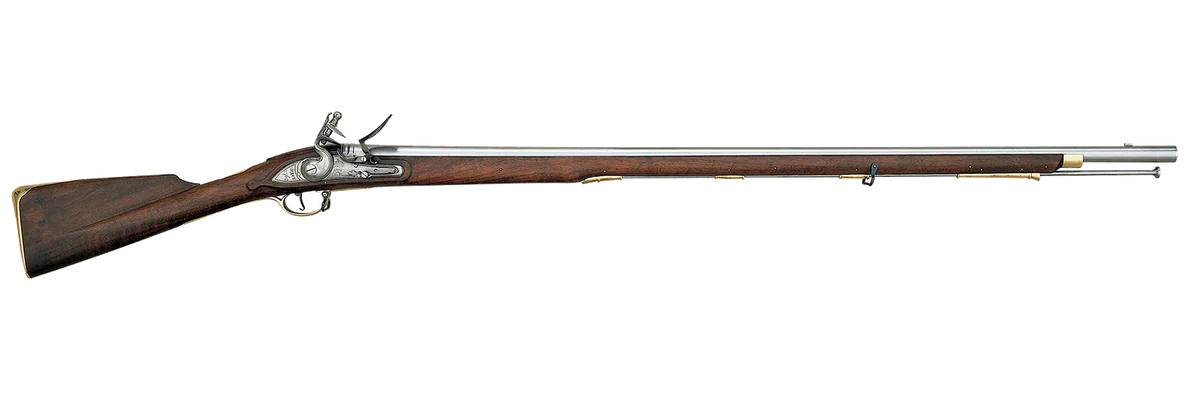
For 116 years, the British soldier carried essentially the same weapon. The Brown Bess was not a brilliant piece of engineering. It was something rarer: a piece of equipment so reliable, so simple to repair, and so well-suited to its tactical role that improving on it seemed unnecessary for nearly four generations.
What it was
"Brown Bess" was a soldier's nickname, never an official name. The weapon's formal designations changed across versions — Long Land Pattern, Short Land Pattern, India Pattern, New Land Pattern — but the family of muskets remained recognizable throughout. It was a flintlock smoothbore, fired a lead ball roughly three-quarters of an inch in diameter, weighed about ten pounds, and was loaded from the muzzle.
The origin of the name is contested. Some historians point to the brown walnut stock and the German "Buchse" (barrel). Others believe it was simple British soldier humor — a familiar name for an unglamorous tool. Whatever the origin, by the late 18th century the name had stuck firmly enough that even officers used it.
How it fought
A trained British infantryman could load and fire a Brown Bess three to four times in a minute. The process required seventeen separate motions, drilled into recruits until they could perform them with frostbitten hands or at night. Powder, ball, and a paper cartridge all went down the same barrel; the flintlock mechanism showered sparks into a pan of priming powder, which flashed through a touch-hole and ignited the main charge.
Accuracy past 80 yards was, charitably, optimistic. The musket was a smoothbore — the ball did not spin in flight — and the standard tactical doctrine reflected this. British infantry fought in two ranks, fired in disciplined volleys at close range, and finished the matter with a 17-inch socket bayonet fixed to the muzzle. The famous British "thin red line" depended entirely on the rate of fire and the steadiness of the men producing it.
"A soldier's musket, if not exceedingly ill-bored as many are, will strike the figure of a man at 80 yards; it may even at 100; but a soldier must be very unfortunate indeed who shall be wounded by a common musket at 150 yards." Col. George Hanger, 1814
- TypeFlintlock smoothbore musket
- OriginKingdom of Great Britain
- In Service1722 – 1838
- Caliber.75 in (19 mm)
- Barrel Length42–46 in (varied by pattern)
- Weight~10 lb
- Rate of Fire3–4 rounds per minute
- Effective Range~50–80 yards
The wars it fought
The Brown Bess was issued during the War of the Austrian Succession and was still in second-line service during the Crimean War over a century later. In between, it fought in nearly every major engagement of the British Empire's expansion: at Culloden against the Jacobites, at Quebec against the French, at Lexington and Yorktown against the American colonists, at Trafalgar's marines and at Waterloo against Napoleon, and in dozens of colonial campaigns from India to South Africa.
It was also, ironically, one of the most common weapons in American hands during the Revolution. American militias seized British armories early in the war, and the Continental Army was equipped with a mix of Brown Besses, French Charlevilles, and homemade copies. The musket that fought for Britain at Bunker Hill also fought against it at Saratoga.
The end
The Brown Bess was eventually replaced by rifled muskets — the Brunswick rifle and then the Pattern 1853 Enfield — that could put a ball through a man's chest at 500 yards. The advantage of rifling had been understood for centuries. What changed was manufacturing. Until the industrial machinery of the 1830s and 1840s could produce rifled barrels at the scale and price required to arm an empire, the smoothbore Bess simply remained good enough.
That is the lesson of the Brown Bess. Military weapons are not adopted because they are the best possible design. They are adopted because they are the best design that can be made in the quantities required, by the manufacturing base of the country that needs them, at a price the treasury will pay. For 116 years, the Brown Bess sat at exactly that intersection — and an empire was built on it.