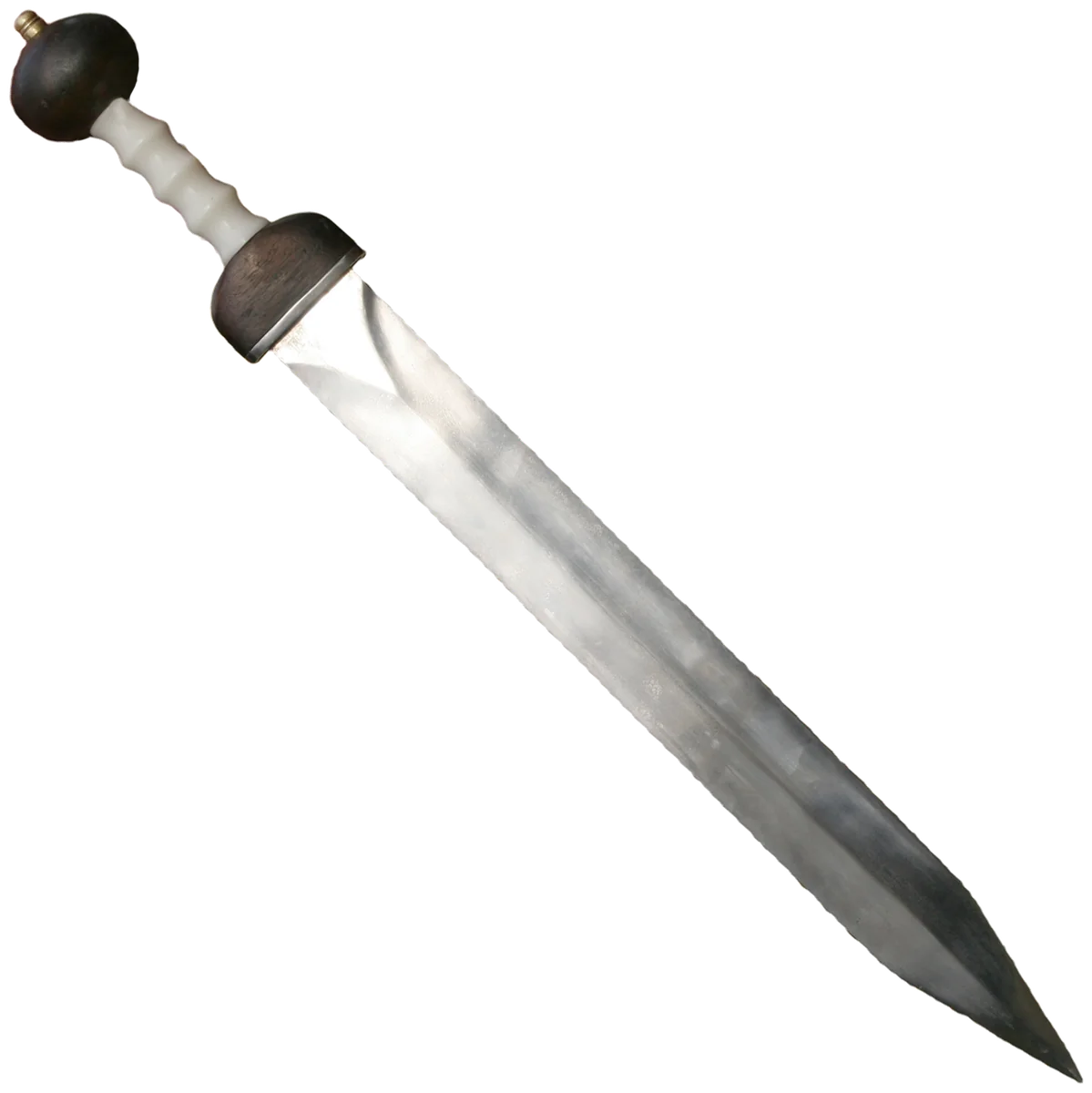
For nearly six centuries, Rome's territorial expansion was carried, almost literally, on the point of the gladius. It was not the longest sword of its era, nor the sharpest, nor the most beautifully made. It was the right tool, used by the right army, in the right way.
Origins
The gladius — Latin simply for "sword" — was not originally Roman. The standard story, drawn from later Roman writers, is that the legions adopted the design from Iberian warriors during the Second Punic War in the late 3rd century BC. The Iberians fought with a short, double-edged blade that could both cut and thrust, and Roman commanders saw immediately what it could do in a tight formation.
The weapon Rome adopted, and refined over the next two centuries, was a piece of practical engineering: roughly two feet long, double-edged, with a tapered point sharp enough to drive through chain mail or leather armor in a single thrust. It was carried on the right hip, drawn across the body, and used at distances measured in inches.
Why it worked
The gladius is often described as a sword designed for a system rather than for individual heroics. The Roman legion fought in close ranks, with each soldier protected by a large rectangular shield (scutum) and the man on his right. The space available for swordwork was small. A long slashing sword would have fouled on the shields of allies. A short stabbing blade, used in quick economical thrusts to the abdomen and groin, was devastating in that environment and almost impossible to defend against from a meter away.
Roman training emphasized the thrust over the cut for exactly this reason. The historian Vegetius, writing in the 4th century AD, observed that a stab of two inches into the body was almost always fatal, while slashing wounds, however dramatic, were often survivable. The legions trained on the thrust until it was instinct.
- TypeShort sword, double-edged
- OriginRoman Republic / Empire
- In Servicec. 200 BC – c. 300 AD
- Blade Length18–27 in
- Weight~1.5–2.2 lbs
- Blade MaterialForged iron, later pattern-welded steel
- Primary UseThrust, in close formation
Variants and evolution
The gladius is not a single weapon but a family of them. The earliest Roman version, the gladius hispaniensis, was relatively long with a pronounced waist in the blade. Later versions — the Mainz, Fulham, and Pompeii types, named for the find sites — became progressively shorter and more uniform, optimized for the standardized combat doctrine of the imperial legions. By the time of the early Empire, the Pompeii gladius was effectively factory-produced across the Roman world to nearly identical dimensions.
By the 3rd century AD, as Roman tactics shifted toward more open-order combat against mobile enemies on the frontiers, the gladius gave way to the spatha — a longer cavalry-style sword that worked better in looser formations. It is a fitting end. The gladius was a weapon of a particular tactical system, and when that system changed, the sword changed with it.
Legacy
Few weapons have ever been so closely tied to the rise of the state that produced them. Rome built an empire stretching from Britain to Mesopotamia, and the legions that did the building carried the gladius for most of the journey. It is a reminder that military technology rarely wins wars on its own — but the right weapon, in the hands of a disciplined army that has thought carefully about how to use it, can shape the world for centuries.