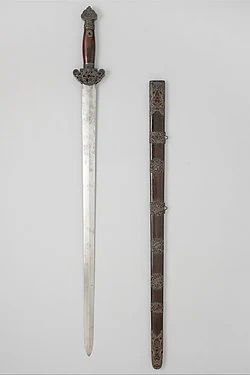
The jian is the sword that ancient China kept on its altar. Where Roman or Japanese culture eventually settled on a single iconic blade, the jian remained one weapon among many in Chinese arsenals for three thousand years — never quite the standard infantry sword, never quite obsolete, always carrying a particular cultural weight that the other blades never matched. It was the sword of philosophers, generals, Daoist priests, and martial artists. It still is.
Origins
The earliest jian were bronze, appearing in the Western Zhou period around the 10th century BC. The earliest surviving examples are short — twenty to thirty inches — and made of cast bronze with separately-forged hilts. The blade is the recognizable shape that the jian would keep ever after: straight, double-edged, narrowing to a sharp point, with a clear ridge running down the center of each face.
The most famous early jian is the Sword of Goujian, found in a tomb in Hubei in 1965, dating to the late 6th or early 5th century BC. It belonged to a king of the state of Yue, and when archaeologists drew it from its scabbard after twenty-three centuries it was still essentially sharp — the bronze had resisted corrosion through a combination of alloy chemistry and a deliberate surface treatment that modern metallurgy is only partly able to reproduce.
Why it worked
The jian was, from the start, a weapon designed for skill rather than mass production. It was used in tight thrusts and precise cuts, with movements built around blade angles and the geometry of the body rather than around brute force. A skilled jian-fighter could disarm, redirect, or kill with movements measured in inches. An unskilled one would simply die — the weapon punished error in ways that heavier, simpler blades did not.
By the time iron and then steel replaced bronze in Chinese sword-making, the basic geometry of the jian was fixed. Han dynasty steel jian, made from folded and differentially-hardened blades, were among the most sophisticated swords being produced anywhere in the world in the first centuries AD.
- TypeStraight double-edged sword
- OriginWestern Zhou / Warring States China
- In Servicec. 10th C. BC – Present
- Blade Length20–32 in (varied by era)
- Weight~1.5–2.2 lbs
- Blade MaterialCast bronze; later folded steel
- HiltWood with cord or wire wrap, tasseled pommel
- Primary UseThrust and cut, dueling and ceremonial
The gentleman's weapon
Even in periods when the jian was no longer the standard military sword — by the Han dynasty, the curved single-edged dao had taken over for cavalry and most infantry — the jian remained the weapon of officers, scholars, and the elite. It was carried as a marker of refinement and self-discipline. A scholar-official who could not write poetry and handle a jian was considered incomplete in the same way a Renaissance Italian gentleman was expected to know Latin and fencing.
This cultural status persisted into the modern era. The jian became one of the central weapons of Chinese martial arts, particularly Daoist traditions and Tai Chi. The Tai Chi jian forms practiced today are descended directly from imperial-era training systems, themselves descended from sword treatises written in the Warring States period.
Legacy
No other Chinese weapon has had the longevity of the jian. It outlasted the bronze age, the iron age, the introduction of cavalry, the introduction of crossbows, the introduction of gunpowder, the fall of every dynasty that issued it, and the end of imperial China itself. It is still made, still trained with, and still revered. There are not many objects in the human inventory that you can say that about.