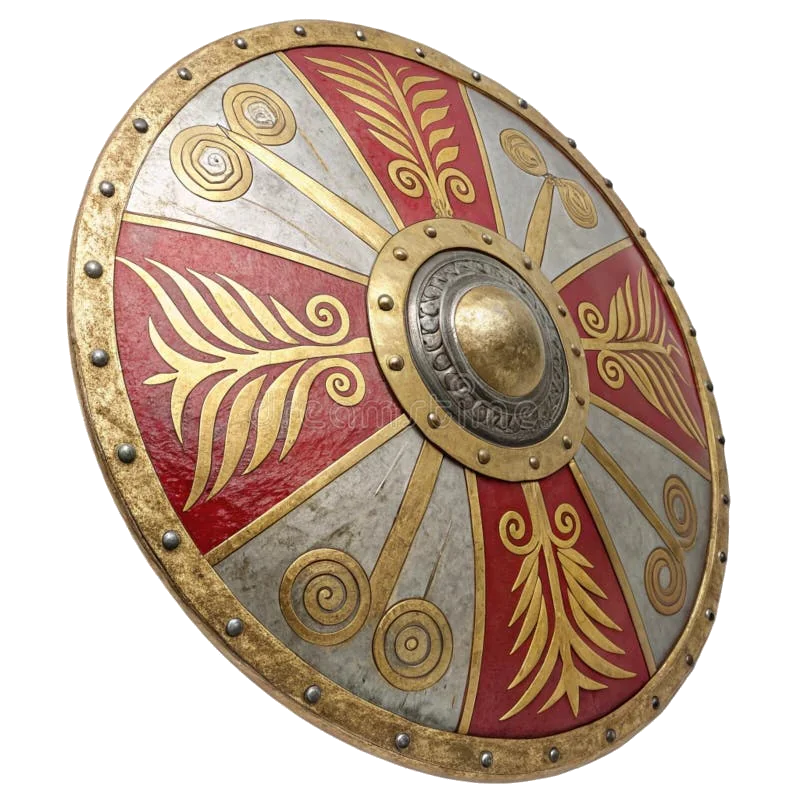
The aspis was the most important piece of equipment a hoplite owned. Three feet across, dished into a deep concave bowl, faced with bronze, weighing 16 pounds of solid wood and metal — it was what made the phalanx possible. The Greek word for the heavy infantryman, hoplites, derives from the older word for this shield, hoplon. Even the soldier was named after the shield.
Construction
An aspis was built around a thick wooden core, typically poplar or willow, dished into a concave shape so the rim projected forward beyond the body. The face was usually covered with a thin sheet of bronze, hammered into shape and pinned to the wood. The interior was lined with leather, both to protect the wood and to provide padding against the wearer's body.
The whole shield ran roughly 3 feet in diameter and weighed 14 to 18 pounds — substantial, but the dish shape allowed the hoplite to rest the rim on his left shoulder, transferring the weight from his arm to his collar bone. This let him hold the shield through a battle that might last an hour or more without his arm failing.
- TypeLarge round dished shield
- OriginGreek, c. 8th C. BC
- In Servicec. 8th – 4th C. BC
- Diameter~3 ft
- Weight~14–18 lbs
- ConstructionWood core (poplar/willow), bronze face, leather lining
- GripPorpax (forearm band) + antilabe (hand grip)
- Primary UseDefense in the hoplite phalanx
The porpax-antilabe grip
The aspis's defining innovation was its two-point grip. A bronze armband (the porpax) ran across the inside center of the shield, through which the hoplite passed his forearm. A leather hand-grip (the antilabe) ran along the rim near his hand. So the shield was held by the elbow and the fingers, distributed across two points rather than gripped at one center boss.
This was not how shields were typically constructed before the aspis. Most earlier round shields used a single central grip behind a boss. The two-point system had real disadvantages — the shield could not be moved easily across the body, and a hoplite's left side was much better protected than his right — but it also let him support the weight of a much larger, heavier shield without exhausting his arm.
The result was a shield that protected from neck to thigh and from sternum to past the hip. It was massive personal protection, paid for with awkwardness in any fighting that wasn't shoulder-to-shoulder formation work.
In the phalanx
The aspis is one of those rare pieces of military equipment that creates the system of warfare around it. Because the shield mainly protected the left side, a hoplite was significantly safer if the man on his right held his own shield in a position that overlapped onto the first man's right side. The way to make this work was for hoplites to fight shoulder to shoulder. The shield demanded the formation.
The phalanx that emerged from this logic was a tight rectangle of overlapping shields, with the rightmost soldier the most exposed (he had no one's shield covering his right side). This was the position of honor in many Greek armies; in others, it was the position of horror. Either way, it was the geometry the aspis dictated.
Decline
The aspis went out of standard use as the Macedonian phalanx replaced the hoplite phalanx. Macedonian phalangites carrying 18-foot sarissai needed both hands on their pikes, which meant they couldn't hold a 16-pound shield by porpax-and-antilabe. The Macedonian solution was a smaller, lighter round shield (the pelta) strapped to the forearm only, leaving the left hand free to help grip the sarissa.
Hoplite-style warfare continued in some Greek armies through the Hellenistic period, particularly in city-states that resisted Macedonian dominance, but the classical aspis-and-dory system was no longer the cutting edge. By the time Rome absorbed the Greek world, the aspis was a museum piece.
Legacy
The aspis is one of the foundational objects of Western military history. The Roman scutum was a different shape but inherited the same logic: a shield large enough to protect a soldier in close formation, designed for an army that would fight shoulder-to-shoulder. The shield-formed-for-the-formation lineage extends from there through medieval pavise shields to modern police riot shields. The basic insight — that personal protection works better when designed around collective formation rather than individual combat — starts here, with the aspis.