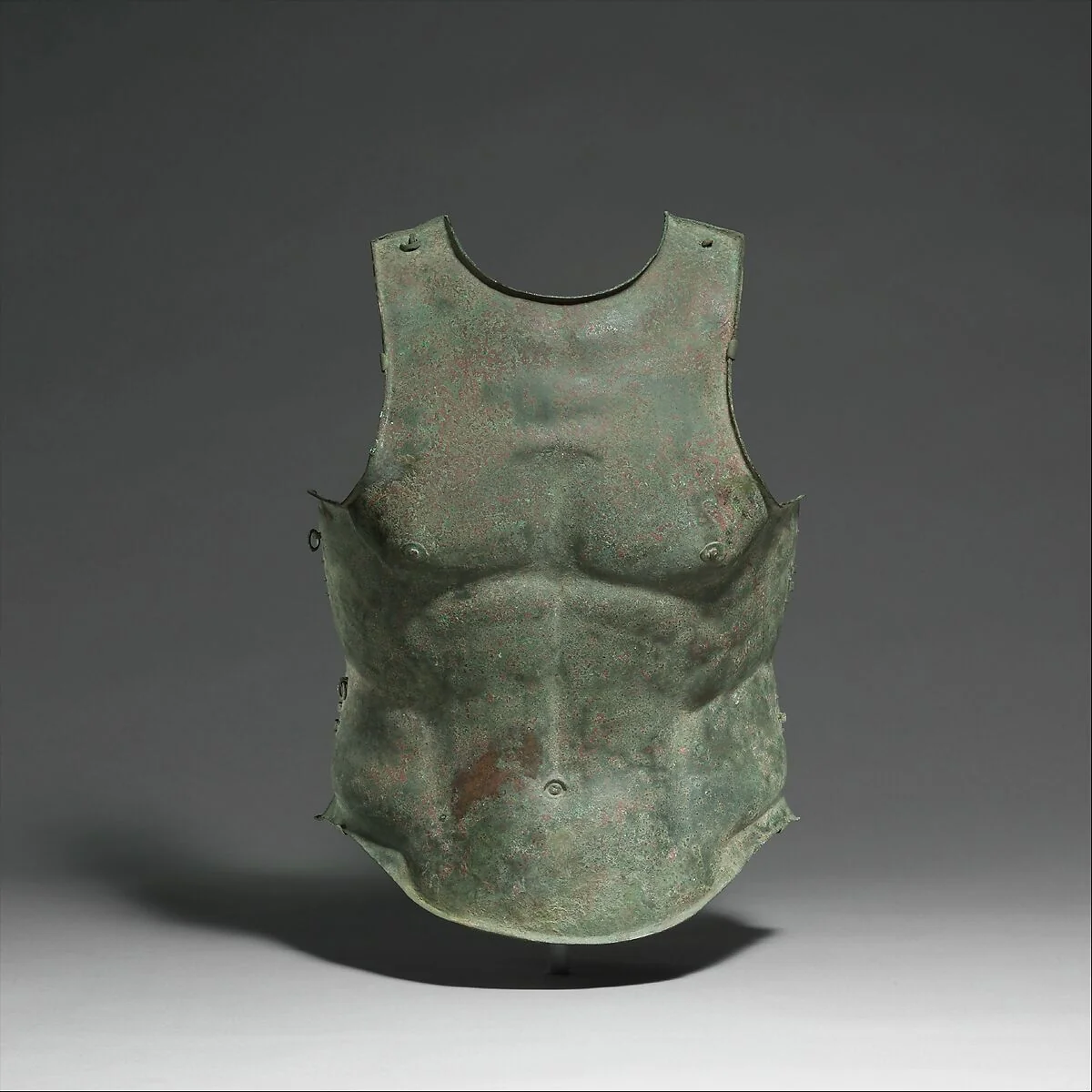
Bronze cuirasses were the high-end body armor of the Greek hoplite world. Heavier than linothorax, more expensive than linothorax, more spectacular than linothorax — they marked the wearer as someone with wealth and standing. Two distinct forms dominated across the period: the early bell cuirass of the Archaic age and the more sculpted muscle cuirass of the Classical period.
The bell cuirass
The earliest standard Greek metal cuirass, in widespread use from the 8th to the 6th centuries BC, was the bell cuirass. Two pieces of beaten bronze — one for the front, one for the back — were hinged together at the shoulders and along the sides. The shape flared outward at the bottom in the style of a bell, which gave it both its name and a degree of clearance for the wearer's hips.
Bell cuirasses provided excellent protection but were not particularly comfortable. The bronze was rigid; the wearer's torso movements were restricted; and in summer combat the heat trapped inside could be brutal. They were also expensive. A bronze cuirass represented the wages of months or years for a typical Greek farmer-citizen, which is why hoplite-grade equipment was associated with the upper third of citizen society.
The muscle cuirass
By the 5th century BC, the bell shape had largely given way to the muscle cuirass — a more sculpted form that mimicked the appearance of an idealized male torso. Two pieces of bronze (front and back), hinged at the sides and shoulders, beaten and shaped to show pectorals, abdominal muscles, and the lines of an athletic body underneath. The shape was both aesthetic and functional: the form-fitting design reduced internal volume (less heat buildup) and, by closely matching the wearer's torso, distributed weight more comfortably on the shoulders and hips.
Muscle cuirasses were status symbols even within the hoplite class. Elaborate examples were chased with mythological scenes; trim was sometimes silvered or gilded; the inner lining was leather or padded fabric. Officers and the wealthier hoplites wore them; ordinary citizen-soldiers more often wore linothorax.
- TypeMetal body armor (front + back plates, hinged)
- OriginGreek, c. 8th C. BC
- In Servicec. 8th – 4th C. BC (standard); officer use later
- Weight~25–35 lbs (bell); ~20–30 lbs (muscle)
- ConstructionBeaten bronze, hinged at shoulders and sides, leather-lined
- VariantsBell cuirass (Archaic); muscle cuirass (Classical)
- Primary UseHigh-end hoplite body armor; later officer's armor
Cost and class
A complete hoplite panoply — aspis, helmet, greaves, body armor, dory, and xiphos — represented a substantial financial investment, equivalent to several years of an artisan's wages. The bronze cuirass was one of the most expensive single items. As a result, a Greek city-state's hoplite force was effectively drawn from its propertied middle and upper classes; those who could not afford the panoply served as light infantry, sailors, or non-combatants.
The shift toward linothorax through the Classical period reflected, among other things, an expansion of who could afford to be a hoplite. Cheaper armor meant more citizens could meet the equipment requirement, and the citizen-soldier base of Greek armies broadened accordingly.
Use in formation
Bronze cuirass was particularly effective in the close work of the phalanx, where most strikes came at relatively oblique angles against the front of the armor. A direct overhead spear thrust or a powerful sword cut at close range could still drive through the bronze, but most phalanx combat involved glancing impacts that the bronze deflected effectively. The combination of aspis (front protection) and cuirass (residual protection if a strike got through the shield) gave a wealthy hoplite genuinely formidable defenses.
The weak points were the same as for any bronze body armor: the gaps. The cuirass left the hips, the inside of the thighs, the armpits, the throat, and the face exposed. A skilled opponent who could create the angle to attack these gaps could kill an armored hoplite. Most hoplite combat did not allow such angles — the formation prevented them — but in any one-on-one fight, the cuirass had clear weaknesses.
Decline
Bronze cuirass began to fade through the 4th century BC. The cost was prohibitive for the broader hoplite class; the linothorax offered acceptable protection at a fraction of the price; and the changing nature of Greek warfare (more mobile, more cavalry-heavy, more siege-focused) made heavy rigid armor less useful. By the Hellenistic period, bronze cuirasses were primarily officer's gear — a status marker more than standard equipment.
Roman officer's armor in the early Imperial period continued to use sculpted bronze cuirasses for ceremonial and command-rank purposes. The form survived in this restricted role for centuries, but as a standard infantry armor, it was effectively gone by 200 BC.
Legacy
The muscle cuirass had an unusually long afterlife. Roman emperors are routinely depicted in muscle cuirasses on coinage and statuary — whether or not they actually wore them in the field, the visual association of the form with command and authority was permanent. Renaissance armor revived elements of the muscle cuirass aesthetic. Modern military dress uniforms in some traditions still use sculpted breastplates that descend from the Greek original. The muscle cuirass has lasted, in some form, for nearly three thousand years.