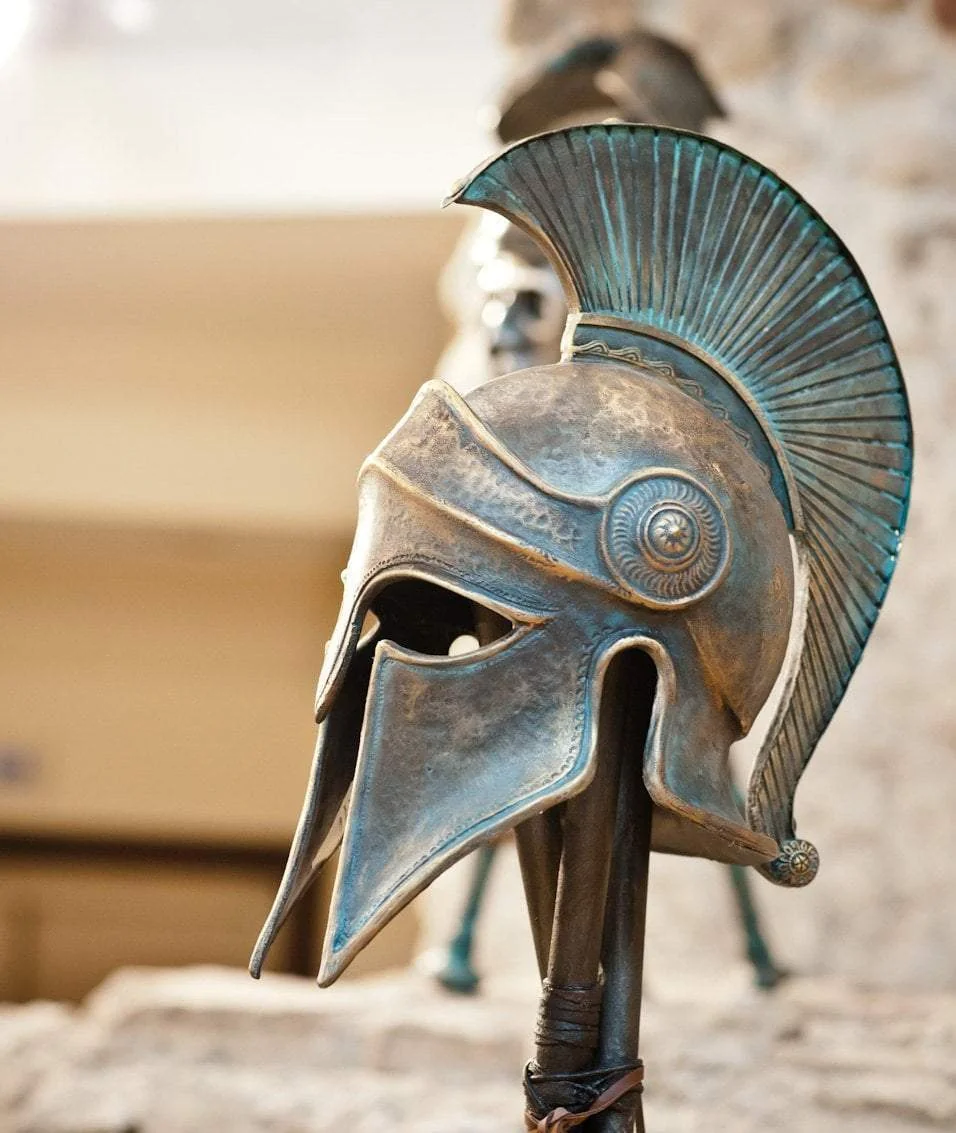
If you picture a Greek hoplite, you picture a Corinthian helmet. The full enclosed bronze bowl, the cheek-guards and nose-guard fused into a single piece, the slits for eyes, the horsehair crest projecting backwards or sideways — this is the iconic Greek soldier's image. It is also a piece of equipment so restrictive of basic sensory input that, by the time of Alexander, almost no one wore it in combat.
Design
The Corinthian helmet was hammered from a single sheet of bronze. The bowl curved down to enclose the entire head, with cheek pieces extending forward to cover the cheeks, a nasal projecting down between the eyes, and slits cut for the eyes themselves. There were no separate hinged components; the whole helmet was one piece, with the wearer pulling it down over his head from above and pushing it back to the top of the head when not in combat.
Total weight was around 4 to 5 pounds. The interior was lined with leather or padded fabric; the chin was secured by a strap. The exterior was often decorated — chased patterns, ornamental cheek-piece designs, and especially the elaborate horsehair crest mounted along the top, projecting either backwards or sideways depending on era and fashion.
- TypeFull-face bronze helmet
- OriginCorinth, Greece, c. 7th C. BC
- In Servicec. 7th – 4th C. BC
- Weight~4–5 lbs
- ConstructionSingle beaten bronze sheet, leather lining
- CoverageEntire head and face, with eye-slits and nasal
- Major WeaknessSevere restriction of peripheral vision and hearing
Protection
The protection was excellent. The full bronze coverage protected against essentially any cutting or thrusting attack to the head, face, or upper neck. The nasal protected the bridge of the nose. The cheek pieces shielded the lower face. Even the back of the neck was covered. For a hoplite in the front rank of a phalanx, where the enemy's primary attacks came at face level, the Corinthian was about as good as helmet protection got in the ancient world.
Surviving examples often show extensive battle damage — sword cuts, spear thrusts, dents from impact — with the wearer presumably surviving. The bronze was thick enough to absorb tremendous punishment, and the curved profile turned glancing blows into bruises rather than penetrations.
The cost: vision and hearing
The Corinthian's protection came at a heavy price. The narrow eye-slits restricted peripheral vision dramatically; a hoplite wearing one could see his immediate front and not much else. The full bronze coverage muffled hearing to the point that battlefield commands were difficult to follow. Breathing was constrained. In Mediterranean summer combat, the heat trapped inside the helmet was punishing.
Hoplites adapted by pushing the helmet up onto the top of the head before combat, then pulling it down at the moment of engagement. Vase paintings frequently show this: hoplites with their helmets shoved back, faces visible, marching forward; only the front rank in actual combat has the helmets pulled down. Once an engagement ended, helmets came off again to allow the soldiers to see, hear, and breathe.
Decline
From the late 5th century BC onward, the Corinthian helmet was progressively replaced by more open designs — the Chalcidian helmet (with cut-outs for the ears), the Thracian helmet (with a wider opening at the face and an attached neck-guard), and the Pilos helmet (a simple conical bronze cap). All offered worse protection than the Corinthian. All offered far better vision, hearing, and ventilation. The trade-off was decisive.
By Alexander's time, the Corinthian was effectively obsolete on the battlefield. The Macedonian phalangite typically wore a more open helmet style, often the simple Phrygian cap or a similar design. Hoplite-style soldiers in some city-states held onto the Corinthian longer for symbolic reasons, but as standard combat equipment, it was gone by the 4th century BC.
Symbolic afterlife
The Corinthian helmet retired from combat but never from Greek imagination. The goddess Athena was depicted wearing one for centuries afterward. Athenian coinage continued to use the Corinthian helmet as a symbol long after the helmet itself was museum-only. By the Roman period, the Corinthian was an instantly-recognizable symbol of "the Greek warrior" the same way the gladius would become a symbol of "the Roman soldier." Statuary, mosaics, and decorative arts kept the Corinthian helmet visually alive for the entire span of antiquity.
Legacy
The Corinthian's actual military descendants are limited. Roman cavalry sports helmets sometimes echoed Corinthian features. Renaissance-era ceremonial armor occasionally borrowed elements. But as a functional military design, the Corinthian's lesson was largely cautionary: it represented the high-water mark of "protection at the cost of everything else," and its replacement by progressively more open designs taught a permanent lesson about the importance of situational awareness in combat. Helmet design has trended toward openness, with various fluctuations, ever since.