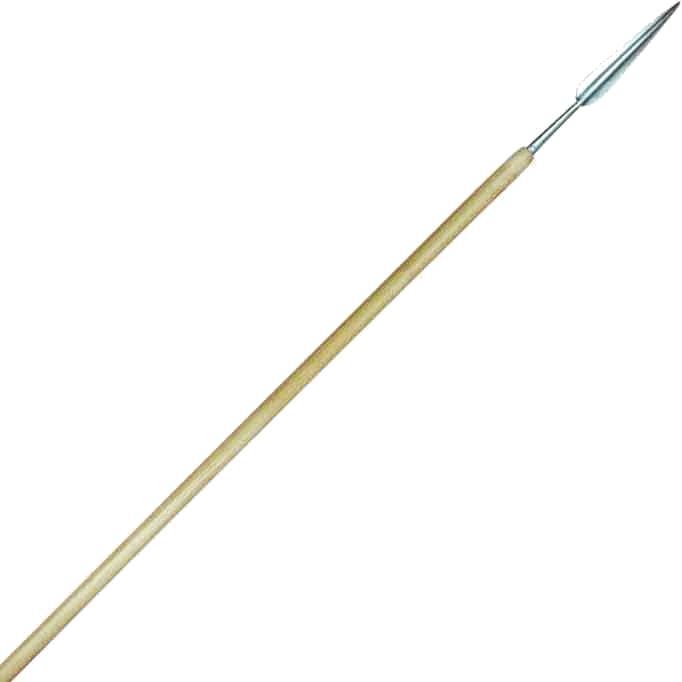
The dory is the weapon Greek warfare was built around. Eight feet of ash or cornel-wood, with an iron point at one end and a bronze butt-spike (the sauroter) at the other, it was carried by every Greek hoplite for nearly half a millennium. The phalanx, the city-state army, the entire classical Greek system of war — all of it existed because of, and revolved around, this one specific spear.
Design
A typical dory was 7 to 9 feet long, weighing roughly 2 to 4 pounds. The shaft was typically ash or cornel wood, both prized for stiffness combined with flexibility. At the business end was an iron leaf-shaped spearhead, socketed onto the shaft. At the rear, the bronze sauroter was both functional and symbolic: it could be planted in the ground to anchor the spear butt, used as a backup point if the primary head broke off, and served as a counterweight to balance the weapon further back in the user's grip.
The balance point of a dory sat about a third of the way back from the front, which let a hoplite hold the spear with the front two-thirds projecting forward. This kept the point well into enemy space while leaving the spear manageable in close quarters.
- TypeThrusting spear
- OriginIron Age Greek; Bronze Age roots
- In Servicec. 8th – 4th C. BC
- Total Length~7–9 ft
- Weight~2–4 lbs
- ConstructionAsh or cornel-wood shaft, iron head, bronze sauroter (butt-spike)
- Primary UseOverhand thrusting in the phalanx
In the phalanx
Dories were used overhand in the phalanx — held above the shoulder, point projecting forward over the rim of the aspis, thrust at the faces and necks of opponents. The front rank delivered the primary attacks. The second rank, holding their spears at slightly different angles, thrust between the shields of the men ahead. From the third rank back, dories were typically held vertically as a thicket of points discouraging anyone trying to leap into the formation.
When two phalanxes met, the front ranks would be in spear-on-spear contact within seconds. The fighting was crowded, hot, exhausting, and brief by ancient-warfare standards. Most hoplite battles were over in less than an hour, decided by which side could maintain its formation longer than the other.
The othismos
The most distinctive feature of phalanx combat was the othismos — the "push." After spear contact, the rear ranks would press forward against the men in front of them, transmitting force forward through the shields and bodies of the front rank. The result was a literal shoving match: two formations of armored men trying to physically drive each other backwards.
Modern historians have argued for decades about whether the othismos was a literal scrum or a metaphorical "pressure" of morale and persistence. The evidence is genuinely mixed. What is not in doubt is that hoplite battles ended when one phalanx broke and ran, and that the men in the rear ranks had a critical role in determining when that happened. The dory was the weapon at the front, but the formation was the weapon overall.
The sauroter
The bronze butt-spike at the rear of the dory was not decorative. If the iron spearhead broke off — which happened often, given the violent contact in phalanx combat — a soldier could reverse the spear and continue fighting with the sauroter. It was not as effective as the proper head, but it gave a soldier a working weapon with no time wasted.
Sauroters could also be planted in the ground, allowing a hoplite to step on them when adjusting his grip or briefly take both hands off his weapon. The name itself — "lizard-killer" — suggests its use against unfortunate small reptiles when the army was on the march. Soldiers' humor doesn't change much across millennia.
Decline
The dory began to lose its dominance in the 4th century BC. Two pressures reduced its effectiveness: the rising importance of cavalry, against which a foot soldier with an 8-foot spear had limited reach, and the development under Philip II of Macedon of a much longer pike, the sarissa. The Macedonian phalanx, with its 18-foot pikes, simply outranged hoplite phalanxes. After Chaeronea in 338 BC, the dory's dominance was over.
Hoplite-style warfare continued in some Greek armies through the Hellenistic period, but the dory was no longer the cutting edge of military thought. By the time Rome absorbed the Greek world, the classical hoplite spear had been a museum piece for over a century.
Legacy
The dory's direct descendants are the Macedonian sarissa (longer) and the Roman hasta (similar length, similar use, somewhat different doctrine). Its broader legacy is conceptual: the idea of a heavy infantry formation built around long thrusting weapons recurs throughout Western military history, from the Roman manipular legion through medieval pike formations to the 17th-century pike-and-shot regiment. Every one of those owed something to the basic insight the Greeks worked out with the dory: that men in tight formation, with long spears, are nearly impossible to charge directly.