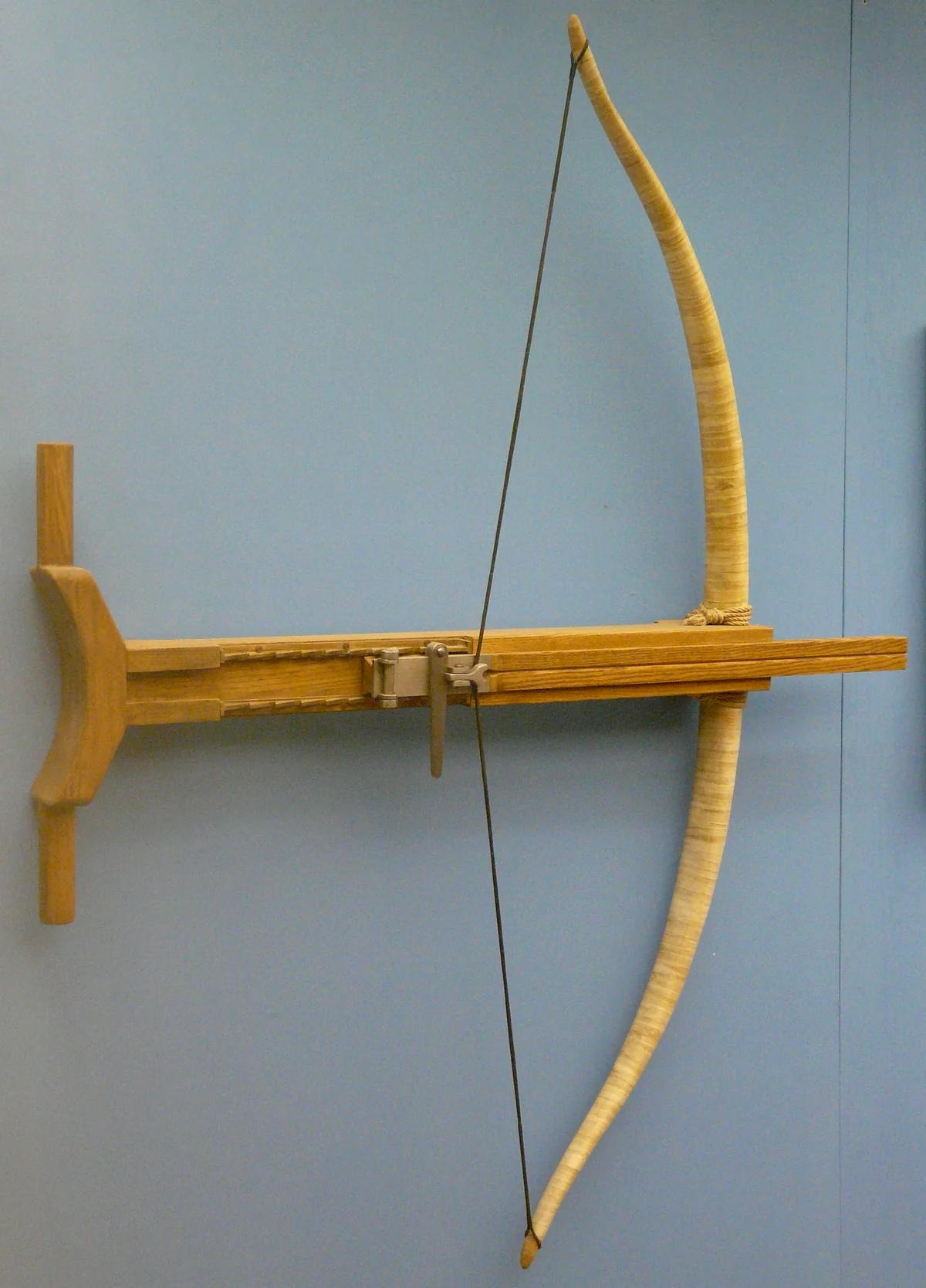
The gastraphetes was the first weapon in Western history that stored mechanical energy beyond what a human could pull and hold by muscle alone. Built in Greek Sicily around 400 BC, it was a composite bow mounted on a wooden slider, drawn back by the user pressing his stomach against a curved butt-plate (hence the name — "belly-bow"). It is not, in a modern sense, a particularly impressive weapon. But it is the starting point of every torsion catapult, every ballista, every scorpio that would follow over the next thousand years.
Origins
The traditional account, given by the historian Heron of Alexandria writing centuries later, credits the invention of the gastraphetes to engineers under Dionysius I, the tyrant of Syracuse, around 399 BC. Dionysius was preparing for war against Carthage, gathered the best craftsmen and engineers from across the Greek world, and gave them the open brief of building new weapons. The gastraphetes was their flagship product.
Whether the engineers actually invented the form from scratch, or refined existing eastern crossbow-like designs, is genuinely unclear. There are hints of similar weapons in earlier Chinese and Eastern Mediterranean contexts. What is certain is that the Syracusan version was the first such weapon to enter Greek military use at scale.
Design
A gastraphetes consisted of a horizontal composite bow mounted at the front of a wooden frame, with a long slider running along the top of the frame back to a curved concave butt-plate. The user placed his stomach against the butt-plate, pushed his body weight forward to compress the bow, latched the slider in place, loaded a bolt, and released the catch with a trigger.
The mechanism allowed a soldier to draw a much heavier bow than he could manage with his arms alone. Rather than being limited by the strength of his draw arm, he could use his body weight against the bow's resistance. A gastraphetes could throw a heavy bolt to ranges of perhaps 200 yards, more than a typical hand-drawn bow could reach with a similarly heavy projectile.
- TypeEarly mechanical missile weapon (proto-crossbow)
- OriginSyracuse, c. 399 BC, under Dionysius I
- In Servicec. 4th C. BC
- MechanismComposite bow + slider drawn back via belly-pressure
- Range~200 yards
- ProjectileHeavy bolt
- Primary UseSiege warfare, defensive positions
How it worked in combat
Gastraphetes were not battlefield weapons in the way later torsion catapults would be. They were too slow to load, too unwieldy to operate in close ranks, and too limited in numbers. Their primary use was siege warfare: clearing defenders off walls, picking off besieging soldiers from fortified positions, providing covering fire while infantry advanced.
The accuracy was reportedly impressive for the period. A trained operator could place bolts with reasonable precision at ranges that hand-bows could not match. But the weapon's slow rate of fire — perhaps one bolt per minute, by the time the user had returned to a stable stance and reloaded — meant it could never replace the volume of fire from massed archery.
Limited adoption
Despite its tactical promise, the gastraphetes was not widely adopted in the Greek world. Other city-states experimented with similar designs, but none made it standard issue. The reasons were probably economic and tactical: the weapon required substantial materials and skilled craftsmen to make, and its specialized use case (siege warfare, primarily) limited demand.
What the gastraphetes did establish was the principle. Mechanical advantage could store more energy than human muscle could draw. That principle was transferable. Once Greek and Macedonian engineers internalized it, the next step was obvious: rather than relying on a composite bow plus body-weight, build a weapon that stored energy in tightly twisted bundles of sinew or hair. The result was the oxybeles — the first true torsion artillery.
Significance
The gastraphetes matters mostly for what came after it. By the mid-4th century BC, Greek engineers had moved past it. The torsion-powered oxybeles, with substantially better range, power, and rate of fire, replaced it. The gastraphetes itself disappeared from regular military use within a generation of its invention.
But the line of descent is unbroken. The gastraphetes leads directly to the oxybeles. The oxybeles leads to the lithobolos. The lithobolos and oxybeles are the immediate ancestors of the Roman ballista and scorpio. Every major artillery weapon of the ancient world derives, technologically and conceptually, from the belly-bow built in Syracuse around 400 BC.
Legacy
The medieval European crossbow, when it appeared in the 10th and 11th centuries AD, was a completely independent rediscovery of similar principles. There is no evidence the medieval crossbow descended from the Greek gastraphetes; the chain of transmission had been long broken. But the underlying logic was the same: a horizontal bow, a slider mechanism, a trigger, a stored energy bigger than the user's draw strength. Some ideas in weapon design simply have to be rediscovered every few centuries because they keep being true.