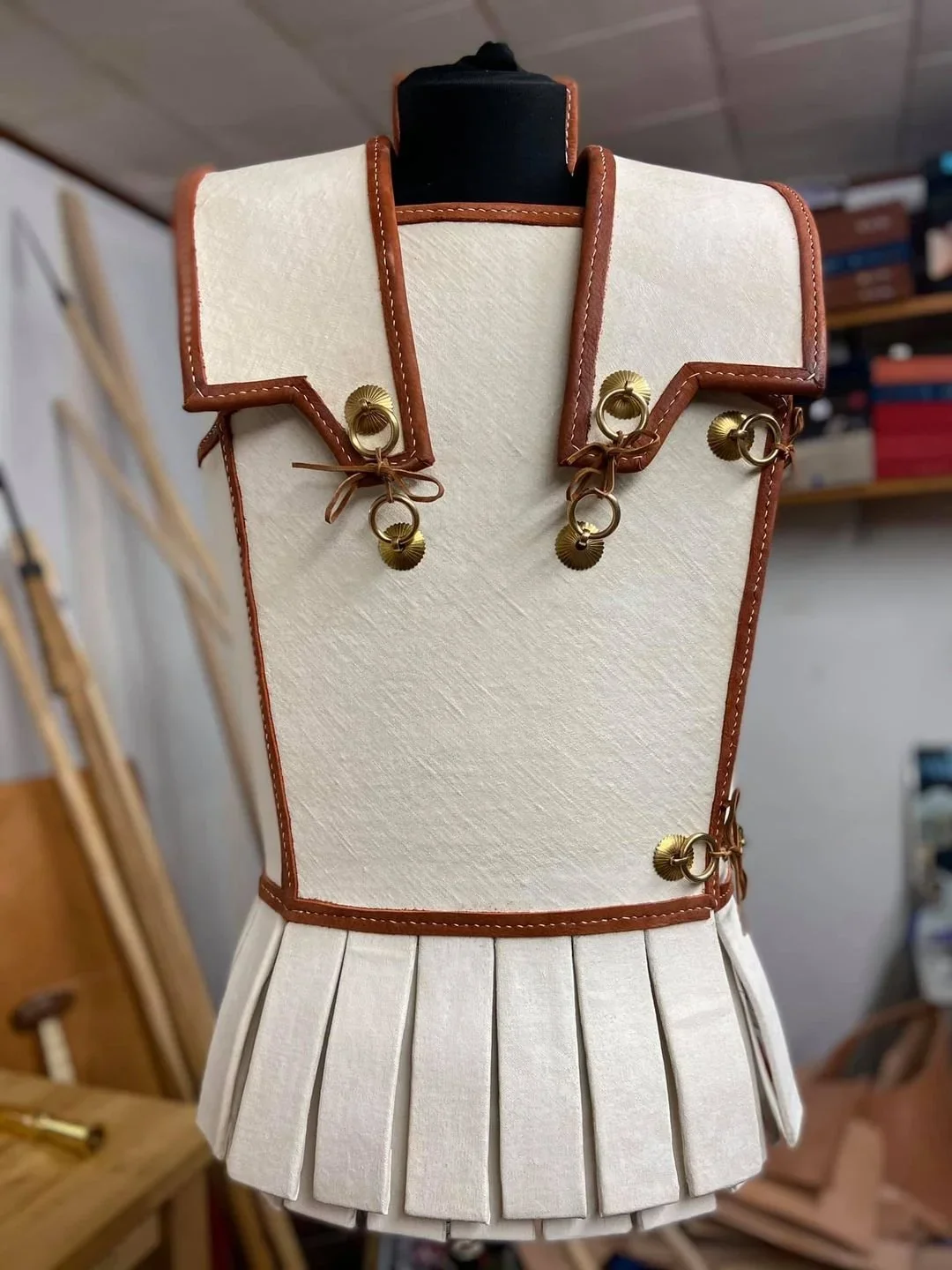
Linothorax means "linen breastplate." It was a piece of body armor made of multiple layers of linen, glued or stitched together into a stiff laminated shell that fit around the torso. Cheaper than bronze, lighter than bronze, breathable in Mediterranean summers, surprisingly effective against most weapons of the period — the linothorax may have been the most common heavy infantry armor in the classical Greek world. Alexander the Great is depicted wearing one in surviving art.
What it was
A linothorax was constructed from multiple layers (typically 10 to 14) of linen cloth, each layer perhaps a millimeter thick. The layers were laminated together, probably with animal-hide glue or similar adhesive, and the resulting stiff sheet was cut and shaped to wrap around the wearer's torso. Shoulder pieces (pteruges) were attached, and a skirt of leather or linen flaps protected the hips and groin.
The whole armor weighed perhaps 10 to 12 pounds — significantly lighter than a bronze muscle cuirass of similar coverage. It was breathable, allowing sweat to evaporate, which mattered in Greek summer fighting. And it could be made by anyone with access to linen and adhesive, rather than requiring a skilled bronze-smith.
- TypeComposite linen body armor
- OriginGreek, c. 6th C. BC
- In Servicec. 6th – 2nd C. BC
- Weight~10–12 lbs
- Construction10–14 layers of linen, laminated
- CoverageTorso, shoulders (pteruges), hips/groin (lower flaps)
- Primary UseHoplite and Macedonian infantry body armor
Effectiveness
Modern reconstructions of the linothorax have been tested against period weapons. The results are surprising. Layered linen, properly bonded, will stop most cutting strokes from period swords and spears. It performs less well against direct thrusts from heavy weapons (a dory thrust at close range will penetrate, as will a heavy crossbow-style bolt), but it offers genuine protection against the kinds of glancing impacts that made up the bulk of phalanx combat.
It is a different kind of armor from bronze. Bronze deflects; linen absorbs. A heavy cut against bronze plate will mostly bounce off; the same cut against linothorax will compress into the armor and possibly reach the body, but the kinetic energy is dispersed across multiple layers and a wider area. The bruising can be substantial. The penetration is often nil.
The material question
There is a long-running scholarly debate about what the linothorax was actually made of. The textual sources are clear that it was linen-based. The archaeological evidence is essentially nonexistent — linen does not survive in the ground, particularly not in Mediterranean conditions. Some scholars have suggested that surviving depictions might actually represent leather armor, or stiffened wool, or something else entirely, and that "linothorax" might have been a loose term covering various organic-fiber armors.
The current consensus, supported by both ancient texts and experimental reconstruction, is that linothorax really was a layered linen composite. But the experimental evidence is recent, and the question is not entirely closed.
Use
Linothorax appears in Greek art from at least the 6th century BC onward. It became increasingly common through the Classical period, partly because it was cheaper than bronze and accessible to less wealthy hoplites, and partly because lighter armor was tactically advantageous as Greek warfare became more mobile.
By Alexander's time, the linothorax was standard among Macedonian infantry and a common choice among Alexander himself and his officers. The Alexander Mosaic from Pompeii shows him wearing one (or, more cautiously, what appears to be a linothorax). The form persisted into the Hellenistic period, sometimes reinforced with bronze scales or plates over the linen, eventually evolving into late-Greek and early-Roman composite armors.
Decline
The linothorax persisted until Roman dominance reshaped Mediterranean military equipment in the 2nd century BC. Roman armies preferred mail (lorica hamata) and, later, segmented plate (lorica segmentata) over linen. Linothorax disappears from the historical record by the 1st century AD, replaced by armor types Romans could mass-produce in their state-run fabricae.
Legacy
Layered fabric armor would return throughout history — medieval gambesons, Aztec ichcahuipilli, modern soft body armor — and each rediscovery of the principle echoes the Greek invention. The linothorax is also a useful reminder that the iconic full bronze panoply most of us picture when we think of a Greek hoplite was a wealth marker. Most hoplites, most of the time, were probably wearing linen.