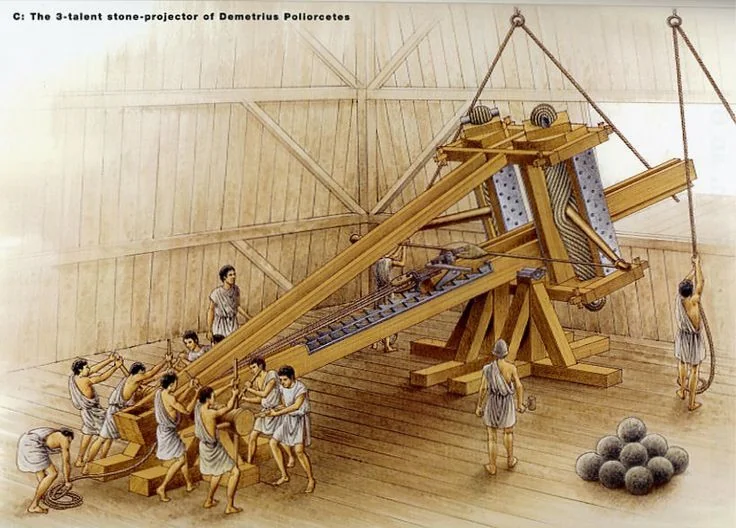
If the oxybeles was the ancient world's first proper field artillery, the lithobolos was its first proper siege artillery. The same torsion-powered two-armed mechanism, but scaled up to throw stones rather than bolts — capable of breaking masonry, splintering timber siege works, and crushing men through their armor at ranges of several hundred yards. The Hellenistic kingdoms built lithoboloi in increasing sizes throughout the 3rd and 2nd centuries BC, ending with platforms that could throw stones weighing well over fifty pounds.
Origins
The lithobolos developed out of the oxybeles in the late 4th and early 3rd centuries BC. The design principles were identical — two horizontal arms in vertical torsion springs, drawn back against a string — but the proportions were scaled larger and the projectile changed from bolt to stone. A sling pouch at the center of the bowstring held the stone, releasing it at the top of the arms' forward swing.
Hellenistic engineers seem to have moved through this evolution gradually. Early lithoboloi were small — throwing stones a few pounds in weight at ranges of perhaps 200 yards. By the mid-3rd century BC, the larger versions could throw a one-talent stone (roughly 57 pounds) several hundred yards. By the late Hellenistic period, the largest siege pieces could match or exceed the famous later Roman ballista in scale.
Hellenistic kingdoms
All three major Hellenistic successor states — the Seleucids, Ptolemies, and Antigonids — developed and used lithoboloi extensively. Ptolemaic Alexandria became a particular center of artillery research; the city's engineers produced detailed technical treatises that survived (in fragmentary form) through Heron and Philon of Byzantium. The Ptolemies invested heavily in coastal defenses against potential rivals, and their fortifications featured ranks of lithoboloi covering both sea approaches and land sieges.
City-states under Hellenistic rule often had their own artillery. Rhodes, in particular, was renowned for both its naval power and its artillery; the famous siege of Rhodes by Demetrius Poliorcetes in 305–304 BC featured both attacker and defender deploying massive numbers of lithoboloi against each other for a year of urban warfare. Demetrius eventually withdrew, leaving behind so much artillery that the Rhodians sold it for funds to build the Colossus.
- TypeTwo-armed torsion stone-thrower
- OriginHellenistic Greek, late 4th – 3rd C. BC
- In Servicec. 3rd – 1st C. BC
- Power SourceTwisted sinew or hair torsion bundles
- Range~200–500 yards (varies with size and stone weight)
- ProjectileStone (~3 to 170 lbs depending on size)
- Primary UseSiege warfare; coastal defense
Sizes and types
Hellenistic engineers developed a classification system for lithoboloi based on the weight of the stones they were designed to throw. The smallest "3-mina" pieces threw stones around 3 pounds; mid-sized weapons threw 10-pound stones; the standard heavy siege piece was the "1-talent" lithobolos throwing 57-pound stones. The largest documented examples threw 3-talent stones — over 170 pounds. Whether these very large weapons were ever produced in significant numbers is unclear; the engineering writings sometimes describe what the engineers thought was possible rather than what was routinely built.
Ranges varied with size and stone weight. Smaller lithoboloi could reach 400 to 500 yards; larger ones, throwing heavier stones, were typically used at shorter ranges (200 to 300 yards) where the weight of the projectile mattered more than the distance. A 57-pound stone at 200 yards has the kinetic energy to break stone walls, smash through siege engines, and kill men through any armor of the period.
Construction and operation
Building a lithobolos was a substantial engineering project. The frame had to be robust enough to absorb the violence of operation; the torsion bundles had to be tightly and uniformly wound from selected sinew or hair; the arms had to be carefully shaped to balance leverage against fracture risk; the trigger and winch mechanisms had to function reliably under high tension. A single weapon represented weeks of skilled labor, and a city's complement of artillery represented a substantial public expense.
Operating a large lithobolos required a crew of several men and significant time per shot. The torsion bundles had to be tensioned (often via large screw mechanisms), the stone had to be lifted into the sling, the arms had to be winched back, the sights had to be adjusted, and the trigger released. Rate of fire was perhaps one stone per minute for smaller pieces, slower for larger ones. Like the onager that would follow it under Rome, the lithobolos was a weapon of patient, deliberate destruction.
Roman absorption
When Rome defeated the Hellenistic kingdoms in the 2nd century BC, it inherited their artillery technology along with their territory. Roman engineers absorbed the lithobolos design and renamed it the "ballista" — a Latinized form of one of the Greek terms for the same weapon class. The Roman ballista of the early Empire was, in technical terms, a Hellenistic lithobolos with refinements: metal-framed (rather than wooden-framed) construction, more standardized proportions, and integration into the regular legion as field artillery.
The form continued to evolve under Rome and into the Byzantine period, but the fundamental design — two-armed torsion, stone-throwing — was Greek. The Roman ballista is properly understood as a continuous descendant of the Hellenistic lithobolos rather than as an independent invention.
Legacy
The lithobolos's direct descendants are the Roman ballista and onager (though the onager was a single-armed variant developing later) and through them the Byzantine torsion artillery that lasted into the medieval period. Its broader legacy is the establishment of stone-throwing artillery as a recognized class of weapon — a category that would persist, under various names and mechanisms, until gunpowder replaced it nearly two thousand years later. The trebuchet, the medieval mangonel, and ultimately the cannon all occupy the same conceptual niche the Hellenistic lithobolos opened up: a heavy weapon that throws something massive against fortifications too strong to break by hand.