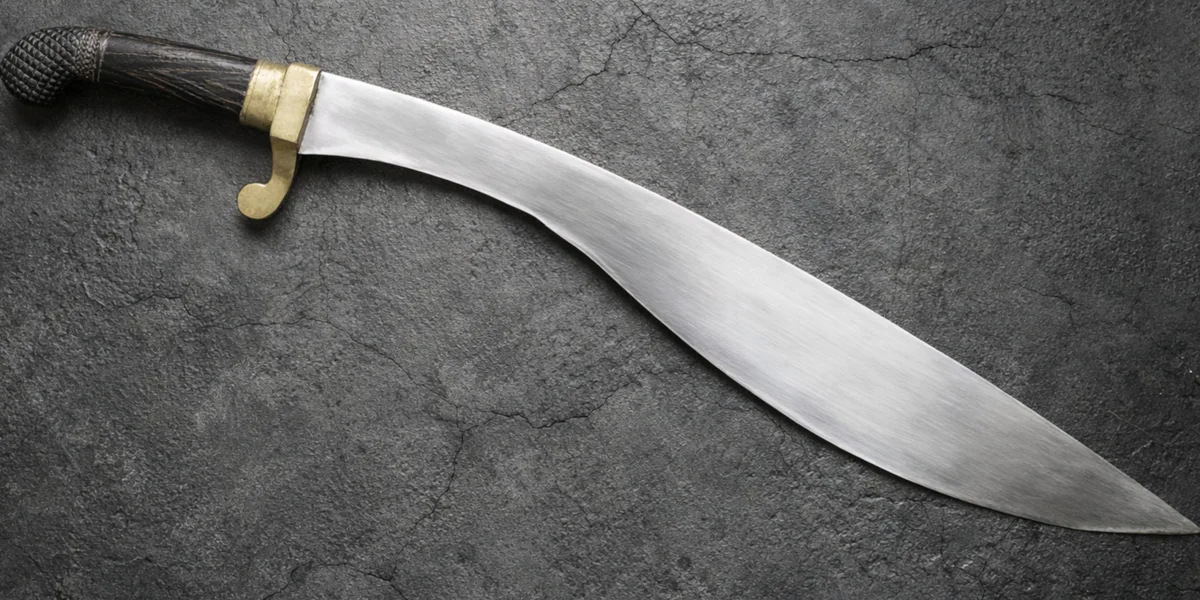
The word makhaira in ancient Greek meant, more or less, "the thing you fight with." It was used for a wide range of single-edged cutting blades, from kitchen knives to cavalry swords. Modern historians often use the term interchangeably with kopis, but the original Greeks did not. The makhaira was a category, not a specific weapon, and its overlap with the kopis is one of the more confused corners of ancient terminology.
Terminology
Ancient Greek writers used makhaira with notable inconsistency. Sometimes it meant a sacrificial knife. Sometimes a kitchen tool. Sometimes a soldier's sword. Xenophon, writing about cavalry, used the word for what was clearly a kopis-type weapon. Other sources used it for more general curved blades, including some that were closer to long knives than swords. Trying to pin down a single "makhaira" weapon-type from the ancient sources is a hopeless task.
What modern scholarship has settled on is a working distinction: kopis for the standardized cavalry sword with a pronounced forward curve, makhaira for related but heavier or more variable single-edged blades, often with less pronounced curvature. This distinction is a modern convention, not an ancient one.
Form
The makhaira, as the term is generally used today, is a heavier and longer single-edged sword than the kopis. Lengths could exceed 30 inches, with broader, heavier blades and more substantial hilts. Some makhaira designs had relatively gentle curves; others had near-straight backs with heavy single edges; some had pronounced forward curves like the kopis. The category covers significant variation.
What unifies them is the single edge and the cutting orientation. These were not thrusting swords. A makhaira was used for heavy cutting strokes, often from horseback, and was prized for the weight of its blow rather than for finesse.
- TypeSingle-edged cutting sword (heavier kopis variant)
- OriginGreek, with broad Mediterranean influence
- In Servicec. 6th C. BC – 4th C. AD (term, if not weapon)
- Total Length~28–36 in
- BladeSingle edge, variable curvature
- Primary UsersCavalry; later, generic Greek term for sword
- Primary UseHeavy cutting from horseback or on foot
Cavalry use
Like the kopis, the makhaira was particularly associated with cavalry. The added length and weight gave a mounted swordsman more reach and more cutting power, both useful when dealing with infantry from above. Greek cavalry of the Classical period — particularly Thessalian cavalry, who were the most respected horsemen in Greece before the Macedonians — were often depicted with curved cutting swords that fall into the makhaira category.
Romans and the Hispaniensis question
Some ancient sources use makhaira to describe the Roman gladius hispaniensis — the long Iberian sword Rome adopted during the Punic Wars. This is interesting partly because the gladius hispaniensis was a thrust-and-cut sword, not a pure cutter, and partly because it suggests how loose the term was. To a Greek writer, an Iberian sword was a makhaira regardless of whether it actually fit the technical pattern of cutting swords elsewhere in the term's usage.
This terminological looseness is part of why the makhaira is hard to pin down: ancient writers were not trying to be technical about weapon types in the way modern historians want them to be.
Decline
As the Hellenistic period gave way to Roman dominance, the term makhaira persisted in literary Greek long after specific weapon-types had changed. It was used in the New Testament for the soldiers' swords at Christ's arrest. It was used in Byzantine military manuals for various single-edged cavalry swords. The word outlasted the weapons it had originally described, becoming a generic term for sword in much of post-classical Greek writing.
Legacy
The makhaira's legacy is largely inseparable from the kopis. As distinct categories, both fade from the archaeological record by the 1st or 2nd century AD. As a general pattern — the single-edged forward-weighted cutting sword — the form persisted throughout the Byzantine Empire, into the Islamic world (where it influenced the development of the saber), and, much later, into the European falchion of the medieval period. The Greek cutting-sword tradition was small and brief but its echoes are detectable for centuries afterward.