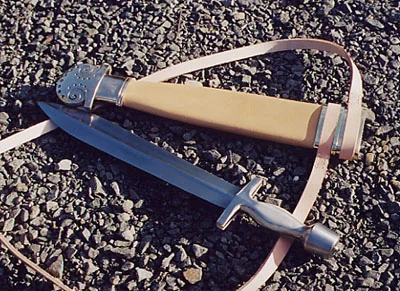
The xiphos was the Greek hoplite's sidearm. Roughly two feet of double-edged iron, leaf-shaped to put weight forward of the hand, it was the weapon a soldier reached for when his eight-foot spear was lost, broken, or stuck in someone. In a Greek battle, this was a frequent occurrence. By the time the lines had been in contact for a few minutes, half the hoplites in the front rank were fighting with xiphoi.
Origins
The xiphos developed out of earlier Bronze Age cut-and-thrust swords carried by Mycenaean and Minoan warriors. By the 8th century BC, the form had stabilized into something Iron Age Greeks would have recognized: a short, double-edged blade with a leaf-shaped profile and a simple hilt of organic materials. It was not a particularly distinctive design — similar swords appear across Iron Age Europe — but the Greeks made it standard issue.
Design
A typical xiphos was 60 to 75 centimeters in total length, with a blade of around two feet. The profile was the key feature: the blade widened from the hilt to a point about two-thirds of the way down before tapering to a sharp point. This put mass forward of the grip, giving the sword cutting power despite its short length. The hilt was simple — bone, wood, or ivory grip; small crossguard; pommel. Decorative elements were minimal compared to later Roman pugios.
Translating that into imperial: blade length around 24 inches, total length 24 to 30 inches, weight roughly two pounds. Light, fast, and built for the close work.
- TypeShort sword, double-edged, leaf-shaped
- OriginIron Age Greek, with Bronze Age roots
- In Servicec. 8th – 3rd C. BC
- Total Length~24–30 in
- Blade Length~22–26 in
- Weight~2 lbs
- Primary UseSidearm; drawn after the dory was lost or broken
In the phalanx
Hoplite combat began with spears. Two phalanxes would close on one another, the front rank thrusting their dora over the rims of their shields, the second rank thrusting underneath. The fighting at this stage was relatively orderly. But spears break. Spears get stuck. Spears get knocked out of hands. After perhaps a minute of contact, a meaningful percentage of the front rank would have lost their primary weapon and would draw the xiphos.
From this point the fighting was at sword-and-shield range — the same kind of close, ugly work the Romans would later do with the gladius. The xiphos was used much like the gladius in fact: short thrusts to whatever exposed flesh was available, with the shield punching, deflecting, and screening. The Greeks did not write tactical manuals about this kind of fighting the way the Romans did, but the underlying logic must have been similar.
Decline and the kopis
From around the 5th century BC, the xiphos started sharing space with another sword: the kopis, a forward-curving slashing weapon adopted from Iberian and Persian designs. The kopis was favored particularly by Greek cavalry and increasingly by infantry as well. By the time of Alexander, both were in service simultaneously, with the kopis dominant in cavalry contexts and the xiphos still common among hoplite infantry.
The xiphos faded from use during the Hellenistic period as Greek warfare evolved. It was a hoplite weapon, and the Macedonian phalanx that dominated the post-Alexander world used different equipment and different tactics. By the 2nd century BC, the xiphos had effectively disappeared as a battlefield weapon.
Legacy
The xiphos has no clear lineage forward. The Roman gladius was adopted from Iberian designs, not from Greek. The medieval European sword tradition descended from the Roman spatha and Germanic Migration-Period blades, neither of which owed anything visible to the leaf-shaped Greek short sword. The xiphos was a competent weapon for its system, and when its system ended, it ended with it.