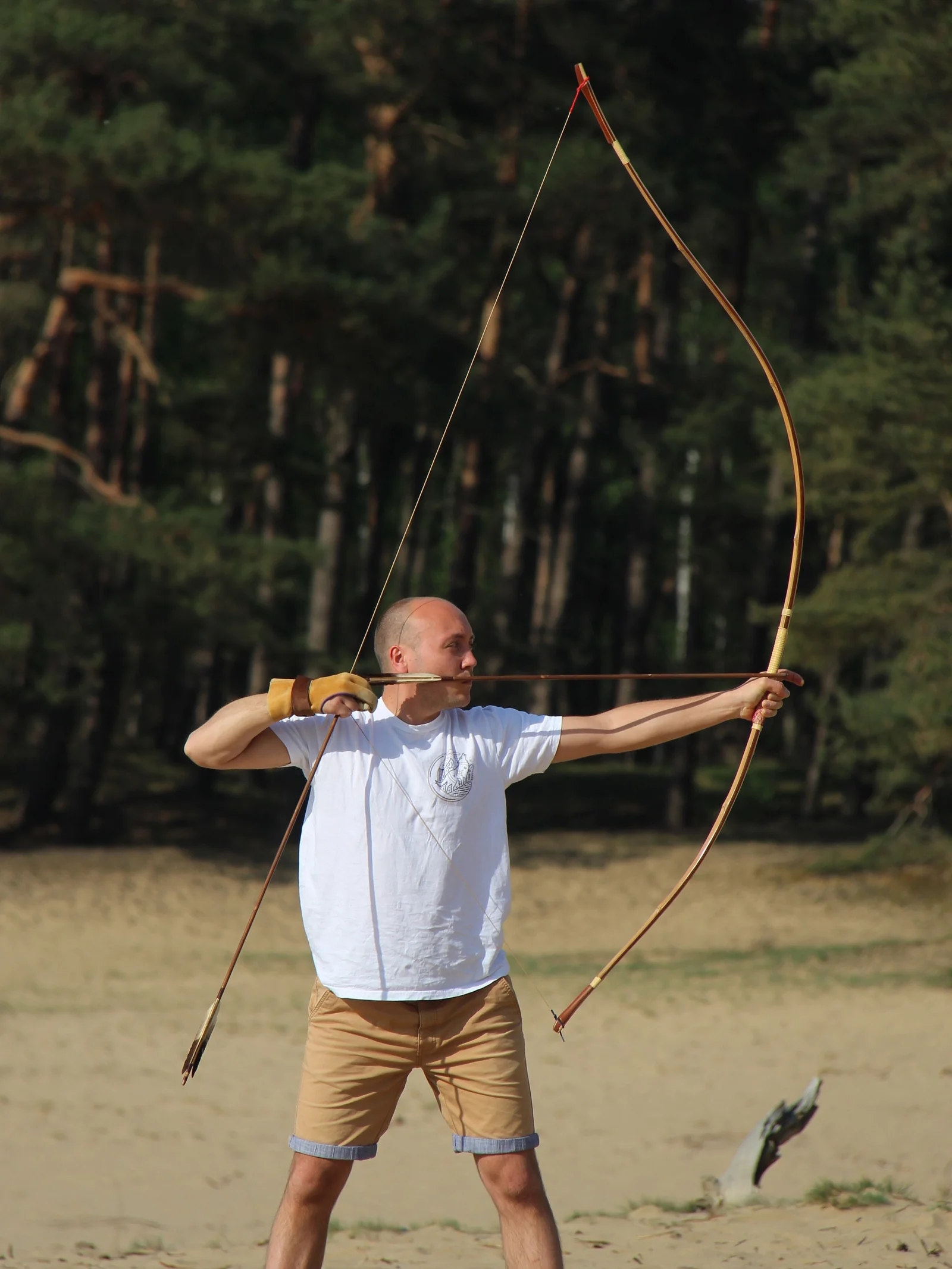
Before the katana became the symbolic weapon of the samurai, the bow held that role. The early samurai of the Heian and Kamakura periods were primarily mounted archers, and the formal description of the warrior's discipline in this period was kyūba no michi — "the way of the bow and horse." The yumi, the Japanese longbow, is unique among major military bows for its asymmetric construction: the grip sits about a third of the way from the bottom, an adaptation that made the long bow practical from horseback.
Origins
Long bows of various forms had existed in Japan since prehistory. The form that became the classical yumi developed gradually across the 7th through 10th centuries, with the asymmetric grip and the laminated bamboo-and-wood construction stabilizing by the late Heian period. The bow was the central weapon of the developing samurai class — far more so than the sword — and the techniques of mounted archery were the central martial discipline of the Heian and Kamakura warrior.
The asymmetric grip
A typical yumi is over seven feet (220 cm) long, with the grip placed about a third of the way up from the bottom rather than at the center. This means the upper limb is roughly twice as long as the lower limb — a configuration that is essentially unique to Japan among major bow traditions. The reasoning is functional: a symmetrically gripped bow of equivalent length would strike a horse's saddle when used from horseback, particularly when shooting downward at targets to the side. The asymmetric grip moves the working portion of the bow up and away from the saddle.
The asymmetry creates interesting consequences for bow performance. The two limbs work differently — the longer upper limb has more travel and stores more energy; the shorter lower limb is stiffer. Skilled archers compensate for the asymmetry through specific shooting technique, and the resulting shot has characteristic timing differences from a symmetric bow's release.
- TypeAsymmetric laminated longbow
- OriginJapanese, classical period
- In Servicec. 600 – present (modern use ceremonial)
- Total Length~7–7.5 ft (220–230 cm)
- Grip Position~1/3 from bottom
- ConstructionLaminated bamboo and hardwood (traditionally haze)
- Primary UseMounted archery for samurai of the Heian and Kamakura periods
Construction
Traditional yumi are laminated composite bows. The classic construction sandwiches a hardwood core (usually haze, Japanese sumac) between two layers of bamboo — the bamboo on the belly (facing the archer) and the back. This composite stores significantly more energy than a solid wood bow of equivalent length, allowing the long yumi to deliver its arrow with serious force despite the slow draw of a heavily reflexed weapon.
The construction process is intricate and traditionally takes months. The component pieces are cut, shaped, and aged; the lamination is done with carefully prepared rice glue; the bow is shaped under tension over forms; the whole assembly is wrapped with rattan or other binding for additional structural integrity. A high-quality traditional yumi made by a skilled bowyer is a substantial piece of craft work.
In combat
In the Heian and Kamakura periods, samurai trained from boyhood in yabusame — mounted archery against fixed targets — and in inuoumono, mounted archery at running dogs (a practice considered cruel by later periods but standard training in the Kamakura period). The expected combat scenario was an exchange of arrows from horseback at distance, often resolving without anyone closing to sword range. Surviving accounts of the Genpei War describe combat that was, in significant part, a long-range archery exchange between mounted samurai.
The Mongol invasions of 1274 and 1281 stressed this system. Mongol bows had different performance characteristics — shorter draw, faster shot, used in massed volleys rather than individual aimed shots — and Mongol tactics emphasized formation archery in a way that Japanese samurai duels did not. The Japanese adapted, but the encounter changed the cultural sense of what a warrior was, and the long-term shift away from archery as the primary samurai discipline accelerated afterward.
Decline as a war weapon
The yumi's role as a primary battlefield weapon ended with the introduction of firearms in the 1540s. A trained samurai archer could shoot with greater accuracy and faster than a matchlock musketeer could load and fire — but the matchlock could be operated by a conscripted ashigaru with weeks of training, while the samurai archer needed years of training. The economics favored the gun. By the late Sengoku, the yumi had largely been displaced from primary battlefield roles, though it persisted in particular tactical contexts and remained part of samurai training and identity through the Tokugawa period.
Modern survival
Unlike many of the other weapons in this archive, the yumi is still in active use. The discipline of kyūdō ("way of the bow") — the formalized contemplative archery practice that descended from samurai training — remains widely practiced in Japan and internationally, with hundreds of thousands of practitioners. Traditional yumi continue to be made by licensed bowyers using traditional techniques, and the form is studied both as a martial art and as a meditative discipline. The bow that was the original weapon of the samurai outlasted the samurai themselves, the swords that replaced it as their symbol, and the wars they fought.