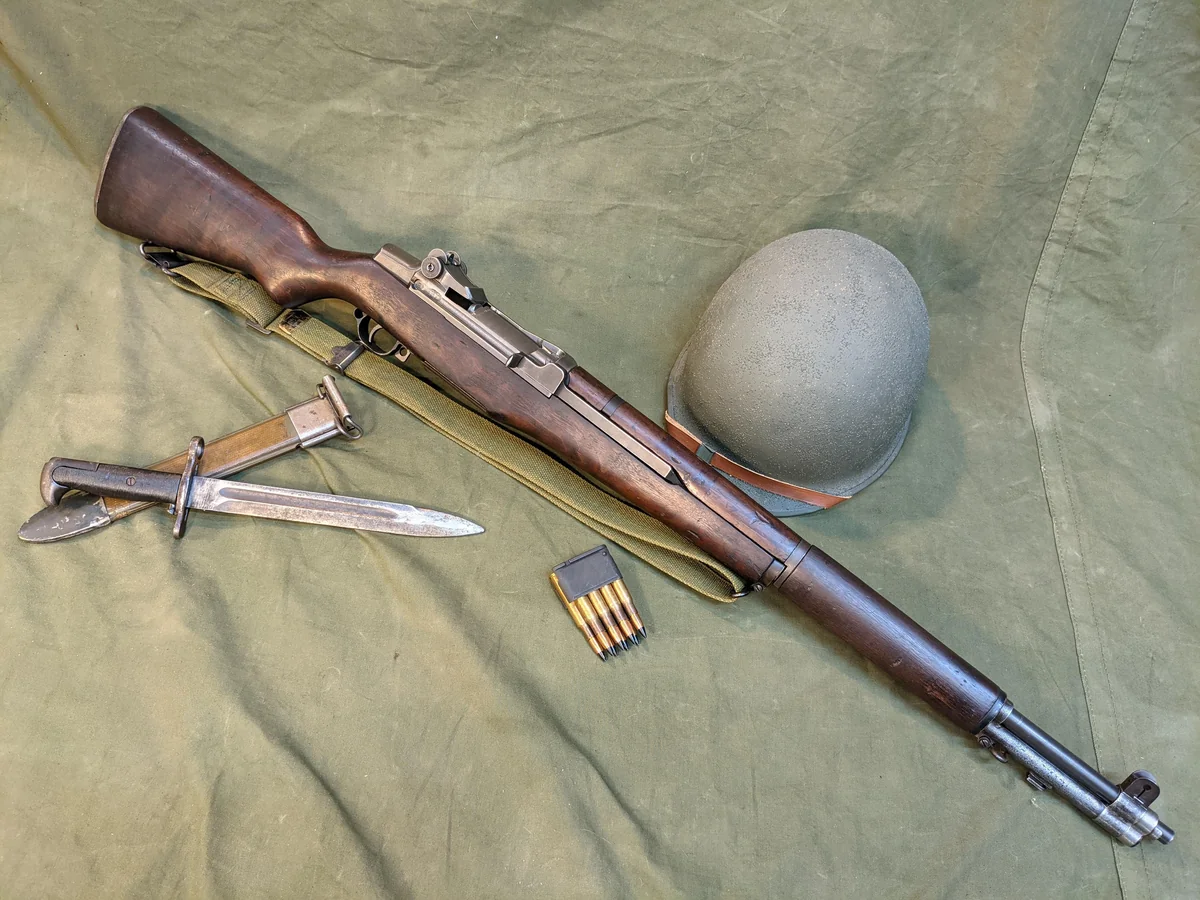
When American soldiers waded onto the beaches at Normandy in June 1944, they did so carrying a rifle that no other army on earth had managed to produce in similar numbers. Every other major combatant — the Germans, the British, the Soviets, the Japanese — was still issuing bolt-action rifles to its line infantry. The Americans had given up on bolt actions in 1936.
John Garand
The rifle was the work of one man: John Cantius Garand, a French-Canadian engineer who emigrated to the United States as a child and spent most of his career at the Springfield Armory in Massachusetts. Garand began work on a self-loading service rifle in 1919, and spent fifteen years refining the design through dozens of failed prototypes before the Army adopted his work as the U.S. Rifle, Caliber .30, M1 in 1936.
Garand was, by all accounts, a quiet and modest man. He never received a royalty on the rifle that bears his name. He continued working at Springfield until 1953, designing improvements that were never adopted because they would have disrupted production of the rifle he had already perfected. When General Patton famously called the M1 "the greatest battle implement ever devised," Garand sent him a polite thank-you note.
How it worked
The M1's mechanism was a gas-operated, rotating-bolt action — gas tapped from the barrel after firing drove a piston rearward, which cycled the bolt, ejected the spent case, and chambered a new round from the magazine. A trained soldier could fire all eight rounds in his rifle in under three seconds without losing his aim. A Mauser-armed German rifleman, by comparison, would need to lower the rifle, work the bolt, and reacquire his target between every shot.
The result was a fundamental shift in infantry firepower. American squads had roughly two and a half times the rate of accurate aimed fire of equivalent German or Japanese units armed with bolt-actions. Combined with the Browning Automatic Rifle and the M1919 machine gun, the typical American rifle squad in 1944 could put down a curtain of fire that would have been impossible a generation earlier.
"In my opinion, the M1 rifle is the greatest battle implement ever devised." Gen. George S. Patton, 1945
- TypeSemi-automatic service rifle
- OriginUnited States (Springfield Armory)
- DesignerJohn C. Garand
- In Service1936 – 1957 (USA)
- Cartridge.30-06 Springfield (7.62 × 63 mm)
- ActionGas-operated, rotating bolt
- Magazine8-round en bloc clip
- Length43.5 in
- Weight~9.5 lb
- Effective Range~500 m (550 yd)
The famous "ping"
The M1's most notorious quirk was its en bloc clip system. Eight rounds of .30-06 were held in a small steel clip, which was inserted into the magazine as a unit. When the last round was fired, the empty clip ejected upward with a distinctive metallic ping audible at close range. The story, repeated in countless memoirs, is that German and Japanese soldiers learned to recognize the sound and rush an American position knowing he was empty.
How often this actually happened is debated. Combat veterans gave conflicting accounts, and the noise of battle would have drowned the ping in most circumstances. American soldiers also developed countermeasures — throwing an empty clip on the ground to fake the sound, or holding the bolt back manually — that suggest the issue was real if exaggerated. The story endures because it captures something true about the weapon: it was loud, mechanical, distinctly American, and it ran out of ammunition all at once.
After the war
The M1 served through Korea, where it remained the standard American infantry rifle, before being replaced by the selective-fire M14 in 1957. Production ran to roughly 6.25 million rifles. Surplus M1s were exported to allies around the world — including South Korea, Greece, Denmark, and Italy — where they remained in service well into the 1980s.
Today the M1 Garand is one of the most collected military rifles in the world. The U.S. Civilian Marksmanship Program still distributes surplus Garands to qualified American civilians, more than eight decades after the rifle entered service. It is a strange honor for a weapon, to be still in the hands of citizens of the country that built it, fired in matches and ceremonies, well after the wars it was made for have passed into history.