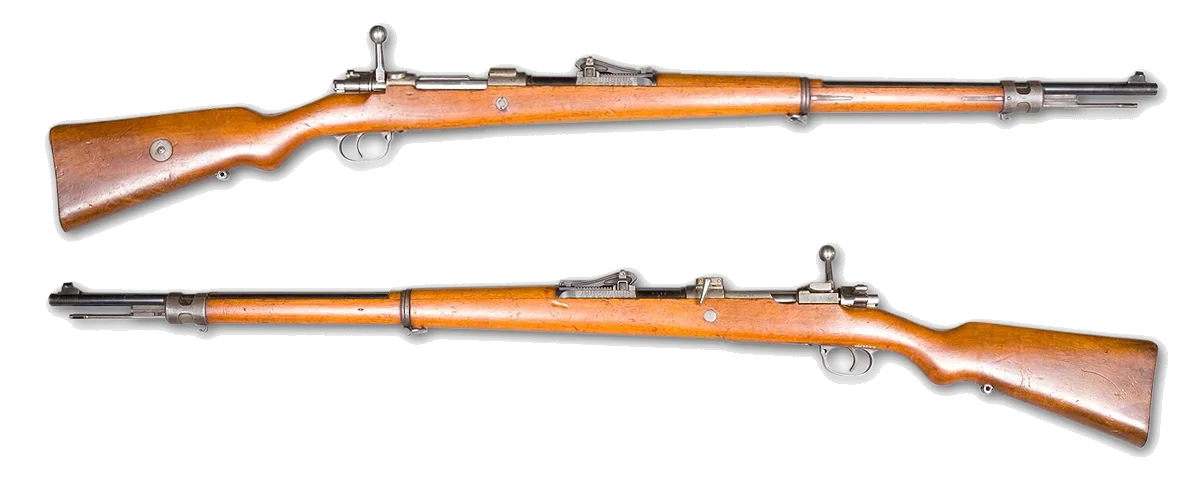
More than any other single weapon, the Mauser 98 defines what we picture when we picture a military rifle. Bolt-action, internal magazine, controlled-feed extraction, and an action so over-engineered that working examples are still in service somewhere in the world today, more than 125 years after the design was finalized.
The design
Adopted by the Imperial German Army in 1898, the Gewehr 98 was the culmination of decades of work by Paul Mauser and his brother Wilhelm at the Mauser factory in Oberndorf. Earlier Mauser rifles had pioneered the metallic cartridge, the box magazine, and the smokeless-powder cartridge. The Gewehr 98 brought all of these developments together with an action that, in retrospect, would prove very nearly perfect for its task.
The bolt locked into the receiver with two large lugs at the front, plus a third safety lug at the rear — strong enough to handle pressures that would have wrecked earlier designs. The internal magazine held five rounds of the new 7.92×57mm cartridge, loaded from a stripper clip in a single motion. A massive non-rotating extractor gripped the cartridge case throughout the loading and firing cycle. None of these features was unique to Mauser. What was unique was the way they fit together.
The Great War
Germany entered the First World War with roughly two million Gewehr 98 rifles in service or storage. By 1918 the figure was over five million. The rifle was issued to nearly every German infantryman, and was used in every theater the Imperial Army fought in: the trenches of the Western Front, the steppes of the Eastern Front, the deserts of Mesopotamia, and the colonies of East Africa.
It performed well, but the war exposed its limitations. The 49-inch length, designed for the 19th-century vision of long-range volley fire across open ground, was unwieldy in a flooded trench. The five-round magazine, fed from above by a clip, was slow compared to the box-fed rifles of some allies and the new submachine guns appearing toward the end of the war. After 1918, Germany adopted the shorter Karabiner 98k as the standard service rifle, and it was the K98k — using essentially the same action — that the Wehrmacht carried into the Second World War.
- TypeBolt-action service rifle
- OriginGerman Empire (Mauserwerke)
- In Service1898 – 1935 (Germany)
- Cartridge7.92 × 57 mm Mauser
- ActionManually-operated bolt, controlled-feed
- Magazine5-round internal, stripper-clip fed
- Length49.2 in
- Weight~9 lb
- Effective Range~500 m (550 yd)
The action that wouldn't die
The real legacy of the Mauser 98 is not the rifle itself. It is the action. Within twenty years of the rifle's introduction, the Mauser bolt-action had been licensed, copied, or adapted by nearly every major military power on earth. The American Springfield M1903 was a near-direct copy — close enough that the United States paid Mauser royalties for years. The British Pattern 1914, the Spanish Mauser, the Belgian FN, the Czech vz. 24, the Yugoslav M48, the Turkish Mauser, and dozens of others were all variations on the same action.
It was also the foundation of the modern hunting rifle. After the Second World War, the Mauser 98 action — refined slightly by manufacturers like Winchester, Remington, and Ruger — became the standard for civilian sporting rifles, where it remains in production to this day. A modern hunter shooting deer with a bolt-action rifle is, in mechanical terms, using a slightly polished version of the same weapon a German soldier carried out of the Imperial arsenal in 1898.
Why it lasted
The Mauser 98 lasted because it solved its problem completely. A bolt-action service rifle needs to feed reliably from a magazine, extract a fired case under any condition, lock up safely against high chamber pressures, and survive the abuse of a soldier who has not slept in three days. The Gewehr 98 did all of these things in 1898 and continued doing them through two world wars. The semi-automatic and selective-fire rifles that eventually replaced it were faster, but for the specific job a bolt-action rifle is meant to do, no one ever really improved on Paul Mauser's design.