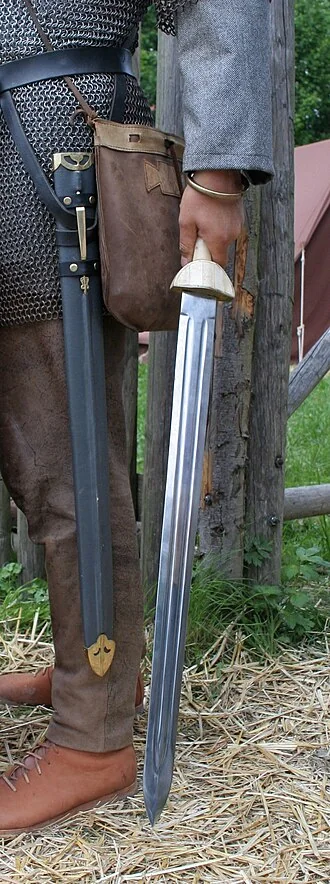
When historians describe "the Roman sword," they almost always mean the gladius. But for the last two centuries of the Western Empire, the standard military sword was something quite different: longer, slimmer, designed as much for cutting as for thrusting. The spatha is the Roman sword most modern people have actually held — because nearly every European sword that came after it was its descendant.
Origins
The spatha was not originally Roman. The name itself is borrowed from Greek — spathē, meaning a flat blade or broad piece — and the weapon's design appears to have come from the Celtic and Germanic peoples Rome encountered along its northern frontiers. Long, straight, double-edged swords had been a feature of Iron Age European warfare for centuries before the Romans showed up.
What Rome added was scale. As the early Empire absorbed Gallic, German, and Thracian auxiliary cavalry into its army, those mounted units brought their long swords with them. By the late 1st century AD, the spatha was standard equipment across Roman cavalry — and through the auxiliary system, Roman manufacturing began producing them in serious numbers.
Description
A spatha was substantially longer than a gladius: roughly 30 to 40 inches in total length, with blades typically 24 to 33 inches. It was double-edged, with a tapered point, and varied in profile across the centuries — earlier examples tended to be broader and more parallel-sided, later ones more leaf-shaped or slightly tapered. The hilts were simple by gladius standards: a wood, bone, or ivory grip, a metal pommel, a small crossguard.
By the late Empire, pattern-welded blades had become common. Twisted iron rods of varying carbon content were forge-welded together, then ground to shape, producing blades that combined the toughness of softer iron with the edge-holding of harder steel — and that displayed an unmistakable rippled grain on the finished surface. A well-made late Roman spatha was, in metallurgical terms, the most sophisticated sword the ancient world produced.
- TypeLong sword, double-edged
- OriginCeltic / Germanic, adopted by Rome
- In Servicec. 1st – 6th C. AD
- Blade Length24–33 in
- Total Length30–39 in
- Weight~2.2–4.4 lbs
- Blade MaterialForged iron, later pattern-welded steel
- Primary UseCut and thrust, cavalry then infantry
The shift from the gladius
For most of its early history, the spatha and the gladius coexisted: cavalry carried the longer weapon, infantry the shorter. What changed in the 3rd century AD was the infantry side of that equation. Roman tactics had been built around a tightly-packed line of legionaries behind large rectangular shields, stabbing forward with short swords. Against the looser, more mobile barbarian armies that increasingly pressed the frontiers, that system began to break down.
The Roman response was to fight in looser formations, with smaller shields, against opponents who were rarely standing still long enough to be stabbed at close quarters. In that kind of fighting, reach matters. By 250 AD, the spatha had largely replaced the gladius as the standard infantry sword. By 300, the gladius was effectively obsolete.
Manufacture
Late Roman spathas were produced by state-run armament factories — the fabricae — scattered across the Empire. These supplied the entire Roman army with weapons, armor, and equipment to defined imperial specifications. Quality varied: the fabricae of Constantinople and the eastern provinces turned out excellent blades well into the Byzantine period, while frontier facilities sometimes produced rough work. But the standardization meant a soldier in Britain could replace a broken sword with one made in Antioch and the new blade would fit his existing scabbard.
Legacy
This is where the spatha's importance is hardest to overstate. When Roman authority collapsed in the West during the 5th century, the spatha did not disappear with it. Germanic kingdoms inherited Roman fabricae, Roman smiths, and the techniques of making the swords. The Vendel-period sword of Scandinavia, the Merovingian sword of Frankish Gaul, and the Anglo-Saxon sword of England are all direct descendants of the spatha — the same length, the same construction, the same general balance.
Those swords, in turn, evolved into the Viking sword, which evolved into the medieval arming sword, which evolved into the longsword. For roughly 1,500 years — from the 1st century AD to the 16th — nearly every sword used by every European warrior could trace its lineage in an unbroken line back to the Roman spatha.
It is a strange kind of legacy. The gladius is the famous sword, the icon, the one in every depiction of a legionary. But the spatha is the sword that actually carried into the medieval world. The gladius died with the empire that built it. The spatha just kept getting made.