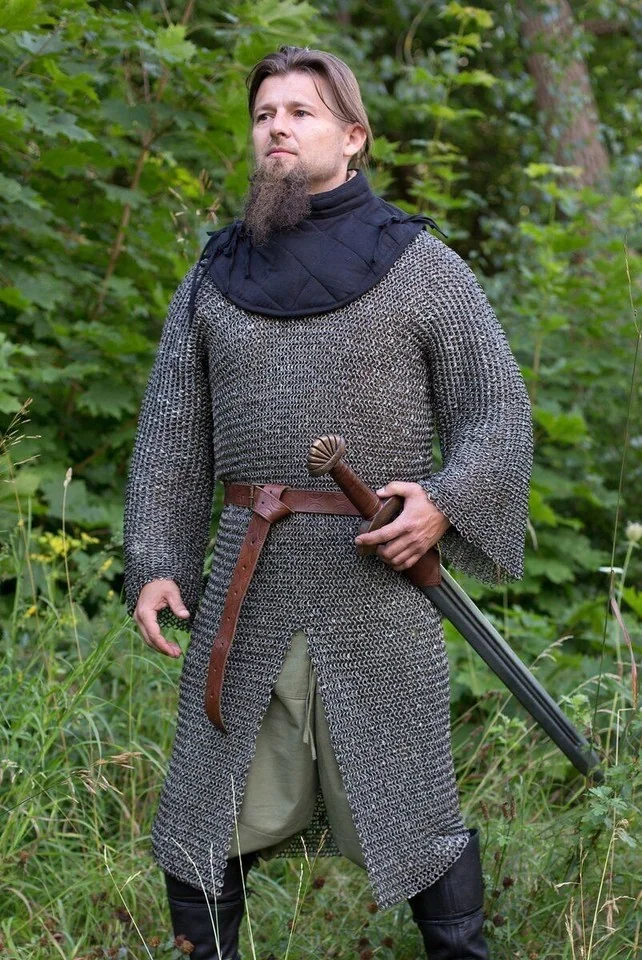
Brynja is the Old Norse word for mail armour — a hauberk of thousands of small interlinked iron rings, each individually drawn from wire, formed into a ring, and riveted closed. Worn over a thick padded undergarment, it stopped sword-cuts cold and softened spear-thrusts. It was the single most expensive piece of equipment a Viking could own, and it marked the boundary between the wealthy professional warrior and everyone else.
Construction
A Viking mail hauberk consists of 20,000 to 30,000 individual rings, each one made by hand. Each ring is drawn from iron wire, bent into a circle, overlapped at the ends, pierced through both overlapping ends, and either riveted closed (the standard for war-grade mail) or welded shut. The rings are then linked in a 4-in-1 pattern: each ring passes through four neighbours, two above and two below. A skilled mailmaker could produce perhaps a few hundred rings in a day; a complete hauberk represented many hundreds of hours of work spread over months.
The economic implications were severe. A complete brynja in the Viking Age cost roughly the equivalent of a small farm, or a substantial herd of cattle. Saga sources price hauberks in numbers of cows; one famous saga entry has a chieftain valuing his mail at "thirty milk-cows," which puts the armour in the same economic bracket as a major land transaction.
A typical Viking-age hauberk reached to the knee or mid-thigh, with sleeves that ended at the elbow. (Longer sleeves and longer skirts came in the high medieval period, with the development of the full hauberk in the 12th and 13th centuries.) The garment was open at the front, sides, or both, for ease of putting on and taking off. The wearer pulled it on over his head and tied or buckled it closed at the front. Under it he wore a thick padded shirt — the gambeson — to absorb impact and prevent the rings from chafing the skin.
- TypeRiveted iron mail hauberk
- OriginCeltic / Iron Age (inherited via Rome and the Germanic peoples)
- In ServiceViking Age and beyond (~5th C. BC – 16th C. AD overall)
- LengthTo knee or mid-thigh; sleeves to elbow
- Rings20,000–30,000 per hauberk
- Weight9–12 kg
- MaterialDrawn iron wire; riveted rings
- Primary UseSlash and thrust protection for elite warriors
How it protected
Mail's defensive performance is differential. Against slashing cuts, it is extremely effective — a sword cut against good mail will not part the rings, and the chain absorbs and distributes the energy of the blow across a wider area than the cut itself. A skilled swordsman cutting at a mailed opponent will, in most cases, leave the rings intact and the wearer alive.
Against thrusts, mail is moderately effective. A fine point with enough force behind it can wedge between rings and force a few of them open, especially if the strike comes from a long thrust or a charge. The point of a thrust spear or the tip of a sword could penetrate mail in the wrong conditions, particularly at the joints where rings naturally separated under tension. Good mail with closely-fitted rings was harder to penetrate than poor mail with looser links.
Against crushing blunt impact, mail is nearly useless without the padded undergarment beneath. A heavy axe blow or a mace strike against a mail-without-gambeson combination will break ribs, rupture organs, and incapacitate the wearer even if the rings themselves hold their integrity. The gambeson is what saves the wearer from blunt trauma. The mail is what saves him from being cut open.
Against arrows, mail offers significant protection at range and reduced protection at close range, depending on the bow's draw weight and the arrowhead's design. A bodkin point — a narrow square-section arrowhead — could penetrate mail at close range, particularly from a heavy war bow. A broadhead — designed for hunting — would generally not.
What it cost a man
A Viking in mail was a Viking who had arrived. The brynja was the equipment of the king's húskarl, the wealthy chieftain, the established raider. It was inherited, repaired, and kept across generations. A father might pass his hauberk to his son. A king might gift one to a favoured retainer. The economic investment was lifelong: a hauberk that survived its first owner might serve three or four more before age and damage finally retired it.
The flip side: a Viking who could afford mail was a Viking who could afford to fight in the front rank, to take the risks that came with leading the wall, and to expect rewards proportionate to those risks. The men in mail were the men who came home with plunder.
In the shield wall
Mailed warriors typically stood in the front rank of the Norse shield wall, where the heaviest fighting happened. The hauberk allowed them to receive cuts and thrusts that would have killed an unarmoured man and remain standing, swinging, holding the line. Behind them in the second and third ranks stood lighter-armoured or unarmoured warriors who fed past them with spears or stepped into gaps as the front rank fell.
The mail-and-shield combination was the most defensible posture a Viking infantryman could adopt. A man in mail with a round shield in his off hand and a sword or axe in his strong hand was vulnerable mainly to thrusts to the face — which the helmet's nasal and spectacle guard largely addressed — and to leg blows below the hauberk's skirt, which the round shield largely covered.
Old technology
Mail was old by the Viking Age. The technology was invented by the Celts in the Iron Age — surviving examples from continental Europe date back to the 4th century BC — and was adopted by the Romans, who built whole legionary cohorts in the lorica hamata. The Romans passed mail through the late Empire to the Germanic peoples, who in turn passed it to the Norse. The Vikings inherited a mature technology and used it for the same reason everyone else had: nothing better was available until the development of plate armour in the 14th century, and even then mail remained in use as a supplement for another two hundred years.
After the Vikings
Mail outlived the Viking Age by more than three hundred years. Norman knights at Hastings wore essentially Viking-style hauberks. Crusader knights in the 12th and 13th centuries wore longer, more enclosed versions. Even in the late 14th century, when plate armour had become dominant for the wealthy elite, mail continued in use as a backing layer beneath plate and as a complete armour for the middle ranks of medieval armies. The Viking brynja was one stage in a continuous European mail tradition that ran for nearly two thousand years.