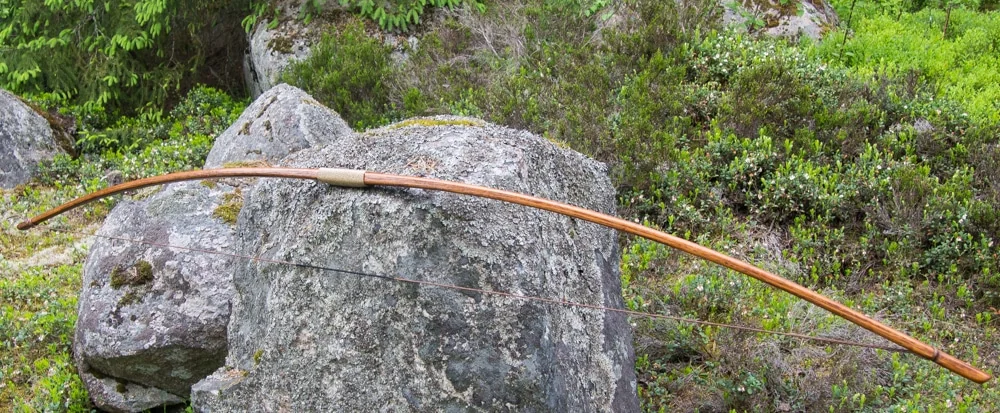
The Hedeby bow is named for the famous specimen recovered from the harbour of Hedeby, the great Viking trading town in what is now Schleswig in northern Germany. The 10th-century specimen is the best-preserved Viking-age bow in the archaeological record, and the type-example for what Norse archers actually shot.
Construction
The Hedeby bow is a self-bow — a single stave of wood, not a composite of horn and sinew like the contemporary steppe bows of the Magyars and Pechenegs. The wood is yew (Taxus baccata), the same species the later English longbow would be made from for the same reasons. Yew has a remarkable natural property: its heartwood resists compression while its sapwood resists tension. A staff cut from the boundary between the two, with heartwood on the belly of the bow and sapwood on the back, behaves like a natural composite material. The two layers do the work of the horn and sinew that a composite bow has to be glued together from.
The Hedeby specimen is approximately 191 centimetres long — just over six feet — with a D-shaped cross-section, wider through the limbs than it is thick in profile. This is a serious war bow, not a hunting bow scaled up. Reconstructed draw weights for bows of this size and material range from 90 to over 130 pounds, depending on the individual stave and the build. Lighter bows certainly existed, but the surviving war specimens are heavy.
Comparable finds — the Ballinderry bow from Ireland (10th century), fragments from York, Birka, and Oslo — confirm a consistent tradition: long yew self-bows of similar dimensions, distributed across the entire Viking world from the British Isles to the Baltic.
- TypeYew self-bow (longbow)
- OriginNorse
- In Servicec. 8th – 11th C. AD
- Length~180–195 cm
- Draw Weight~90–130 lbs (estimated)
- Cross-SectionD-shaped
- MaterialYew stave; linen or sinew bowstring
- Primary UseNaval combat, skirmish, hunting
What it could do
A 100-pound draw-weight yew bow shooting a heavy arrow has serious combat capability. At close range — within 50 metres — it could penetrate a mail haubergeon at the right angle, and certainly kill an unarmoured man at 100 metres. Effective ranges depend on the archer and the target: against a stationary target, a skilled archer could place arrows accurately at 75 to 100 metres; against a moving man, half that. Against a massed shield wall, accuracy is unnecessary — any arrow that drops into the formation has a target.
The Viking bow's role in pitched battle was secondary to the spear and the axe, but it was not negligible. Skirmish action — flanking parties, ambushes, attacks on supply trains — frequently involved Norse archers as their decisive arm. And in naval combat, archery was primary.
Naval archery
Longships locked together for boarding fought their first phase with missiles, and archery was the most important of those missiles. A skilled archer at the prow of his own longship could pick off rowers and helmsmen on an approaching enemy vessel before any other weapon could come into play. The arrow exchanges of major Viking sea-fights — Hafrsfjord, Svolder, Stiklestad — were extended and bloody, and the archers' work shaped the outcome of the boarding action that followed.
Svolder and Einar Tambarskelfir
The most famous archery story in Norse literature is from the Battle of Svolder in the year 1000 AD. King Olaf Tryggvason of Norway, fighting against a combined Danish-Swedish-Norwegian fleet, had aboard his flagship Long Serpent a young archer named Einar Tambarskelfir, who was reputed to be the finest bowman in the Norwegian fleet. Through the long missile exchange of the morning, Einar shot at the steerers and standard-bearers of the enemy ships with extraordinary effect.
Then his bowstring snapped. Olaf, hearing the noise, called out from the stern: "What broke there with such a great crack?" Einar's reply has passed into legend: "Norway, lord, from your hand."
Olaf was indeed defeated at Svolder, and although the saga's exchange is almost certainly literary embellishment, it preserves something real about how the Norse understood archery in their wars: the bow, when wielded by the right archer, could decide a battle, and a battle could be lost in a single moment when a string broke.
Hunting
Outside war, the bow was the primary Norse hunting weapon. Norse archery skill was developed in everyday hunting of deer, elk, seal, and waterfowl, long before it was ever used in combat. The bow was a tool of subsistence in Iceland and Greenland especially, where farming was thin and hunting was necessary. The same men who shot at Svolder had shot at deer in their own valleys, and the same skills carried across.
Decline
The Hedeby bow tradition continued into the medieval period as the basic Scandinavian longbow form. It influenced — and was influenced by — the contemporary Welsh and English bow traditions, which eventually produced the famous English longbow of the Hundred Years War. The line of descent is direct enough that the great longbows recovered from the wreck of Mary Rose in 1545 are recognisably the same weapon, scaled up: yew, six feet long, drawn to over 100 pounds, shot at men in armour. The Viking Age archer would have recognised it instantly.