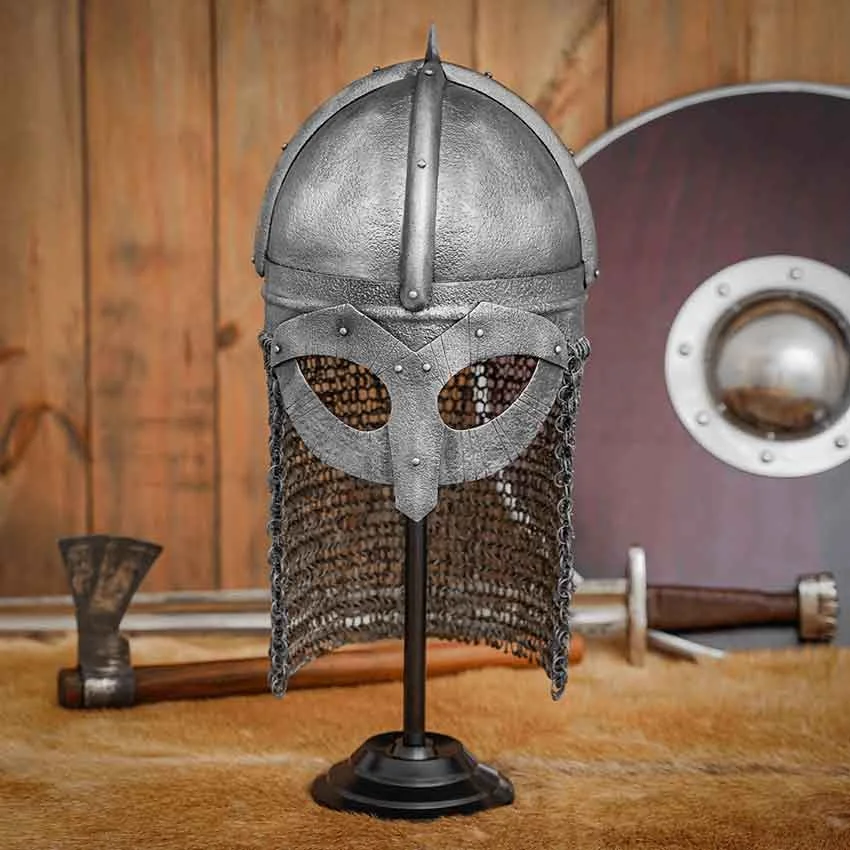
The Viking helmet is famous mostly for what it was not. The horned helmet, that recurring image in opera-house costuming and modern football mascots, has no archaeological basis. It is a 19th-century Romantic invention, popularised by the costume designers of Wagnerian opera in the 1870s and afterward picked up by every illustrator who needed to draw a Viking. No actual Viking-age helmet had horns. The horned helmets that do exist in the archaeological record come from the Bronze Age, more than two thousand years before the Viking Age, and were almost certainly ceremonial rather than martial. A real Viking helmet was an iron cap, practical and unadorned, designed for one purpose: keeping a man's head intact in a fight.
What survives
The archaeological evidence is thin. Of the tens of thousands of Vikings who must have owned helmets across three centuries of the Viking Age, only a handful of complete or substantially complete helmets have survived. Most were melted down for the iron, lost to corrosion, or never recovered from battlefield burials. The single intact Viking-age helmet known is the Gjermundbu helmet, recovered in 1943 from a chieftain's grave in Buskerud county, Norway, and dated to the 10th century.
The Gjermundbu helmet is the closest thing we have to a type-specimen for what a Norse elite warrior actually wore on his head.
Construction
The Gjermundbu helmet is built from four curved iron plates, riveted together along their edges to form a rounded dome. A low brow band runs around the base of the dome, providing structural reinforcement and a mount for additional fittings. A short iron nasal bar projects downward from the brow band over the bridge of the nose. Above and to either side of the nasal, an iron "spectacle" guard — two oval frames joined across the bridge — wraps around the upper face, protecting the eyes and upper cheekbones from cuts and arrow-fire.
The whole assembly weighs around 2.0 to 2.5 kilograms, evenly distributed across the head. A simple cloth or padded liner would have made it bearable for extended wear. There is some evidence — corrosion patterns at the bottom edge of the helmet — that aventail (a mail neck guard) was attached, though no mail has survived attached to the helmet itself.
- TypeSpectacle-style iron helmet
- OriginNorse
- In Servicec. 9th – 11th C. AD
- ConstructionFour iron plates riveted into a dome
- FeaturesBrow band, nasal bar, eye-guard ("spectacles"), aventail mount
- Weight~2.0–2.5 kg
- MaterialForged iron
- Primary UseHead protection for elite warriors
The spectacle type
The Gjermundbu's distinctive spectacle face-guard is the canonical form of the Viking elite helmet. Fragments and partial recoveries from across Scandinavia and the British Isles suggest the spectacle type was the standard for warriors who could afford iron headgear. The face-guard's purpose is dual: protection against thrust-cuts to the face — the weak point of any helmet — and protection against arrow fire to the upper face, which was particularly relevant in naval combat where opening volleys came from above and ahead.
Some Viking helmets used simpler forms — a plain dome with just a nasal, or even a plain dome without face protection at all. These appear in the record as well, and probably reflect different price points: a warrior who could afford a good helmet got a spectacle type; one who could only afford a basic helmet got a plain cap with a nose-bar.
Who actually wore one
Most Vikings did not own a helmet. An iron helmet — particularly a well-made spectacle helmet — was expensive, comparable in cost to a mail hauberk. Surviving estimates suggest a complete helmet might equal the value of a dozen cattle. Only the chieftain, the king's húskarl, the wealthy raider, the established warrior could afford one. The ordinary Viking went into battle bareheaded, perhaps with a leather or felt cap, perhaps with a quilted hood of cloth — but with iron on his head only if he had earned or inherited it.
The archaeological pattern bears this out: helmets appear only in the wealthiest Viking graves, alongside swords and mail. They are a marker of elite status as much as they are functional equipment.
Design priorities
The Gjermundbu's construction reveals what the Viking helmet-maker considered important. The conical-rounded dome is shaped to deflect rather than absorb a downward blow — an overhead axe strike will tend to skid sideways rather than transfer full energy through the metal into the wearer's skull. The nasal protects against thrusts to the face. The spectacle guard protects against missiles, particularly arrows shot from above and ahead.
What the helmet does not protect well is the lower face and the back of the neck. The Viking helmet-maker chose to leave those areas exposed in exchange for the lighter weight, the wider vision, and the better hearing that a more open design allowed. A man fighting in a shield wall needed to hear orders, see his flanks, and breathe; a fully enclosed helmet would have cost him all three.
After the Vikings
The spectacle-and-nasal helmet form did not survive the Viking Age intact. By the 11th and 12th centuries, the conical Norman nasal helmet — a simple dome with a single nose-bar, no eye-guard — had become standard across western Europe. The face-guard would eventually return in the 13th century in the form of the great helm, fully enclosing the head. But the Gjermundbu's particular combination of practicality and partial face protection was a Viking-Age design that did not outlive its century.