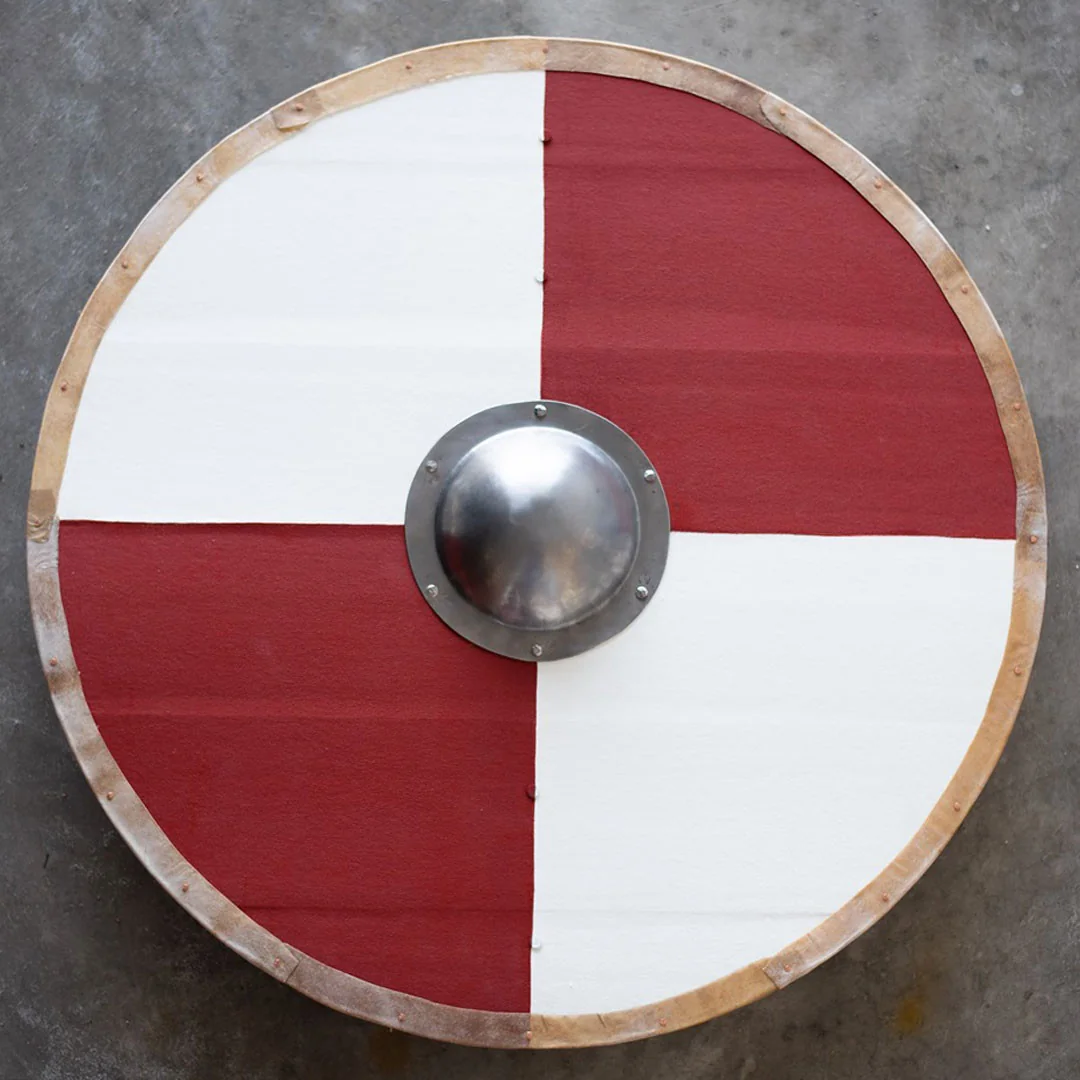
The Viking round shield is one of the most recognisable Norse artefacts and one of the most consistently misrepresented. Popular imagery shows it as a heavy, almost armour-plated disc, sometimes nearly the height of its bearer. The archaeological evidence shows the opposite: the Viking shield was a relatively light, relatively thin wooden disc, designed for active defence rather than passive absorption, and used by a fighter who moved his shield rather than hiding behind it.
Construction
A Viking shield is built from edge-glued planks of light wood — most commonly lime (linden), but also willow, fir, and occasionally alder. The planks are arranged in parallel and glued at their edges, then planed flat to produce a disc 6 to 10 millimetres thick. The face is then covered with a thin sheet of rawhide or thin leather, glued and tacked in place, which holds the planks together as a single unit and prevents splitting under impact. The rim is bound, either with rawhide or with a thin iron edging.
The centre of the disc is pierced for the hand-grip. A round iron boss — typically 15 to 18 centimetres in diameter, hemispherical or dome-shaped — is nailed over the hole, providing protection for the wielder's hand and a domed striking surface that can also be used offensively. Behind the boss, on the inside face of the shield, a horizontal wooden handle runs the full diameter of the disc, glued and pegged in place. The wielder holds this handle with a single hand, balanced through the boss.
Diameters varied from approximately 70 to 95 centimetres, with most surviving fragments suggesting a typical size of 80 to 90. Total weight: typically 2.5 to 4 kilograms, depending on size and construction. This is light. A Viking shield can be held at arm's length for an extended period without fatigue, and swung actively to intercept blows.
- TypeRound centre-grip wooden shield
- OriginNorse
- In Servicec. 8th – 11th C. AD
- Diameter70–95 cm (typically 80–90)
- Thickness6–10 mm
- Weight2.5–4 kg
- MaterialLime / willow / fir planks; hide facing; iron boss
- Primary UseActive deflection; shield wall component
Active defence
The Viking shield is centre-gripped, in contrast to the strapped shields of the Roman scutum tradition that came before and the kite shields of the medieval knight that came after. The strap-grip shield is held against the body and used as a wall; the centre-grip shield is held away from the body and used as an interceptor. A skilled Viking shield-fighter actively moves his shield to meet each incoming blow, deflecting rather than blocking, swinging the shield's mass through the boss to redirect force away.
This is fundamentally a different tactical philosophy. The Roman with his scutum could be hit by something heavier than himself and stand his ground — the shield, strapped to his arm, did the work. The Viking with his round shield could not afford to take blows passively — the disc was too thin to absorb a heavy strike. He had to meet each blow on the angle, deflect it, and move on. His footwork mattered as much as his shield-work.
The shield wall
The Norse shield wall — the skjaldborg, "shield-fortress" — was a real formation, but it was looser and more flexible than its Roman or Greek counterparts. Warriors stood shoulder to shoulder with their shields overlapping perhaps a third of their diameter. They remained mobile individual fighters rather than the wall-as-single-unit of the legionary line. When the formation closed with the enemy, individual men were already pivoting, deflecting, striking past their neighbours' shields. The shield wall was a position, not a posture.
Saga accounts describe shield walls of dozens or hundreds of warriors, with reserve ranks behind ready to step into the line as men fell. The wall could shuffle forward in step, hold ground, or break apart into independent fighting groups depending on what the engagement demanded. It was not a Greek phalanx. It was a flexible shoulder-to-shoulder infantry line of individual fighters.
Paint and display
Viking shields were painted. Solid colours — black, red, yellow, white — divided into halves or quarters by the iron boss were the commonest pattern. The famous Gokstad ship burial in Norway, dating to around 900 AD, preserved 64 round shields hung along the gunwales of the ship: painted alternately yellow and black, arranged for visual effect along the rail. The iron bosses had been removed before deposition, suggesting either that the shields were a display piece (not meant to be used in combat aboard the buried ship) or that the bosses had been deliberately stripped as part of the burial ritual.
Saga sources mention more elaborate painted devices — beasts, runes, geometric designs — but the archaeological evidence for these is thin. Most shields were probably plain or in simple colour blocks. Heraldry in the medieval sense did not yet exist.
Decline
The Viking round shield disappeared with the Viking Age. By the 11th and 12th centuries, the kite shield — long, narrow, designed to protect a mounted warrior's leg as well as torso — had displaced the round form across most of Europe. The change reflects the rising importance of cavalry: a horseman needed a shield shaped for his side and his stirrup, not for his shoulder. The infantry shield wall remained a feature of medieval warfare for centuries afterwards, but its shields were rectangles or kites, not the simple round disc the Vikings had carried for three hundred years.