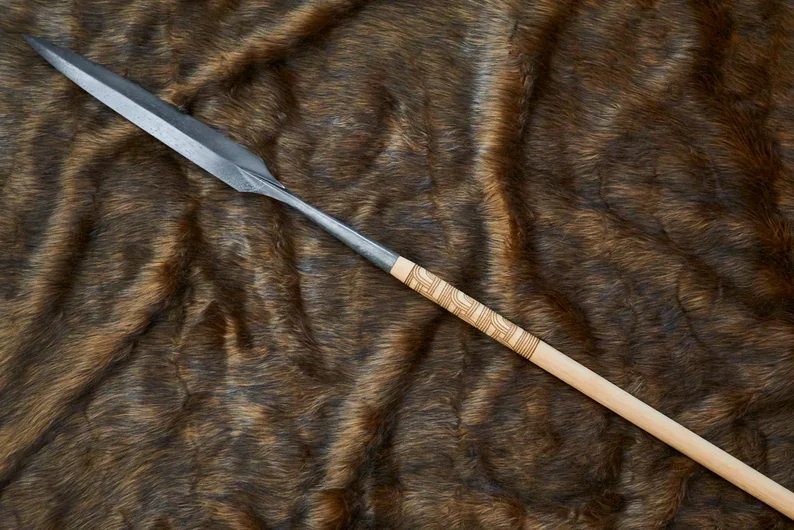
The spear was the bread-and-butter weapon of the Viking Age. Cheaper than a sword, more versatile than an axe, lethal in formation, and theologically charged in a way no other Norse weapon was — the spear is what most Vikings actually carried into combat.
Form and construction
A Viking spearhead is a forged-iron leaf or lozenge shape, typically 20 to 50 centimetres long, with a sharpened point and two cutting edges down its length. Most heads are socketed — that is, the base of the head is formed into an open cone that slides over the end of the wooden haft and is secured with rivets or nails through the socket walls. The haft is ash, sometimes hickory or oak, 180 to 250 centimetres long and around 25 millimetres thick.
A few prestige spears survive with elaborate decoration. The socket might be inlaid with silver wire in interlace patterns, or the blade might be pattern-welded in the style of contemporary sword blades. A pattern-welded spearhead was a deliberate status statement: a weapon nominally for the front rank, carried by a man who could have afforded a sword and chose to display his wealth this way instead.
In the shield wall
The spear's role in formation was straightforward. Two ranks of spear-armed warriors could deploy weapons at once — the front rank thrusting overhand or underhand, the rear rank reaching past them to extend the line of points another metre forward. The combined reach made a Norse spear-line nearly unbreakable from the front: any attacker had to pass three or four spearpoints before he could reach a man with a sword or axe.
The thrust was usually underhand, with the haft tucked under the elbow and the spear held parallel to the ground. This grip kept the point steady, used the wielder's body weight to drive it forward, and freed the shield arm to defend. Overhand grips were used at closer range and against opponents pressed in tight, where the downward angle of attack could find gaps in defensive postures.
- TypeThrust spear (also thrown)
- OriginNorse / universal
- In ServiceEntire Viking Age
- Haft Length180–250 cm
- Head Length20–50 cm
- Weight~1.0–1.5 kg
- MaterialIron head, ash haft, sometimes silver-inlaid socket
- Primary UseFormation thrust, opening cast, ritual offering
Thrown and ritual
The Viking spear was a thrown weapon as well as a thrust one. Lighter spears — or any spear in a pinch — could be hurled at the opening of an engagement, and a substantial spear thrown with full force at 15 to 20 metres could pierce a shield and the man behind it. Many shield-wall engagements opened with a volley of thrown spears before the formations met.
The ritual significance was inseparable from the practical. Norse tradition held that battles should open with a thrown spear cast over the enemy line, dedicating them to Odin — who hung pierced on the world-tree Yggdrasil by his own spear, Gungnir, in the great myth of self-sacrifice. The cast was both tactical (one more missile thrown at the enemy) and theological (one more sacrifice promised to the war-god). The two purposes were not separable; the Vikings did not separate them.
Odin's own spear, Gungnir, is the central weapon of Norse cosmology. It never missed its target. It returned to his hand after every cast. Oaths were sworn upon it. Norse stone carvings of Odin almost always show the spear, often more prominently than the god himself. Every Viking spear was, in some small symbolic sense, an echo of Gungnir.
What it cost
A spearhead was the cheapest substantial iron weapon a man could own. The forging required less skill than a sword, less material than a Dane axe, and produced an effective weapon. A young man's first weapon, in many sagas, is a spear his father gives him at coming-of-age. The spear is the weapon of the freeman, the way the sword is the weapon of the chieftain — and the way the bow, in many neighbouring cultures, was the weapon of the conscript.
Decline
The spear did not decline with the Vikings. It carried on, unbroken, into the medieval period and far beyond. The high-medieval lance, the late-medieval pike, the early-modern halberd, the 19th-century bayonet — all are descendants of the same simple weapon. The Viking spear was a fully solved design by the year 800, and the next thousand years of European infantry simply kept refining it.