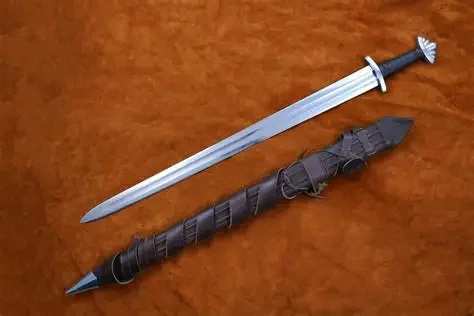
The Viking sword was not a Norse invention. It was inherited — descended from the late Roman spatha through the Germanic peoples of the Migration period — and the Vikings took an existing form and made it the most recognizable elite weapon in early medieval Europe. They did not change the geometry much. They changed what owning one meant.
Form and typology
The standard Viking sword is straight, double-edged, around 80 to 100 centimetres in total length, with a blade of 70 to 85 centimetres and a shallow central fuller that runs most of the blade's length. The hilt is short — meant to be gripped with one hand — with a simple straight crossguard and a pommel that varies enormously from sword to sword. The blade is for cutting first and thrusting second; the point is rounded enough that a thrust is awkward, but the long edges and the weight balance close to the hand make for fast, decisive cuts.
In 1919 the Norwegian archaeologist Jan Petersen classified the swords found in Viking graves into 26 types lettered A through Z, plus several special types, based entirely on hilt geometry. The system is still used. Different hilts came in and out of fashion across the Viking Age — Type H is the early classic, Type S the late prestige form — but the blade beneath the hilt stayed remarkably consistent. A swordsmith was making the same blade in 1050 that his great-grandfather had made in 850. He was making it for a different kind of hilt.
- TypeDouble-edged straight sword
- OriginNorse (descended from Roman spatha)
- In Servicec. 8th – 11th C. AD
- Total Length80–100 cm
- Blade Length70–85 cm
- Weight~1.0–1.5 kg
- Blade MaterialPattern-welded steel; later crucible steel (Ulfberht type)
- Primary UseElite warrior weapon, cut and thrust
Steel and the Ulfberht question
Most Viking swords were pattern-welded — bars of iron and softer steel twisted, forge-welded together, and surface-etched to reveal flowing patterns along the blade. The technique was both functional and decorative. The combined materials gave the blade resilience that monolithic iron lacked, and the patterns identified the smith.
Beginning in the 9th century, a separate tradition appears in the record: blades of homogeneous high-carbon crucible steel, vastly superior to pattern-welded iron, marked with the inlaid inscription +VLFBERH+T or close variants. The Ulfberht swords are one of the great archaeological puzzles of the early Middle Ages. Modern metallurgical analysis shows that the genuine examples are made from a steel whose chemistry matches crucible steel originally produced in Central or South Asia. The blades were almost certainly forged in Frankish workshops — somewhere along the Rhine — from imported ingots that came up the Volga trade route. They were then exported throughout Europe, and the Vikings, who could afford them, bought them in quantity. Counterfeit Ulfberhts also exist, with the inscription mis-spelled or wrongly placed and the steel ordinary; the brand was being faked within decades of its appearance.
What it cost
A good Viking sword was extraordinarily expensive. Saga sources and law-codes price a sword somewhere between a small farm and a substantial herd of cattle. Most Vikings never owned one. The spear and the axe were the weapons of the ordinary warrior; the sword was for the chieftain, the king's húskarl, the wealthy raider. A sword in a grave is one of the surest archaeological signals of high status.
Swords were also named — Sköfnung, Tyrfing, Leg-biter, Quern-biter — and inherited across generations. A famous sword had a personality, a history, sometimes a curse. Owning one connected a man to the warriors who had owned it before him. This is a different relationship to a weapon than the Roman legionary had with his gladius; the gladius was kit, the Viking sword was kin.
Legacy
The Viking sword shaped what came after. The Norman knights who fought at Hastings in 1066 carried weapons that were essentially Viking swords with slightly longer crossguards. The high-medieval arming sword is a direct descendant. The form survived, with continuous refinement, into the late Middle Ages, by which time it had become a knightly weapon recognizable on either side of the English Channel. The pattern was set in the longhouses of the 9th century, and most of it never had to change.