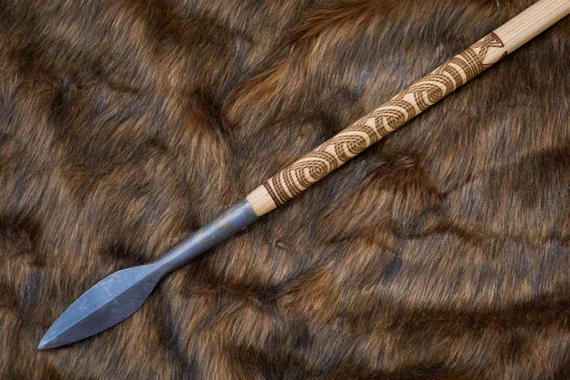
The throwing spear — Old Norse skotspjót, literally "shot-spear" — is the lighter cousin of the heavy Viking thrust-spear. The Vikings considered it a distinct weapon: shorter, lighter, balanced differently, and intended for hurling rather than thrusting. A warrior who could afford both carried both: a heavy spear for the formation, a quiver of light throwing spears for the cast that opened the engagement.
Built for the throw
A throwing spear is a precision instrument. The iron head is smaller and narrower than that of a thrust spear — 15 to 25 centimetres long, with a long tapered profile designed for deep penetration rather than wide wound channels. The haft is shorter — 150 to 200 centimetres against the thrust-spear's 180 to 250 — and the whole weapon weighs less, typically 0.6 to 1.0 kilograms.
The balance point sits slightly forward of the centre, which makes the spear stable in flight but not so head-heavy that range suffers. With practice, an effective casting range of 25 to 30 metres was achievable with reasonable accuracy. Greater ranges, up to perhaps 50 metres, were possible with reduced accuracy and against massed targets — a shield wall, a ship's deck.
Lighter throwing spears were sometimes flighted with small fletchings or leaf-shaped fins at the base of the haft, although surviving examples are rare. The Old Norse darraðr (literally "the dart") may have referred to either a small fletched javelin or to throwing spears generally; the terminology is not entirely settled.
- TypeThrowing spear (javelin)
- OriginNorse
- In ServiceEntire Viking Age
- Haft Length150–200 cm
- Head Length15–25 cm
- Weight0.6–1.0 kg
- Effective Range25–30 m (accurate), up to ~50 m at reduced accuracy
- Primary UseOpening volleys, naval combat, ritual cast
Opening the engagement
The throwing spear's primary use was the opening of land combat. As two shield-wall formations closed to within 30 metres of each other, the front ranks would cast spears — sometimes one volley, sometimes a few — at each other before the lines met. The thrown spear's purpose was not necessarily to kill, although it sometimes did; the purpose was to wound, to unbalance, and above all to disable shields. A spear lodged in a wooden shield is a problem for the man behind that shield: the head is hard to extract, the heavy haft trails forward and downward, and the shield becomes unwieldy at exactly the moment the wielder needs it most.
A skilled spear-thrower opening a fight might cast three or four spears in quick succession, each aimed at a specific opponent's shield rather than his body. A few crippled shields in the enemy line could open gaps that the next moments of combat would exploit.
Naval combat
Throwing spears were even more important in naval combat than on land. Two longships locked together — by grappling lines, by the chaos of a head-on collision, or by deliberate boarding action — fought their first minutes as a missile exchange. Bows fired arrows across the gap; spears were thrown across the gap; rocks, fragments of broken oars, and anything else weighable were hurled across the gap. Only once one ship's crew was demonstrably depleted did the survivors close to melee on the decks.
Norse longships carried bundles of throwing spears in the bilge — twenty or thirty per warrior was not unusual on a long raid. A single ship might cast hundreds of spears in an extended sea-fight. The Battle of Svolder in 1000 AD, where King Olaf Tryggvason's flagship Long Serpent fought against the combined Danish-Swedish-Norwegian fleet, was a missile-exchange engagement in its opening hours before becoming a deck-by-deck boarding action.
Ritual cast
The throwing spear inherited the heavy spear's ritual significance. The opening cast over the enemy line — dedicating them to Odin before the fight — was usually performed with a light throwing spear, since the cast had to clear the entire enemy formation. The act preserved the link to Odin's myth: the god who had hung pierced on the world-tree by his own spear was also the god to whom enemy soldiers were now being given by the same act.
A Viking commander opening a battle with a thrown spear was performing a ritual at the same time as he was performing tactics. The two activities were one activity.
Decline
Throwing spears persisted across the early Middle Ages but were progressively displaced — first by the rising prominence of the war bow, which provided more shots per warrior and longer effective range, and later by the medieval crossbow. By the 13th century, the dedicated throwing spear had effectively disappeared from European battlefields. The bow had won the missile-weapon competition, and the spear retreated permanently to its thrust-only role, where it would remain until the bayonet replaced it.