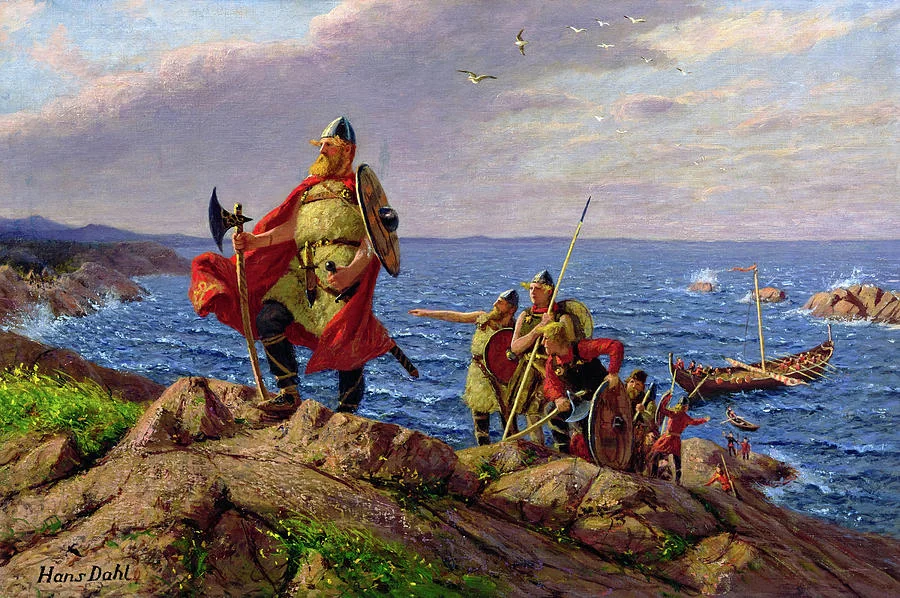
The Viking Age conventionally begins on June 8, 793, when Norse raiders attacked the monastery of Lindisfarne off the coast of Northumbria, and ends on the day after Stamford Bridge in 1066, when the last great Norse invasion of England ran into Harold Godwinson and the era closed. In between sit nearly three hundred years in which Norse warriors, traders, and settlers ranged from Newfoundland to Constantinople, from Spain to the upper Volga. The weapons they carried built that range, and they did it not through technological superiority but through institutional and cultural fit between the warrior, the weapon, and the work.
A society organised for war
Norse society was decentralised, land-poor, and oriented around the household, the ship, and the assembly. There was no standing army. There were no state arsenals. Every adult free man was expected to own his own weapons and to come when the local chieftain called. The result was a militia culture spread across thousands of farms, where any household might at any moment field two or three armed men with their own axes, spears, and shields. War was not an occupation in Viking society. It was a periodic obligation of free men, undertaken alongside farming, fishing, and craft work.
The longship and the raid
The defining technology of the Viking Age was the longship — a shallow-draft, clinker-built, oared and sailed vessel capable of crossing open sea, navigating river systems, and beaching directly on a foreign shore without a port. The longship made the Viking raid possible. A handful of ships carrying eighty or a hundred men could cross the North Sea, strike at an undefended monastery or town, take what they could carry, and be back at sea before any local force could be mustered. The weapons that mattered most were the ones that fit in a longship and could be used in the cramped, ugly fighting that happened on its decks: the spear, the hand axe, the round shield, the bow.
From raid to conquest
The simple raid was the Viking economic model for the first century of the era. By the 9th and 10th centuries, the model expanded. Raiding gave way to extortion (the Danegeld), to settlement (the Danelaw, Iceland, Greenland), and eventually to wholesale conquest (Cnut's North Sea Empire, the Norman conquest of England, the Norse foundation of the Kievan Rus'). The weapons changed with the work. The light, fast equipment of the early raid gave way to the heavier kit of the conquering army — the mail hauberk, the Dane axe, the spectacle helmet — even though the cheap spear and the universal hand axe remained the bedrock of every Norse force.
What we have, what we know
The archaeological record for Norse weapons is strong because of one cultural fact: the Vikings buried their dead with their weapons. Thousands of weapon graves across Scandinavia, the British Isles, Iceland, the Baltic, and the Volga route have preserved the kit of the Viking-age warrior in detail. We know what they actually carried, in what combinations, with what frequency. The image of the Viking that emerges from the graves is not the sword-and-mail elite of popular imagination. It is the spear-and-axe freeman, with a round shield if he could afford one and a knife at his belt either way. The elite kit existed and is well represented in chieftains' burials. But the ordinary Viking went to war as a farmer with iron tools that could also kill, and most of the killing was done by those tools.