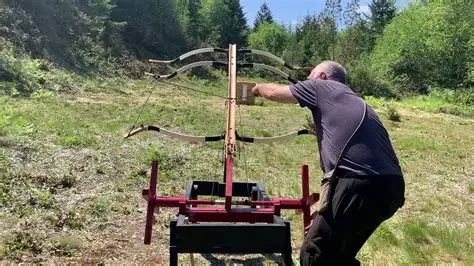
The chuangzi nu — literally "bed crossbow," from the bed-like wooden frame on which it was mounted — was the heaviest crossbow ever fielded in any significant numbers by any army in the pre-gunpowder world. The largest forms used three composite bows mounted in series on a single stock, required winch mechanisms to draw, and fired bolts the size of spears. They could put those bolts through stone walls at ranges that out-reached every other ranged weapon of the era. And they were responsible, by most accounts, for one of the most consequential single weapon-kills in world military history.
A scaled-up crossbow
The basic principle of the chuangzi nu is just the principle of the hand crossbow, scaled up by an order of magnitude. The smallest forms used a single very heavy bow on a long stock; the standard forms used two or three bows in series, with the bowstrings linked so that all bows release together. Drawing the assembly required mechanical advantage — typically a windlass or winch — operated by a team of three to seven soldiers. Loading and firing a chuangzi nu took several minutes per shot.
What you got for those several minutes was a projectile that no other weapon could match. A standard chuangzi nu bolt was a wooden shaft three to five feet long, sometimes tipped with iron, sometimes simply iron throughout. It could travel a thousand meters at the longest ranges, and could be reliably aimed for tactical engagement at about half that. At impact, it carried enough kinetic energy to pin two armored soldiers together, knock down a wooden tower, or punch holes in stone fortifications.
- TypeFrame-mounted siege crossbow
- OriginHan Dynasty China
- In Servicec. 1st C. BC – 13th C. AD
- ConfigurationSingle-, two-, or three-bow versions
- Crew3–7 soldiers per engine
- Bolt3–5 ft, wood with iron head, or all-iron
- RangeUp to 1,000 m; effective ~500 m
- Primary UseLong-range siege fire and counter-battery
Deployment
The chuangzi nu was both a defensive and an offensive siege weapon. Mounted on city walls, it gave defenders the ability to reach attacking siege engines from outside their effective range, picking apart trebuchets and siege towers before they could be brought close enough to function. Mounted on offensive siege platforms, it allowed besiegers to engage defenders on city walls at distance, suppressing the defenders' fire while infantry and engineers prepared an assault.
The standard Tang and Song military manuals describe deployments in batteries of three to twelve chuangzi nu, often interleaved with traction trebuchets, with each battery firing in rotation to maintain continuous pressure on a fixed point of the wall. A coordinated siege might field thirty or forty chuangzi nu in addition to perhaps a hundred traction trebuchets. The chuangzi nu was not a mass weapon — there were not many of them — but it was the longest-range pre-gunpowder weapon any army of its era could field.
The death of Möngke Khan
On July 21, 1259, the Mongol Great Khan Möngke — fourth supreme ruler of the Mongol Empire and grandson of Genghis Khan — was outside the walls of Diaoyu Fortress on the upper Yangtze River, personally directing the siege of one of the last major Southern Song strongholds in Sichuan. According to several Chinese sources and the official Yuan history compiled by Möngke's own descendants, he was struck by a bolt fired from a chuangzi nu mounted on the fortress walls. He died within days.
The geopolitical consequences of this single weapon-impact were almost incalculable. Möngke's death triggered a succession crisis in the Mongol Empire. His brother Hulagu, who had been campaigning in the Middle East, was forced to halt his advance and return east to participate in the succession struggle — leaving only a token force in the Levant. That force was defeated at the Battle of Ain Jalut by the Egyptian Mamluks in September 1260, stopping the Mongol expansion westward into the Mediterranean world. Another brother, Kublai, eventually emerged as Great Khan after years of civil war, but he ruled a fractured empire. The unified Mongol war machine that had nearly conquered Europe and the Middle East simply never reconstituted.
Modern historians treat the chuangzi nu story with some caution. Other accounts of Möngke's death attribute it to dysentery or cholera, both common in 13th-century military camps. But the chuangzi nu narrative is the official one in Chinese sources, and it is at least plausible: a Khan close enough to the walls to direct the siege personally would have been within the chuangzi nu's effective range.
If true, it would mean that a single Chinese siege crossbow bolt halted the largest contiguous empire in human history at the height of its expansion. It is the kind of event that the modern term "decisive engagement" was invented to describe.
Sunset
The chuangzi nu's military relevance ended with the introduction of gunpowder cannon. The largest forms continued to be made, and used, into the early Ming dynasty, but a cannon could deliver more energy more reliably at longer range, with shorter reload times, and with better accuracy. By the 16th century the chuangzi nu had been retired from regular service.
It survives now in archaeological reconstructions, in Chinese military manuals like the Wujing Zongyao, and in the historical memory of one summer afternoon in 1259, when a Sichuan garrison fired a bolt that may have changed the shape of the world.