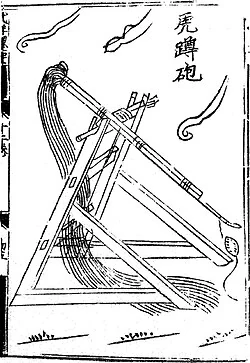
The traction trebuchet is one of those Chinese inventions that the broader world has never quite given proper credit for. It is the original trebuchet — the form from which all later trebuchets descend, including the great counterweight engines of the European middle ages — and it predates the European counterweight trebuchet by approximately fifteen hundred years. From its first appearance in the Warring States period until the 13th century AD, it was the standard heavy siege weapon of every Chinese army that fought serious sieges, which is to say, every Chinese army.
How it worked
The traction trebuchet is mechanically simple. A long wooden throwing arm is mounted on a horizontal axle, like a seesaw, with the axle placed asymmetrically along the arm. The short end of the arm carries a set of ropes — often dozens of them — that hang down to ground level. The long end carries a sling, which holds the projectile.
To fire, a team of soldiers — anywhere from a dozen to over a hundred, depending on the size of the engine — grabs the ropes on the short end. On command, they pull down sharply and in unison. The short end whips toward the ground; the long end swings up and over; the sling at the long end releases at the top of its arc, hurling the projectile in a high arcing trajectory at the target.
The whole motion takes about four seconds. The team relaxes, the throwing arm is reset, a fresh stone is loaded into the sling, and the cycle begins again. A practiced crew could fire a traction trebuchet every fifteen to thirty seconds — much faster than any counterweight trebuchet, though with significantly less range and power.
- TypeLever-arm siege engine, manpower-pulled
- OriginWarring States China
- In Servicec. 4th C. BC – 13th C. AD
- Crew12–100+ soldiers per engine
- ProjectileStone (50–250 lb typical)
- Range~75–125 m
- Rate of Fire~2–4 shots per minute
- Primary UseSustained battering of city walls
Why it dominated Chinese siegecraft
The traction trebuchet was the right siege engine for the kind of sieges China actually fought. Chinese walls were typically rammed-earth or compressed-clay structures, ten to thirty feet thick, faced with brick or stone. They were vulnerable to two things: sustained battering that gradually fractured the facing and undermined the structure, and incendiaries that ignited the wooden gates and roof timbers above.
The traction trebuchet excelled at sustained battering. Where a counterweight engine could throw enormous stones great distances at slow intervals, a traction engine threw moderately-sized stones at moderate distances at high tempo. A single counterweight throw might do more damage than a single traction throw, but four traction throws in the time of one counterweight throw added up to more total damage to a wall. For Chinese walls, the trade-off favored tempo.
The traction engine also had a manning advantage. Counterweight trebuchets, once introduced to China, required complex wooden machinery and skilled engineers to maintain and operate. Traction trebuchets needed only the throwing arm, the axle, the ropes, and a crew. A Chinese army could conscript labor from a captured town and have a traction battery firing within hours.
Diffusion westward
The traction trebuchet traveled west out of China along the Silk Road, reaching the Byzantine Empire by the late 6th century AD via the Avars — nomadic intermediaries who had encountered it in Central Asia. The Arabs adopted it from the Byzantines by the 7th century, and used it extensively in the early Islamic conquests. From the Arabs it spread into Sicily, Italy, and Western Europe by the 9th and 10th centuries. The Crusader siege engines of the 11th and 12th centuries — almost all of them, before the development of the counterweight form — were traction trebuchets of recognizably Chinese ancestry.
The European counterweight trebuchet that followed in the 12th century was itself heavily influenced by Arab and Byzantine refinements of the original Chinese design.
Sunset
The traction trebuchet was eventually displaced in China itself by the counterweight version — and not by domestic invention but by foreign import. The Mongols, during their long campaign against the Southern Song in the 13th century, used Persian and Arab engineers to construct counterweight trebuchets — known in Chinese sources as the huihui pao, the "Muslim trebuchet" — at the siege of Xiangyang in 1268–1273. These were the engines that finally cracked the Song defenses. After Xiangyang, the counterweight trebuchet became the standard heavy siege engine in China, and the traction form retreated to lighter and faster-fire applications.
Within a century or two, gunpowder cannon would displace both forms. But for fifteen hundred years, the traction trebuchet was what Chinese armies used to break walls — and for nearly that long, it was what most of Eurasia used too, even if Eurasia never quite knew where it came from.