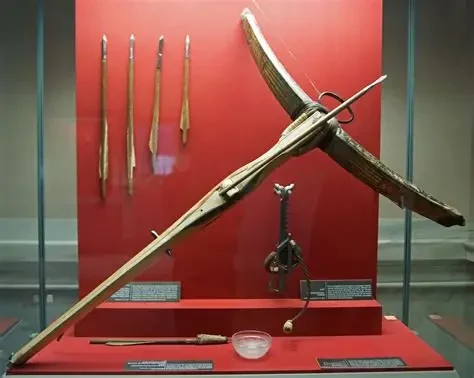
The Chinese crossbow is one of the most underrated weapons in world military history. By the time the Han dynasty was a century old, the Chinese state was issuing standardized crossbows to its armies in quantities, and to a precision, that no other ancient society approached. Western European militaries would not match Chinese crossbow production until at least the 12th century AD, and would not match the standardization until much later than that.
Origins
The crossbow appeared in China during the Warring States period, almost certainly in the 5th or 4th century BC. The earliest surviving examples date to the 5th century BC, and crossbow components — particularly the distinctive bronze trigger mechanism — are found in increasing quantities at sites from the 4th century onward.
The decisive early use came at the Battle of Ma-Ling in 341 BC, where the state of Qi famously defeated the state of Wei by ambushing their forces with massed crossbow fire in a narrow defile. Sun Bin, the Qi commander, had read the terrain correctly and concentrated his crossbowmen in a position where the Wei infantry could not close to engage. It was the first time massed crossbow fire is recorded as having won a major battle, and it would not be the last.
- TypeMass-issue military crossbow
- OriginWarring States China
- In Servicec. 5th C. BC – 17th C. AD
- Draw Weight~150–600 lb (varied by class)
- Effective Range~200–300 m
- TriggerStandardized bronze three-piece mechanism
- BoltBronze or iron, 8–14 in
- Primary UseMassed volley fire against infantry and cavalry
The bronze trigger
The most remarkable feature of the Han military crossbow was its trigger mechanism. The Han crossbow trigger is a sophisticated three-piece bronze assembly, with internal angles and tolerances calculated to give a smooth, predictable trigger pull while holding back the full draw weight of the bow. Modern measurements of surviving Han triggers show interchangeable parts to within fractions of a millimeter — across crossbows produced in different state armories, separated by hundreds of miles and decades of time.
What this represents, in modern terms, is interchangeable manufacturing. The Han state imposed standards on its weapons producers that allowed broken triggers to be replaced with parts from any other armory, and crossbows to be repaired by units without specialist craftsmen. European firearms manufacture would not reliably achieve this level of standardization until the 19th century. The Han achieved it with bronze, in the 1st century AD, for crossbows.
Tactical doctrine
The Han military deployed crossbows in massed formations using a rotation system that prefigured the volley fire of much later eras. A crossbow company would be drawn up in three ranks. The front rank fired, then stepped back to reload. The second rank fired, then stepped back. The third rank fired. By the time the third rank stepped back, the first rank was ready to fire again. The result was continuous fire from the formation, at a sustained rate that no archer formation could match without exhausting itself.
This doctrine — recorded in military manuals from the late Warring States onward — was the secret of Chinese success against the steppe cavalry that perpetually threatened the northern frontier. Mounted archers could outshoot Chinese infantry archers; they could not outshoot massed Chinese crossbowmen. A Han crossbow with a sufficient draw weight could put a bolt through nomad cavalry armor at ranges the nomads could not match with their bows.
Legacy
The crossbow remained the standard Chinese ranged infantry weapon for most of the next eighteen hundred years. It was supplanted by gunpowder weapons only gradually, beginning in the Song dynasty and not completing until the Ming. Even then, the crossbow persisted in specialist applications — particularly hunting, and the defense of mountainous regions where firearms supply was unreliable — into the late Qing.
The Chinese crossbow tradition shaped weapons in Korea, Vietnam, Japan, and Central Asia. Its trigger mechanism, in particular, was copied across the Asian continent. The basic Chinese crossbow was a weapon that gave a moderately-trained soldier the killing power of a professional archer, and the consequences for organized infantry warfare were profound.