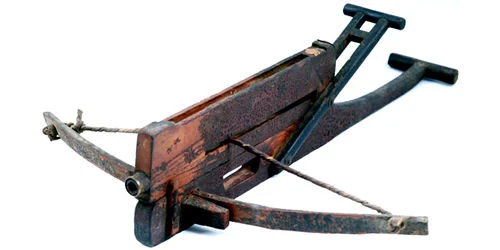
The zhuge nu — literally "Zhuge crossbow," after the great Three Kingdoms strategist Zhuge Liang — is one of the most distinctive ranged weapons in Chinese military history. It is also one of the most misunderstood. Popular imagination has cast it as a kind of ancient machine gun, capable of breaking enemy formations with sustained fire. The reality is more interesting and more limited. The zhuge nu was a low-power repeating crossbow, designed for rapid area suppression rather than penetrating fire, and its tactical role was much narrower than its reputation suggests.
How it worked
The mechanism is elegant. A wooden magazine sits above the firing channel, gravity-feeding bolts one at a time as the operator works a lever. The lever's forward stroke draws back the string and aligns a fresh bolt; the backward stroke releases the bowstring and fires. A trained operator could empty a ten-bolt magazine in fifteen seconds, then reload the magazine in another fifteen.
The trade-off was draw weight. To allow rapid lever operation by a single soldier, the zhuge nu used a much lighter bow than a standard military crossbow — typically a draw weight of forty to eighty pounds, compared to the two hundred to six hundred pounds of a proper Han military crossbow. The bolts were correspondingly lighter. At realistic combat ranges, the zhuge nu could wound an unarmored soldier reliably, but it could not penetrate even modest armor. Some accounts mention coating the bolt tips with poison, partly because the bolts themselves were not relied upon to kill on impact.
- TypeMagazine-fed repeating crossbow
- OriginWarring States / Three Kingdoms China
- In Servicec. 3rd C. AD – 19th C. AD
- Draw Weight~40–80 lb
- Magazine8–12 bolts, gravity-fed
- Rate of Fire~10 bolts in 15 seconds
- Effective Range~50–80 m
- Primary UseSuppressive defensive fire; close terrain
The attribution
The "Zhuge" in zhuge nu refers to Zhuge Liang (181–234 AD), the celebrated Shu Han chancellor and military strategist of the Three Kingdoms period. The Records of the Three Kingdoms credits him with inventing or significantly improving the repeating crossbow, and the name has stuck for the better part of two thousand years.
Modern scholarship treats the attribution skeptically. Repeating crossbow components have been recovered from sites that predate Zhuge Liang by several centuries — most notably a Warring States-period tomb in Hubei that yielded a mechanism functionally identical to the canonical zhuge nu, several hundred years before the man it is named after was born. What Zhuge Liang may legitimately have done is standardize, popularize, or improve the weapon's manufacture; the basic concept was already old.
Tactical role
The zhuge nu found its real niche in two specific contexts: defending fortified positions and providing close-range area fire in jungle or mountainous terrain. In a defensive role, the rate of fire mattered more than penetration: a wall of repeating crossbows could keep an attacking column under continuous fire from arrow slits and parapets, regardless of armor. In broken terrain, the short effective range of the weapon was less of a handicap than it would have been on open ground.
Chinese sources from the Song through Qing dynasties continue to list the zhuge nu among issued weapons, particularly for garrison forces in southern and southwestern China. It remained in service longer than almost any other crossbow design — long enough that, during the First Sino-Japanese War of 1894–95, Chinese militia in some southern regions reportedly carried zhuge nu alongside their firearms. A weapon designed in the Warring States period was still being carried in anger when the first commercially-produced automobiles were rolling off European assembly lines.
Legacy
The zhuge nu's place in modern memory is outsized relative to its actual military impact. It captures the imagination because it looks, to a modern eye, like an ancient anticipation of automatic weapons — and because its association with Zhuge Liang, one of the most romanticized figures in Chinese history, attaches it to the great storytelling tradition of the Three Kingdoms.
Mechanically, the zhuge nu does represent a real and important innovation: a magazine-fed, lever-operated, repeating projectile weapon, in mass production, eighteen hundred years before similar mechanisms appeared in firearms. The fact that it never crossed the gunpowder threshold means it is rarely cited in the development of repeating arms; but the engineering principles, in their pre-gunpowder form, are recognizably ancestors of what would eventually become the lever-action rifle.