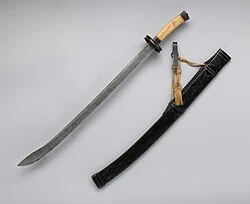
By the time the Han dynasty was a century old, the jian — long the scholar's sword — was no longer what Chinese soldiers carried into battle. They carried the dao: a single-edged, curved or slightly-curved saber that was easier to make, easier to learn, easier to use from horseback, and more forgiving of imperfect technique. The dao would remain the standard military sword of China for the next two thousand years, and would seed almost every other Asian saber tradition along the way.
A simpler sword
The dao's design is straightforward. A single-edged steel blade, typically with a slight to moderate curve, mounted to a short hilt. The back of the blade carries weight and structural strength; the curved cutting edge does the work. Where the jian rewarded precise blade-angle work, the dao rewarded committed cuts at full extension — a much simpler motion to drill into conscript troops.
Early dao were nearly straight, descended from earlier Bronze Age Chinese knives and the ringed-pommel huandao that became standard issue under the Han dynasty. Han-era huandao were exported across Asia: surviving examples have been found from Korea and Japan in the east to Central Asia in the west, and the basic form influenced everything from the Korean hwando to the early Japanese chokuto.
- TypeSingle-edged saber, slight to moderate curve
- OriginHan Dynasty China
- In Servicec. 1st C. BC – Present
- Blade Length26–34 in (varies by variant)
- Weight~1.8–2.6 lbs
- Blade MaterialForged steel, often differentially hardened
- VariantsYanmaodao, liuyedao, piandao, niuweidao
- Primary UseSlashing cuts; cavalry and mass infantry
The willow leaf and the goose quill
The dao is not really one weapon but a family of them. The classification system established in the Ming and Qing dynasties named four canonical forms:
The yanmaodao, or "goose-quill saber," with its near-straight blade and slight terminal curve, was the closest of the four to the older Han designs and served as a general military sword. The liuyedao, or "willow-leaf saber," with a graceful overall curve, was the most common form of cavalry and officer's saber from the late Ming through the Qing. The piandao, a deeply-curved scimitar-like blade, was used by specialist troops trained in fast slashing techniques. The niuweidao, or "ox-tail saber," with a heavy, flared tip, was largely a civilian and martial-arts weapon — but it is the form that most Western audiences picture when they hear "Chinese sword," because it features in countless wuxia films.
A democratic weapon
Where the jian remained a weapon of the elite, the dao was a soldier's tool. It could be mass-produced. It could be wielded effectively after a few months of training rather than years. It could be carried by every infantryman in a Han-era column or every Bannerman in a Qing-era one. The dao was, in modern terms, the assault rifle to the jian's competition pistol — less elegant, less prestigious, vastly more militarily useful.
The cultural status reflected the use. The dao never carried the scholarly and spiritual weight of the jian. Chinese poets did not write about their dao. Daoist priests did not perform rituals with one. The dao was for fighting, and that was enough.
Legacy
Almost every Asian saber tradition descends from the Chinese dao. The Japanese chokuto and early tachi developed from imported Han-era huandao. The Korean hwando, the Vietnamese kiem, and the various Mongol and Tibetan sabers all share lineage with the dao or its immediate ancestors. The trade and military contact along the Silk Road carried the form westward as well, and some scholars trace influences in the development of the Turkish kilij and the Arab saif.
The dao itself never went away. It was the standard sidearm of Chinese troops into the early 20th century. Republican-era officers carried dao alongside their pistols. Today the dao remains central to Chinese martial arts, and the willow-leaf form is still produced — for ceremony, for training, and, occasionally, for collectors who want the weapon that two thousand years of Chinese soldiers actually carried.