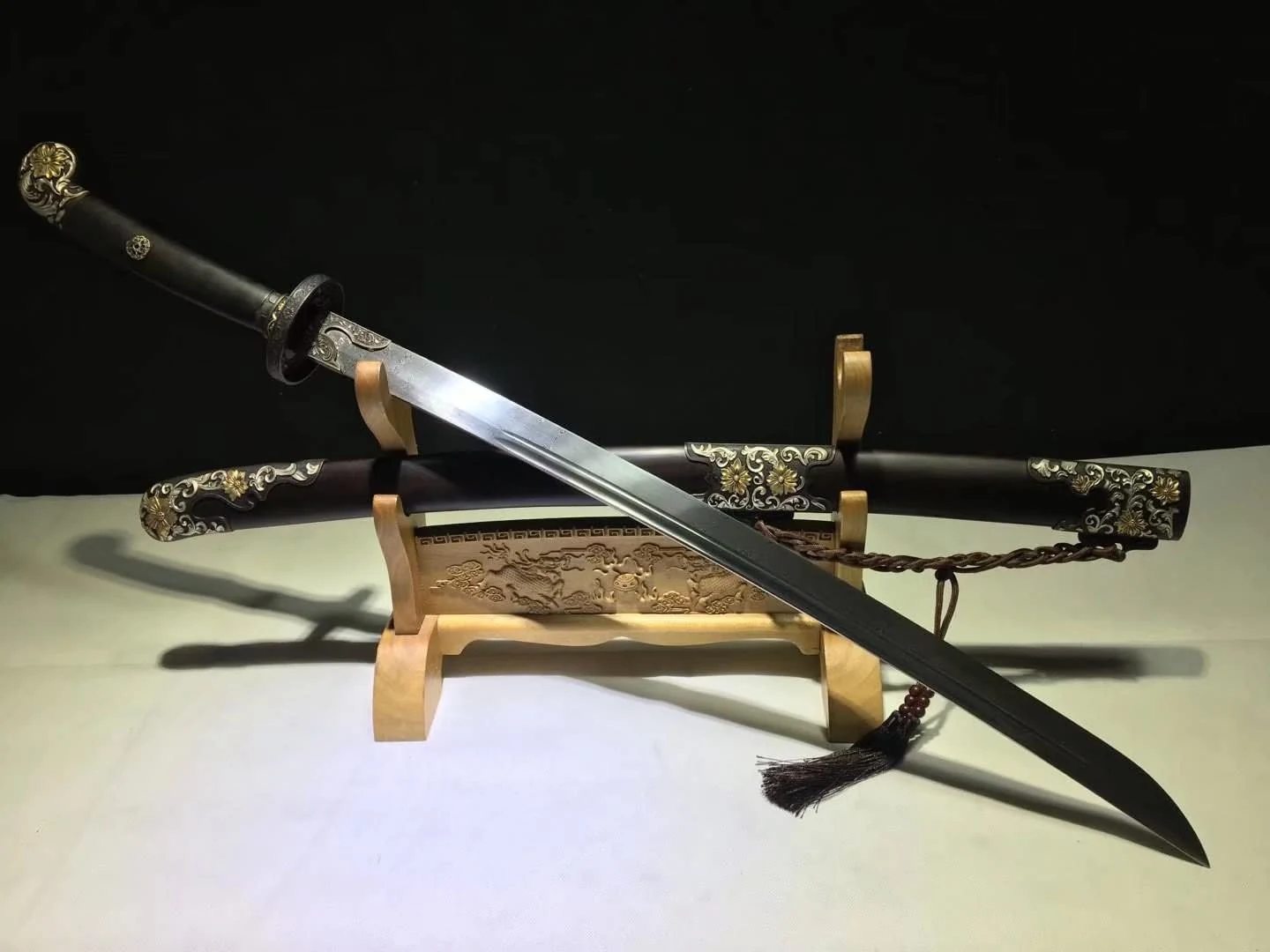
The zhanmadao — literally "horse-cutter blade" — was the Song dynasty's answer to a specific tactical problem: how does infantry stop an armored cavalry charge? The Song military faced this question constantly. To its north and northwest sat the Jurchen Jin dynasty and, later, the Mongol Empire, both of which fielded heavy cavalry that could break Song infantry formations through sheer impact. The standard Chinese answer to cavalry, for two thousand years, had been the crossbow. The zhanmadao was the answer for what happened when the crossbows had already fired and the cavalry was still coming.
Design
The zhanmadao is one of the largest swords ever issued to organized infantry. Total length runs about nine feet — a five-foot blade on a four-foot two-handed hilt. The blade is single-edged, broad, and heavy, with a forward weight that lets it land cuts with the energy of a polearm rather than a sword. It was used in massive downward and side-to-side sweeps, aimed at the legs and chests of charging horses.
The design appears in the Wujing Zongyao, the great Song military manual compiled in 1044 AD under the Emperor Renzong. The manual specifies the dimensions, the construction technique, and the tactical context: zhanmadao units were to be deployed in front of, or interspersed with, pike formations, ready to step out and take the legs from any horse that survived the initial volley.
- TypeTwo-handed anti-cavalry long sword
- OriginSong Dynasty China
- In Servicec. 11th – 13th C. AD
- Overall Length~9 ft
- Blade Length~5 ft
- Weight~6–9 lbs
- Blade MaterialForged steel, heavy single edge
- Primary UseAnti-cavalry — hamstringing and unhorsing
The "Crouching Tiger" formation
The most famous tactical use of the zhanmadao came during the Song-Jin wars of the 12th century. The Song general Yue Fei is credited — by some sources, with some embellishment — with developing the "Crouching Tiger" formation, in which zhanmadao-armed infantry took shelter behind shield walls, then emerged at the moment of cavalry impact to hamstring the lead horses. A horse with severed leg tendons cannot charge. A cavalry charge in which the front rank crashes to the ground stops being a charge.
Yue Fei used the technique successfully at the Battle of Yancheng in 1140, against Jurchen heavy cavalry. The accounts in the official Song histories suggest the zhanmadao was responsible for breaking the Jurchen cavalry advantage, though modern historians read those accounts with appropriate skepticism — Yue Fei was a celebrated patriot and his battlefield exploits attracted the same kind of legendary accretion that surrounded any Chinese hero of similar stature.
A weapon for a specific moment
The zhanmadao was a niche weapon, deployed for a particular tactical problem in a particular period. It required strong, well-trained troops — the size and weight made it useless to a small or fatigued soldier. It required a battlefield with infantry standing behind solid lines, not breaking and running, ready to take the impact of a charge head-on. Outside of those conditions it was an awkward weapon, hard to carry and hard to use.
By the late Song and Yuan dynasties, as cavalry tactics evolved and gunpowder weapons began to appear on the battlefield, the zhanmadao gradually fell out of use. It was never adopted by the Mongol or Ming armies. By the Qing dynasty it survived only in martial arts traditions and as a ceremonial weapon.
Legacy
The zhanmadao left an indirect descendant in the Japanese odachi and nodachi, the great two-handed swords of the medieval Japanese battlefield. The Japanese versions were lighter and more elegant, but the basic concept — a two-handed sword long enough to reach a horse's body from foot soldier height — was almost certainly transmitted from China through trade and warfare with Korea during the Mongol invasions of Japan in the 13th century. The Japanese refined the design. The Chinese had invented it.