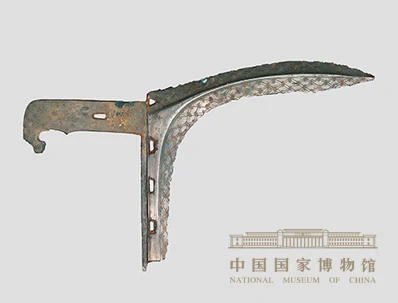
The ge is the weapon that defines the Chinese Bronze Age the way the gladius defines Rome or the spear defines classical Greece. It was the signature infantry weapon of the Shang dynasty and the Western Zhou, and it remained in service, in modified forms, through the Warring States period — nearly fifteen hundred years from first use to obsolescence. More ge have been recovered from Chinese archaeology than any other single category of ancient weapon. They have been found, by the thousands, in tombs, in foundation deposits, in battlefield deposits along the Yellow River. The Shang state issued them; the Zhou state issued them; every state of the Warring States period issued them.
A weapon designed for chariots
The ge consists of a flat, dagger-like bronze blade — typically six to ten inches long — mounted perpendicular to a wooden shaft. The shaft length varied dramatically with the intended use: short ge of three or four feet for infantry, long ge of fifteen feet or more for chariot crews. The blade is sharpened along one long edge, with a sharp point. It is, fundamentally, a hooking weapon.
The tactical context is critical. Shang and Western Zhou warfare was dominated by chariot warfare. A Shang army at full mobilization fielded hundreds of chariots, each carrying a three-man crew: a driver, an archer, and a ge-wielder. As the chariot passed an enemy formation or an opposing chariot, the ge-wielder used the long shaft to hook downward and across, catching enemy soldiers behind the neck or in the back, pulling them off their feet, or slashing them with the blade's leading edge. It was a weapon designed for use at speed, from elevation, against tightly-packed enemy formations.
- TypeBronze dagger-axe (perpendicular blade on a shaft)
- OriginShang Dynasty China
- In Servicec. 16th – 3rd C. BC
- Blade Length6–10 in
- Shaft Length3 ft (infantry) – 15 ft (chariot)
- Blade MaterialCast bronze (Cu-Sn alloy)
- Primary UseHooking and slashing from chariots
Bronze casting and standardization
The Shang state's ability to mass-produce ge in bronze was one of the markers of its administrative sophistication. Shang bronze workshops at sites like Anyang produced ge in standardized molds, with consistent dimensions and alloy compositions, in quantities that imply a centralized military supply system extending across most of the Yellow River basin. The bronze itself — a copper-tin alloy with controlled additions of lead — was a state monopoly. The ability to issue thousands of identical weapons to a field army was, by the standards of the late second millennium BC, a remarkable feat of state capacity.
The transition to ji
By the late Spring and Autumn period, around the 5th century BC, the ge began to be replaced by the ji — a combination weapon that mounted a spear-point on the same shaft as a ge-style hooking blade. The ji could thrust as well as hook, making it more versatile in the increasingly infantry-dominated warfare of the Warring States. For another two or three centuries, the pure ge persisted in ceremonial use and in some regional traditions, but the ji had largely supplanted it as a frontline weapon.
By the time of the Han dynasty, the ge was almost entirely ceremonial — buried in elite tombs as a symbol of military rank, displayed in temples, but no longer carried into battle. Iron weapons had displaced bronze. Infantry tactics had displaced chariots. The weapon system that had won the Shang their empire was an antiquarian curiosity.
Legacy
The ge is the rare ancient weapon that left no direct functional descendant. The hooking-and-slashing role it filled disappeared with the chariot. But its visual influence persisted. Chinese ceremonial halberds, the elaborate stage weapons of opera and martial arts performance, the iconography of military deities — all show the perpendicular-blade silhouette of the ge long after the weapon itself had gone out of use. The Chinese word for "war," zhan, contains the radical for ge. Three thousand years after the weapon left the battlefield, the language still remembers it.