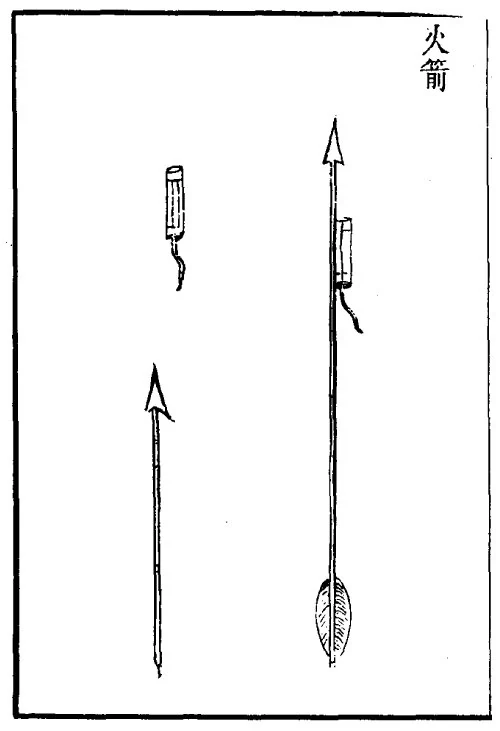
The huo jian — literally "fire arrow" — is the weapon at which Chinese gunpowder development turned a corner. The earliest forms, from the 10th-century Song dynasty, were essentially incendiary arrows: regular arrows with a small packet of burning material attached behind the head, designed to set fire to enemy ships, structures, or grain stores. Within two centuries, however, the same name had come to describe something genuinely new — an arrow propelled by a gunpowder rocket strapped to its shaft. The huo jian had become the world's first rocket-propelled military weapon, and it had founded a technological lineage that runs directly through every rocket ever built, up to and including the ones that put humans on the moon.
The incendiary version
The original huo jian, described in the Wujing Zongyao of 1044, was a wooden arrow with a packet of incendiary mixture attached to the shaft below the arrowhead. The mixture varied — sulfur, saltpeter, charcoal, pine resin, and various oils were standard ingredients. The arrow was ignited just before firing and shot from a bow or crossbow. The intent was to deliver burning material to a target a normal arrow could not, and to make extinguishing it as difficult as possible once it landed.
These incendiary huo jian were used extensively against ships, against tents and wooden buildings, and against grain stores. The famous Battle of Caishi in 1161 — in which a Southern Song fleet defeated a much larger Jin invasion across the Yangtze — relied heavily on huo jian to ignite the Jin transport boats before they could disembark troops. Chinese sources describe Jin ships catching fire by the dozens. The Song victory was, in effect, an early demonstration of the strategic value of incendiary stand-off weapons against an enemy that had not adopted them.
- TypeIncendiary arrow / rocket-propelled missile
- OriginSong Dynasty China
- In Servicec. 10th – 16th C. AD
- VariantsSingle arrow, multi-rocket launcher, multi-stage
- Range~100–500 m (rocket forms)
- Mass-LauncherUp to 32 rockets per huo jian fei jia frame
- Primary UseIncendiary; area suppression; multi-stage attack
The rocket version
Sometime in the 12th or early 13th century, Chinese gunpowder makers crossed a critical threshold. They began producing gunpowder mixtures with proportions suited to slow, controlled burning rather than fast detonation, and packing them into tubes with one end open and the other end attached to a wooden shaft. When the gunpowder was ignited, the gases vented backward out of the open end, and the tube — and the shaft it was attached to — accelerated forward. The huo jian had become a rocket.
By the late Song and the Yuan dynasty, rocket-propelled huo jian were in regular military use. By the Ming dynasty they had become a substantial part of the Chinese arsenal. The Ming military manual Huolongjing, compiled in the late 14th century, describes dozens of variant huo jian and their tactical uses: single-arrow rockets fired from bamboo launchers, racks of multiple rockets fired in volleys, large multi-stage rockets — the huo long chu shui, "fire dragon emerging from water," which carried smaller rockets within a larger rocket body and released them mid-flight — and even crude winged versions intended to glide farther than their unguided counterparts could fly.
The mass-rocket launcher
The most spectacular of the Ming huo jian systems was the huo jian fei jia, a launching frame that held thirty-two or more rockets pointing at slightly diverging angles, ignited together by a single fuse. The frame could be carried by two soldiers and set up in seconds. When fired, it delivered a rolling barrage of rockets across a hundred-meter front, useful both as a terror weapon against enemy infantry and as an incendiary against wooden fortifications and supply trains.
Variants of the mass-rocket launcher remained in Chinese service into the late Ming and were among the weapons most often noted by foreign visitors. The Korean singijeon of the 15th century, used famously by Admiral Yi Sun-sin against Japanese invasions, was a direct adaptation of Chinese huo jian technology. The European interest in Chinese rocket weapons, which reached its peak during the late 18th-century Napoleonic Wars via observations of the Mysorean rockets used by Tipu Sultan against the British in India, traced its lineage through the same Chinese source.
Legacy
Every rocket in the world today — the Saturn V, the Falcon 9, the cruise missile, the bottle rocket — is a refinement of the principle the huo jian established. A controlled chemical reaction, contained in a tube, vents reaction mass through a nozzle, generating thrust in the opposite direction. That principle was discovered, embodied in a usable weapon, and put into mass production in China at least seven hundred years before any European or Middle Eastern army managed the same.
The Chinese huo jian tradition was not unbroken — the Qing dynasty largely allowed rocket development to lapse, and by the 19th century European rocket artillery was substantially more advanced than its Chinese predecessors. But the foundational work, the proof of principle, the demonstration that gunpowder could be used to propel a payload through the air with usable accuracy and range — that all belongs to Chinese engineers of the late Song and early Ming. They invented the rocket. Everyone else has been refining their work ever since.