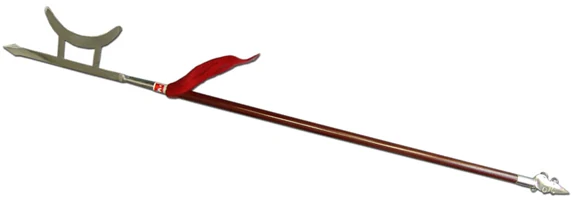
The ji was the polearm of the Chinese imperial elite for almost a thousand years. It evolved from the Bronze Age ge during the Spring and Autumn period, became the standard prestige weapon of Warring States cavalry and infantry officers, served through the Qin and Han dynasties as the marker of senior military command, and persisted into the Three Kingdoms period before being displaced by simpler, more specialized weapons.
A combination weapon
The defining characteristic of the ji is its combination of two distinct cutting heads on a single shaft: a forward-pointing spear-point for thrusting, and a perpendicular dagger-axe blade (or sometimes a crescent blade) for hooking and slashing. Some ji had a single hooking blade; others had two, one on each side of the shaft. The most elaborate forms, including the famous fang tian ji ("square-heaven halberd"), had a central spear point flanked by two crescent moon-shaped blades, creating a weapon that could thrust, slash, hook, parry, and trap an opponent's weapon, all without changing grip.
The result was a polearm of remarkable versatility but also significant difficulty to wield well. A spearman with a simple thrusting spear can be trained in months. A ji-wielder needed years of practice to use all of the weapon's capabilities without fouling its own blades or shaft. This is why the ji became, increasingly, a weapon of officers and elite troops rather than of mass infantry.
- TypeCombination halberd (spear + hooking blade)
- OriginLate Spring and Autumn China
- In Servicec. 5th C. BC – 6th C. AD
- Shaft Length~7–9 ft
- Weight~5–7 lbs
- MaterialBronze, later forged iron and steel
- VariantsSingle-blade ji, fang tian ji (crescent-flanked)
- Primary UseOfficer and elite trooper combination polearm
Lu Bu and the cultural memory
No discussion of the ji can avoid Lu Bu. The 2nd-century AD warlord, immortalized in the Romance of the Three Kingdoms, is depicted as wielding a fang tian ji of fearsome proportions, and the cultural association between the weapon and the heroic individual combatant became permanent in Chinese popular memory. Centuries of opera, novels, woodblock prints, and now film and television have made the fang tian ji the visual signature of the heroic Three Kingdoms warrior.
How much of this reflects historical reality is hard to say. Lu Bu existed; he was a celebrated and feared cavalry commander; surviving texts describe him as carrying a halberd. The specific fang tian ji of legend, with its elaborate crescent blades, is a later visual confection — likely shaped as much by Tang and Song-dynasty staging conventions as by anything Lu Bu actually carried. What is real is the cultural impact: for a Chinese audience, the fang tian ji is the heroic weapon, the way the longsword is for a European audience or the katana for a Japanese one.
Decline
The ji's eclipse came gradually. By the late Han dynasty, simpler weapons were displacing it across most of the army. The pure thrusting spear (qiang) was easier to train and produce, and cavalry tactics had begun to emphasize the long lance over the multi-headed halberd. By the Tang dynasty, the ji had largely retreated to ceremonial use — though its cultural prestige outlasted its battlefield service by another thousand years.
A version of the ji persisted in temple guard service and palace ceremony into the Qing. By the time the Qing dynasty fell in 1912, the ji had been ceremonial for so long that almost no one alive remembered seeing one used in actual combat.
Legacy
The ji's most important legacy was the weapon that replaced it: the qiang, the simple spear, which would dominate the Chinese battlefield for the next thousand years. By stripping away the hooking blades and refining the thrust, Chinese armorers produced a weapon that did one thing extremely well rather than four things adequately. The ji is the better fighting weapon in skilled hands; the qiang is the better fighting weapon in average hands. Mass armies make that choice every time.