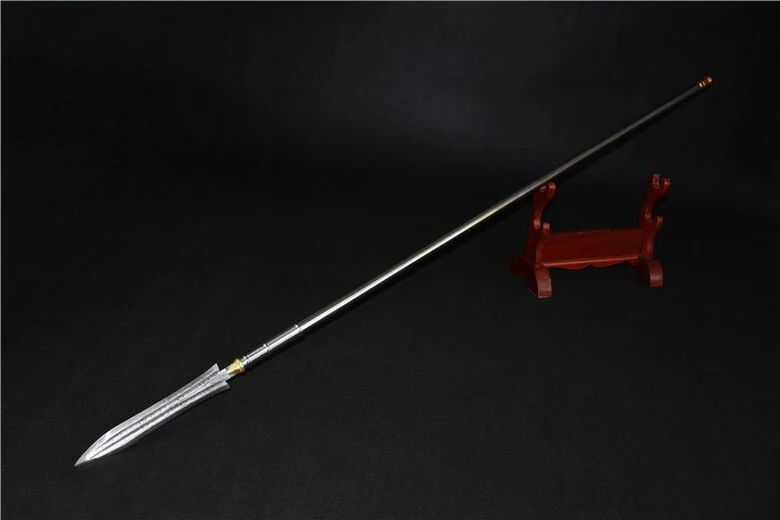
Chinese martial tradition calls the qiang — the spear — the king of weapons. The phrase is older than reliable attribution and has been repeated in martial-arts manuals for at least eight hundred years. There are reasons for it. A trained spearman, armed with seven feet of flexible wood and a sharp iron point, beats almost any other single-weapon opponent. He outreaches the swordsman. He outmaneuvers the halberdier. He can engage and disengage at will. The qiang is the most efficient infantry weapon the pre-firearms world ever produced, and from the late Warring States period until the introduction of mass-issue firearms in the 19th century, it was what most Chinese soldiers actually carried.
The white wax shaft
The most distinctive feature of the qiang, compared to its European or Middle Eastern cousins, is the shaft material. Quality qiang were made from white wax wood — bai la mu — the flexible, springy wood of the Chinese ash, prized above all other materials for spear shafts. A white wax shaft bends rather than breaks under heavy impact. It returns the force of a parry. It allows the spearhead to "snap" at the end of a thrust, adding velocity that a rigid shaft cannot match.
The result was a weapon that handled differently from European pikes or Japanese yari. The qiang in motion has a recognizable whip-like quality — a skilled practitioner can make the tip describe small circles that throw aside an opponent's weapon and recover instantly into a thrust. Several of the canonical qiang techniques in Chinese martial arts depend on this elasticity in ways that simply do not translate to a rigid-shafted spear.
- TypeSingle-handed or two-handed thrusting spear
- OriginWarring States China
- In Servicec. 4th C. BC – 19th C. AD
- Overall Length~7–9 ft (cavalry versions to 18 ft)
- Weight~3–5 lbs
- ShaftWhite wax wood (Chinese ash, bai la mu)
- HeadForged steel, leaf or willow-leaf shape
- Primary UseMass infantry; defense against cavalry
A weapon for armies
The qiang was the dominant Chinese military weapon for the same reasons the pike was the dominant European one: it could be issued in enormous quantities, it could be trained quickly, and it punished cavalry. Chinese sources describe regiments of qiang-armed infantry fielded by every dynasty from the Han onward, in ratios of one spearman for every two or three sword-and-shield troops. Tang and Song military manuals lay out detailed formations in which qiang ranks anchored the front lines while crossbowmen and skirmishers operated from the rear.
The basic doctrine never changed much. Spearmen stood in dense ranks with shields. The front rank held a low guard, points forward. The second rank held a high guard, points forward and slightly up. Cavalry charging this formation impaled the front rank of horses on the front rank of spear points before the riders ever reached the infantry. Enemy infantry trying to close to sword range had to push through twice the length of their own weapons before reaching one of yours.
The red tassel
Most Chinese qiang carry a distinctive red horsehair tassel — qiang ying — bound just below the spear head. The tassel is functional, not decorative. It absorbs blood running down the shaft from the wound, preventing the user's grip from becoming slick. It also confuses an opponent's eye in motion, making it harder to track the location of the actual spear point in fast exchanges. And it serves as a unit identifier — different colors, lengths, and bindings were used to distinguish formations and ranks.
By the late imperial period the tassel had become so iconic that it was retained on training spears, ceremonial spears, and the qiang used in opera and theater long after its practical function had been forgotten.
Legacy
The qiang remained in service longer than almost any other Chinese weapon. Republican-era Chinese troops carried qiang into combat as late as the 1930s, particularly in regions where firearms were scarce. It is still the foundational long weapon of Chinese martial arts. There are styles devoted entirely to the qiang, and the basic spear forms of the major Chinese martial systems — Yang style Tai Chi, Bagua, the various Shaolin lineages — descend directly from the military spear-fighting manuals of the Ming dynasty.
The qiang is what Chinese armies actually carried, for longer than any other weapon. The jian gets the cultural attention; the dao gets the cinema. But if you had asked a Chinese soldier in 1300 or 1500 or 1750 what weapon he expected to fight with, he would have answered: the spear.