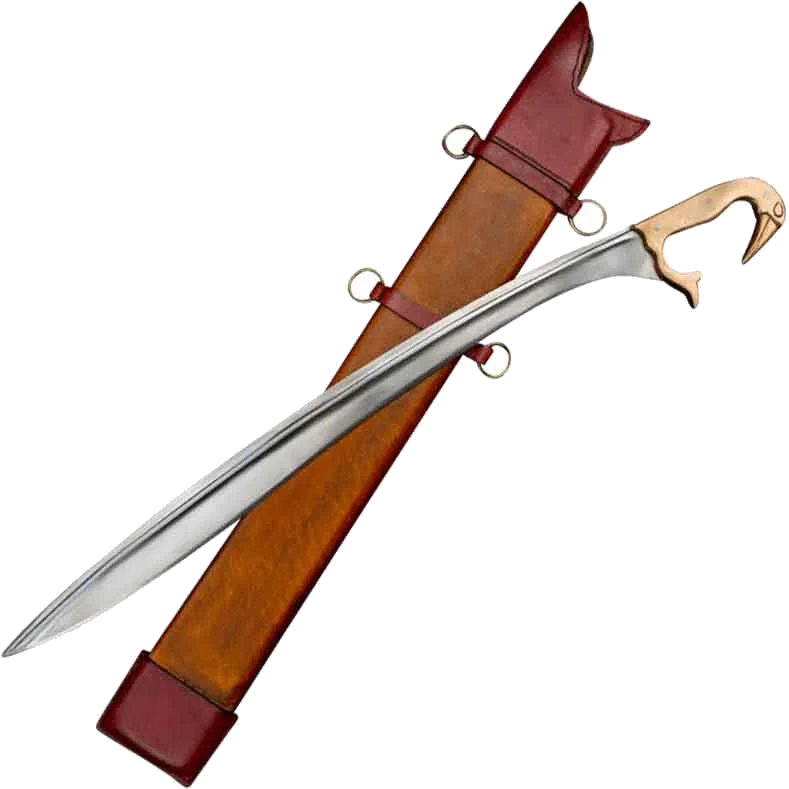
The kopis is the strangest-looking Greek sword and probably the most effective for what it was meant to do. Single-edged, forward-curving, weighted toward the tip — it concentrated force on the cutting edge in a way no straight sword could. Greek hoplites carried it. Greek cavalry preferred it. Alexander's Companions probably used it. And after Alexander, it spread across the Hellenistic world as the standard mounted-warrior's blade.
Origins
The kopis was not originally Greek. Forward-curving cutting swords appear in many cultures around the same period — the Iberian falcata, the Persian shamshir's ancestors, the Egyptian khopesh from much earlier — all share the basic insight that a blade curved forward concentrates impact at the point of contact. The Greeks adopted the design from contact with their neighbors, particularly during the Greco-Persian Wars and the long campaigns in the western Mediterranean.
By the 5th century BC, the kopis was in widespread Greek use. By the 4th century, under Macedon, it had become the dominant cavalry sword.
Design
A kopis ran 20 to 26 inches in total length — slightly longer than a xiphos. The blade was single-edged, with the cutting edge on the inside of the curve. The shape was not gradual: the blade typically widened forward of the hilt, reached its broadest point about two-thirds of the way down, then tapered sharply to a point. The result was a weapon that delivered the bulk of its mass at the cutting edge during a swing.
The hilt often had a more pronounced guard than the xiphos — sometimes hooked or shaped to enclose the hand — and a knob-like pommel. Cavalry kopides could be larger and heavier than infantry versions, since a mounted soldier had more leverage and didn't need to worry about formation tightness.
- TypeSingle-edged forward-curving sword
- OriginAdopted from Iberian / Eastern designs
- In Servicec. 6th – 3rd C. BC
- Total Length~24–30 in
- BladeSingle edge, forward curve, weighted forward
- Primary UserCavalry; some infantry
- Primary UseCutting strokes, especially from horseback
Cavalry preference
The kopis became the favored sword of Greek and Macedonian cavalry for clear practical reasons. A horseman cutting down at an opponent on foot benefits enormously from a forward-curving blade: gravity assists the swing, the curve concentrates the impact, and the single edge makes for a heavier, more durable blade than a comparably long double-edged design.
Xenophon, in his treatise On Horsemanship (4th century BC), specifically recommended the kopis for cavalrymen, calling it more effective than the straight-bladed xiphos for fighting from horseback. This was the period when Greek cavalry was developing into a serious tactical arm, and the choice of weapon reflected the change.
Macedonian adoption
Under Philip II and Alexander, the kopis became standard equipment for the Macedonian Companion cavalry — the elite shock force that won most of Alexander's battles. Surviving art from the period (the Alexander Mosaic, vase paintings, coinage) consistently shows Macedonian cavalry with curved swords, and grave goods from Macedonian elite burials regularly include kopides.
Alexander's conquests then spread the form across his empire. Hellenistic successor kingdoms continued to use the kopis as standard cavalry equipment for the next two centuries. The Romans, after defeating Macedon, encountered the form repeatedly and produced their own versions.
Kopis vs makhaira
Ancient Greek terminology was inconsistent. The word kopis meant something like "chopper" and was applied to forward-curving cutting blades. The word makhaira ("that which fights") was a more general term that could cover various single-edged blades, including some that overlapped heavily with what we'd call kopides. Modern scholarship generally treats them as related variants of the same weapon family.
For practical purposes: if you read about a Greek soldier carrying a curved sword, the modern label would be "kopis"; if you read "makhaira" the original Greek source might be referring to the same weapon or to a slightly different variant.
Legacy
Unlike the xiphos, the kopis has clear descendants. The Iberian falcata is essentially the same weapon. Some Roman cavalry swords show kopis-like features. The medieval European falchion — a single-edged forward-weighted cutting sword — appears in the historical record centuries later, possibly through continuous transmission via the Mediterranean and possibly as independent reinvention. Either way, the kopis pattern keeps reappearing across cultures because the underlying design principle is sound.