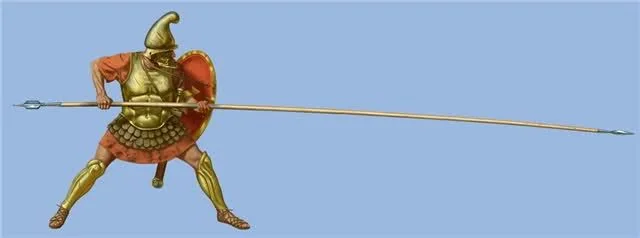
The sarissa was the longest infantry weapon the ancient world ever fielded as a primary battlefield weapon. At 18 to 22 feet, it more than doubled the reach of the hoplite's dory. A formation of men carrying sarissai presented an opponent with five ranks of points all projecting beyond the front line — a hedgehog of iron tips at distances no enemy could match. For the half-century between Philip II's reforms and the rise of Rome, this hedgehog was unbreakable.
Origins
The sarissa was Philip II of Macedon's invention, or at least his refinement, sometime in the 350s BC. Macedon at the time was a backwater kingdom on the northern fringe of the Greek world, considered semi-barbarian by Athens and Sparta. Philip's military reforms transformed it into a hegemonic power within twenty years — and the sarissa was the centerpiece of those reforms.
The basic idea was simple: longer spears mean longer reach. If your phalanx can engage the enemy phalanx at distances they cannot return, you win. Philip pushed the spear length further than anyone had dared before, accepting the costs (fragility, awkwardness, slower movement) in exchange for the reach advantage.
Design
A sarissa ran 18 to 22 feet in length. The shaft was cornel wood — a dense, springy hardwood — and was constructed in two pieces joined by an iron sleeve in the middle, both for transport (a single 20-foot shaft is unwieldy on the march) and to make breakage repairable. The forward section had a small iron leaf-shaped head; the rear had a heavy bronze butt-spike that served as both counterweight and ground-anchor.
Weight was substantial — 12 to 15 pounds for a long sarissa — but the heavy butt-spike moved the balance point well back, allowing soldiers to grip the weapon perhaps a third of the way from the rear. This still left 12 to 14 feet of pike projecting forward. Holding the sarissa required two hands, which meant Macedonian phalangites could not carry the large hoplite shield. Instead, they used a smaller round shield (the pelta) strapped to the left forearm so the hand could remain on the pike.
- TypeLong pike
- OriginMacedonian, under Philip II
- In Servicec. 4th – 1st C. BC
- Total Length~18–22 ft
- Weight~12–15 lbs
- ConstructionTwo-piece cornel-wood shaft with iron sleeve, iron head, bronze butt-spike
- Primary UseTwo-handed thrusting in the Macedonian phalanx
The Macedonian phalanx
The phalanx Philip built around the sarissa fought 16 ranks deep — deeper than the typical hoplite phalanx of 8 ranks. The first 5 ranks held their pikes horizontally, all 5 sets of points projecting beyond the front line. The remaining 11 ranks held their pikes vertically, both as a hedge against missile fire from above and as a reserve to push forward as casualties opened the front ranks.
On flat, open ground the system was nearly invincible. An enemy phalanx with 8-foot spears simply could not get close enough to use them. Cavalry could not charge into the wall of points. Skirmishers could harass but not break it. The Macedonian phalanx's only weaknesses were broken or rough terrain, where the long pikes became liabilities, and its flanks, which were vulnerable to flexible mobile enemies. Both of these would matter eventually.
Alexander's conquests
Philip was assassinated in 336 BC; his son Alexander inherited the army and the system. Over the next twelve years, Alexander used Macedonian phalanxes and Companion cavalry to defeat the Persian Empire, the largest state the world had ever seen, in a series of pitched battles — Granicus, Issus, Gaugamela — that broke Persian armies many times the size of his own. The sarissa was at the heart of every one. It pinned the Persian center while Alexander's cavalry struck for the kill.
The system continued working well after Alexander. His successor kingdoms — the Antigonids in Greece, the Seleucids in Asia, the Ptolemies in Egypt — all built their armies around sarissa-armed phalanxes, and these forces dominated their region for over two centuries.
Decline against Rome
The sarissa's weakness was rigidity. The Macedonian phalanx worked on flat ground, in a straight line, advancing slowly. Romans, fighting in smaller, more flexible units (the maniple, later the cohort), could exploit broken ground, work around flanks, and force the phalanx to fight on terrain it wasn't built for. At Cynoscephalae (197 BC) and Pydna (168 BC), Roman legions broke Macedonian phalanxes despite the latter having every advantage of pure phalanx-vs-phalanx mathematics.
Polybius, the Greek historian who watched these battles, gave a clear-eyed analysis. The phalanx, he wrote, was unbeatable when it could fight on its own terms. But its terms were narrow, and a flexible enemy who refused to meet it on flat open ground could pick it apart at the edges.
Legacy
The sarissa's direct legacy is short. Hellenistic kingdoms continued to use it through their conquest by Rome, and Roman writers studied it; but Rome did not adopt it. The basic idea — very long pikes wielded in close formation by men with small shields — would resurface 1,800 years later in the European pike formations of the 15th and 16th centuries (Swiss and German Landsknecht pikemen used pikes of similar length to the sarissa, in formations conceptually similar to the Macedonian phalanx). Whether this was direct continuity or independent rediscovery is debated. Either way, the principle that mass plus reach plus discipline can break almost anything in front of you is one of the most durable lessons in military history.