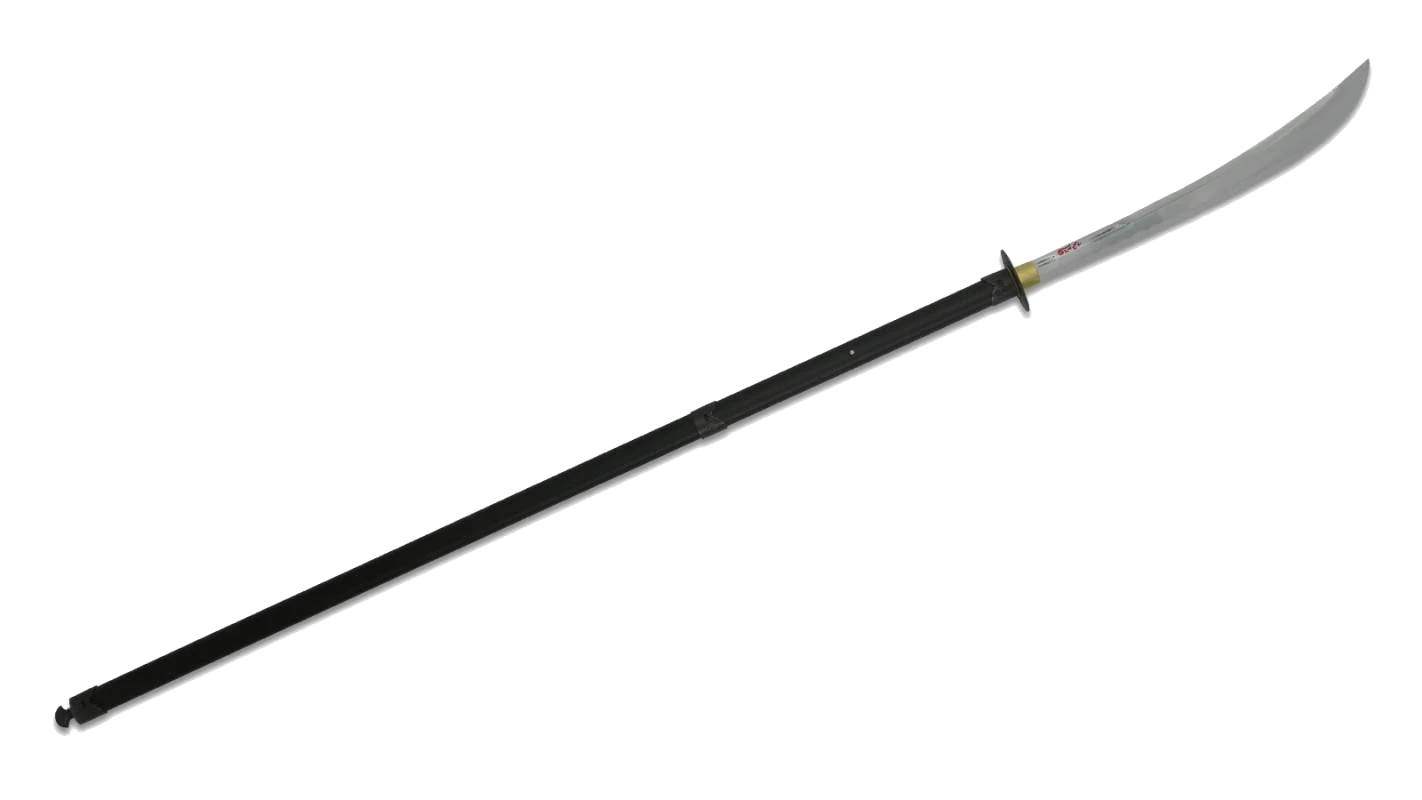
The naginata is, geometrically, a sword mounted on a long pole. The curved blade gives it a fundamentally different combat character than the straight-thrusting yari — it is a slashing and sweeping weapon, capable of long arcing cuts that work well against unarmored targets and against horses' legs. Its history in Japan tracks an interesting cultural arc, from medieval warrior-monk weapon to Sengoku battlefield tool to the favored arm of the Edo-period onna-bugeisha, the women who defended samurai households.
Origins
The exact origins of the naginata are debated, but the form was firmly established by the late Heian period (12th century). It is closely associated in tradition with the sōhei — the warrior monks of the great Buddhist temple complexes like Enryakuji on Mount Hiei and Kōfukuji in Nara, who maintained their own armed forces and frequently intervened in secular politics. The legendary warrior-monk Benkei, in the popular imagination, is invariably depicted with a naginata.
Design
A naginata blade is essentially a katana-style curved blade fitted to a long shaft instead of a sword hilt. Blade lengths typically run 12 to 24 inches; shaft lengths run 4 to 7 feet. Total weapon length is therefore roughly 6 to 9 feet. The blade is constructed using the same folded-steel laminate tradition as Japanese swords — the same smiths produced both — and the same differential heat treatment produces a hamon temper line on naginata blades.
The mounting between blade and shaft is the most distinctive technical element. A long tang on the blade (often as long as the blade itself) extends down into the shaft, fixed with collar fittings (habaki) and metal bands. This long tang gives the joint structural integrity against the side loads that a swinging cut puts on the connection — a critical engineering problem for a weapon designed for slashing rather than thrusting.
- TypeCurved-bladed pole-arm
- OriginJapanese, Heian period
- In Servicec. 1100 – 1876
- Total Length~6–9 ft
- Blade Length~12–24 in
- Weight~4–7 lbs
- Primary UseSlashing pole-arm; warrior monks, samurai, women of samurai households
In combat
Where the yari was a weapon of formation tactics, the naginata was more often a weapon of individual combat or small-unit action. Its sweeping cuts gave a single warrior an extended cutting arc, useful for keeping multiple opponents at distance. Against cavalry, the naginata could be used to cut down at the legs of horses — a tactic that exploited the lower limbs as the most vulnerable target on a mounted enemy.
In the Genpei War (1180–1185), the naginata was a frontline samurai weapon. By the Sengoku period, it had been displaced from primary infantry roles by the yari — mass formations of pole-arms with straight thrusting blades worked better for drilled infantry combat than the curved sweeping naginata did — but it retained roles in particular tactical situations, especially for individual warriors operating outside formation.
The onna-bugeisha
Under the Tokugawa peace, the naginata became closely associated with women of samurai families. The reasoning was practical. Samurai men were absent from home for extended periods on official duties; their households needed defensive capacity in their absence; and the naginata's reach gave a smaller defender significant advantages against larger attackers. Daughters of samurai families were trained from a young age in naginata-jutsu, and a naginata over the door was a standard fixture of samurai homes.
The training tradition was institutionalized and codified, with formal schools (ryūha) producing certified instructors, both male and female. This was unusual in a society where formal martial training was overwhelmingly male; women who became naginata masters had professional standing in a way that was rare in Tokugawa Japan. The tradition continued past the abolition of the samurai class and survives today as the modern competitive martial art of naginatadō, which is practiced primarily by women.
Legacy
Surviving naginata blades from medieval and Sengoku-period smiths are studied alongside swords as products of the Japanese metallurgical tradition. The form persists in modern martial arts and in occasional ceremonial and theatrical contexts. And the cultural memory of the warrior monk and the onna-bugeisha — both heavily associated with the naginata — remains a significant part of how Japan remembers its medieval past.