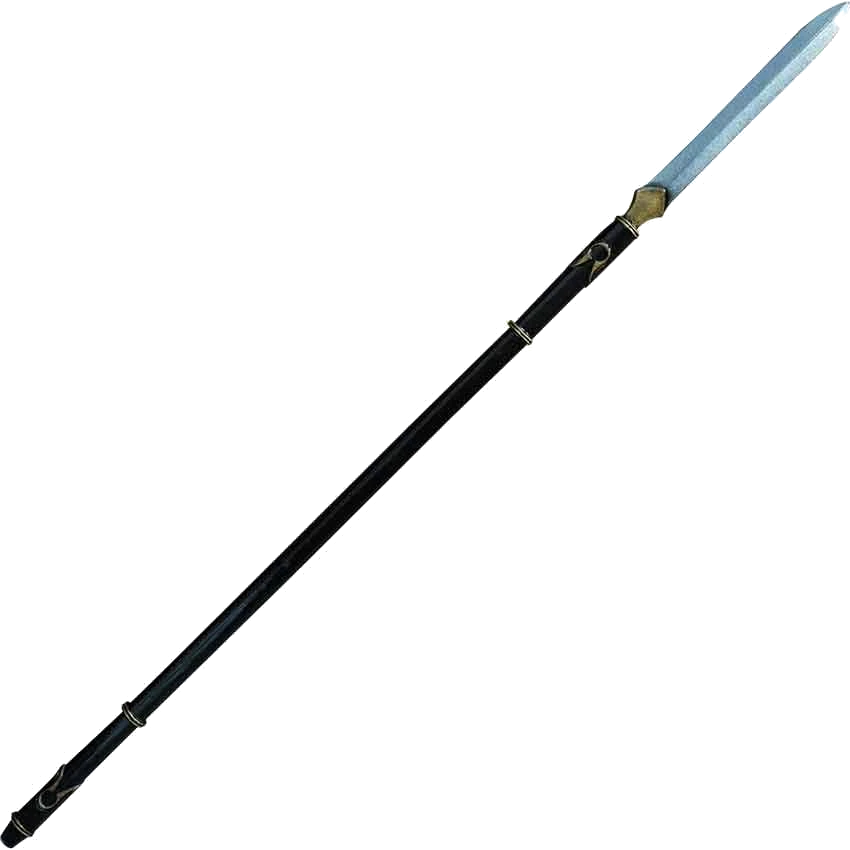
Despite the cultural prominence of the sword, more men were killed in Japanese pitched battles by the yari than by any other weapon. The straight-bladed Japanese spear, in its various lengths and forms, was the primary battlefield tool of the ashigaru — the foot soldiers who made up the bulk of every Sengoku-period army. Massed ranks of disciplined yari-men, drilled in coordinated thrust patterns, were the infantry backbone of the warring states.
Origins
Spears had existed in Japan since prehistory, but the yari as a distinct form of straight-bladed thrusting spear emerged in the Kamakura and early Muromachi periods (14th century). Its development paralleled a broader shift in Japanese warfare from individual duels among armored mounted samurai to mass infantry combat involving large numbers of foot troops — a shift that the long, straight, simple yari was perfectly suited to support.
Design
Yari heads were forged from the same kind of laminated steel as sword blades, generally smaller and simpler in geometry but produced to similar quality standards by sword smiths. The basic form, the su-yari, was a straight blade of roughly 6 to 12 inches set on a long shaft. Specialized variants existed: the cross-shaped magari-yari or jumonji-yari with side-blades for catching opposing weapons; the long-bladed ōmi-yari with a blade approaching sword length; and various hooked and barbed forms.
Shaft lengths varied widely with role. Personal yari for samurai officers might be six to nine feet. Mass infantry pikes (nagae-yari) reached fifteen to twenty feet, comparable to European pikes of the same period and used in similar massed-formation tactics. Shafts were typically built up from a hardwood core wrapped with bamboo strips and lacquered, producing a stiff, durable weapon.
- TypeStraight-bladed thrusting spear
- OriginJapanese, Kamakura period
- In Servicec. 1300 – 1700
- Total Length~6–20 ft (variable)
- Blade Length~6–12 in (su-yari)
- Weight~3–6 lbs
- Primary UseInfantry battlefield weapon for ashigaru and samurai
In combat
Sengoku infantry combat revolved around the yari. Massed ranks of ashigaru, drilled in synchronized overhead thrusting, presented an opposing army with a wall of points. Where the European pike was used primarily to defend against cavalry, the Japanese pike was used aggressively in infantry-vs-infantry combat as well, with whole units advancing in coordinated formation. The ashigaru wielding these pikes were not aristocratic samurai but conscripted peasants and townsmen, equipped and trained by the daimyō for whom they fought.
Samurai in the Sengoku period also frequently fought with yari, particularly when commanding ashigaru units or when fighting on foot. A samurai's personal yari was a shorter, more individually crafted weapon than the mass-issue pike of his men. Famous Sengoku warriors are often associated with particular named yari — the legendary spear of Honda Tadakatsu, the Tonbogiri ("Dragonfly Cutter"), supposedly so sharp that a dragonfly that landed on its blade was cut in two by its own weight, is one of the more famous examples.
Decline
The yari's tactical primacy ended in the same way as the European pike's: through the gradual perfection of firearms. Matchlock muskets arrived in Japan in 1543 with the Portuguese, and within a decade Japanese smiths were producing them in volume. The Battle of Nagashino in 1575 demonstrated the new logic with brutal clarity — Oda Nobunaga's massed musketeers, firing in coordinated volleys from behind palisades, destroyed the traditional yari-and-cavalry charge of the Takeda clan.
The yari did not disappear after Nagashino — pikes remained essential as protection for the slow-loading musketeers, and continued to be used through the early Tokugawa period — but its days as a primary battlefield weapon were numbered. By the time of the Tokugawa peace, the yari had become a household and ceremonial weapon rather than a working battlefield tool, though particular forms persisted in martial arts traditions through the modern era.
Legacy
Japanese spear-fighting (sōjutsu) survives as a recognized martial art, drawing on schools developed during the Sengoku and refined under the Tokugawa peace. Surviving Sengoku-period yari are studied alongside swords as products of the same metallurgical tradition. And the cultural memory of massed yari combat — the ashigaru wall of points — is central to most modern depictions of the Sengoku, even when the popular cultural imagination prefers to focus on the more glamorous samurai sword.