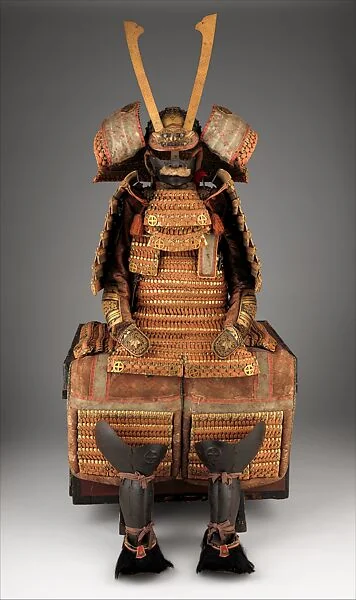
The ō-yoroi is the iconic armor of the early samurai period — the heavy lacquered-scale harness depicted in the great war scrolls of the Genpei War and the Mongol Invasions. Built around mounted archery, distinctive in its box-shaped construction and elaborate silk lacing, it represents the high point of Japanese laminar armor and the visual symbol of the warrior class in the centuries before the rise of the foot-fighting samurai of the Sengoku era.
Origins
The ō-yoroi developed during the late Heian period (10th–12th centuries) out of earlier Japanese lamellar armor traditions that themselves drew on continental Chinese and Korean models. By the time of the Genpei War (1180–1185), the form was mature, and surviving Kamakura-period ō-yoroi from temple collections show the form at its full sophistication. It was an aristocratic armor, expensive to produce and reserved for high-ranking samurai who fought from horseback — not the equipment of an army's bulk but the harness of its officers and elites.
Construction
Ō-yoroi was built up from thousands of small lamellar scales (kozane), each typically about an inch wide and three inches long, made of iron or lacquered leather. The scales were laced together horizontally with leather thongs into long strips, then connected vertically with silk cord (odoshi) into rigid panels. The whole assembly was lacquered repeatedly, both for weather resistance and for visual effect.
The torso section was distinctive: not a wraparound cuirass but a four-sided box, with separate plate sections for chest, back, and sides, joined by silk cords. A wide lacquered-leather skirt (kusazuri) hung from the bottom edge, splaying outward to fall over a saddle. Separate components covered the shoulders (sode, large square shoulder plates that functioned almost as small shields), arms (kote, an early form of half-sleeve), and legs (haidate, thigh guards). The kabuto helmet was its own elaborate construction with wide flaring neck protection (shikoro).
- TypeHeavy lamellar armor for mounted use
- OriginJapanese, late Heian period
- In Servicec. 900 – 1400
- Total Weight~50–65 lbs
- ConstructionIron and leather scales, silk lacing, lacquered
- ComponentsDō (torso), kusazuri (skirt), sode (shoulders), kote (arms), kabuto (helmet)
- Primary UseMounted samurai of the Heian and Kamakura periods
Use in combat
Ō-yoroi was designed around mounted archery. The box-shaped torso provided strong protection against arrows when the warrior was facing forward; the wide kusazuri skirt protected the legs from arrows shot upward at the rider; the large sode shoulder plates protected the arms during the act of drawing and releasing the bow. The total weight, which could exceed 65 pounds for a fully equipped ō-yoroi, was bearable on horseback even if it was awkward on foot.
Surviving accounts of Genpei-period combat describe ō-yoroi'd samurai as nearly invulnerable to standard arrows under most circumstances, with armor failure typically happening through either prolonged shooting at the unprotected face and limbs or through the close-combat penetration of the lacing at vulnerable joints with a tantō or short blade.
Limitations
On foot, ō-yoroi was significantly less effective. The heavy weight without the saddle's support fatigued the wearer; the silk lacing absorbed water and could become heavy and restrictive in rain or river crossings; and the box construction did not flex well with infantry combat motions. As Japanese warfare shifted toward foot combat in the late Muromachi and early Sengoku, ō-yoroi became increasingly impractical and was displaced by lighter, more flexible forms like the dō-maru and ultimately the tōsei-gusoku.
By the late 14th century, ō-yoroi was already a ceremonial and high-status form rather than a working battlefield armor. It was retained as a ceremonial harness for the highest ranks of samurai and worn for formal occasions and for combat by particularly wealthy or traditionalist commanders well into the 15th century, but the actual fighting men of the Sengoku-period armies wore something different.
Legacy
Surviving Kamakura-period ō-yoroi, often preserved in temple and shrine collections (some donated by samurai families as votive offerings), are masterworks of medieval Japanese craft. The most famous examples — the ō-yoroi at Itsukushima Shrine, Kasuga Shrine, Ōyamazumi Shrine — are designated National Treasures and are extensively studied as exemplars of medieval armor-making. The visual language of the ō-yoroi — the lacquered scales, the silk lacing, the wide skirt, the elaborate kabuto with its flaring neck guard — remains the dominant image of "samurai armor" in popular culture, even though the working samurai armor of the Sengoku period was something quite different.