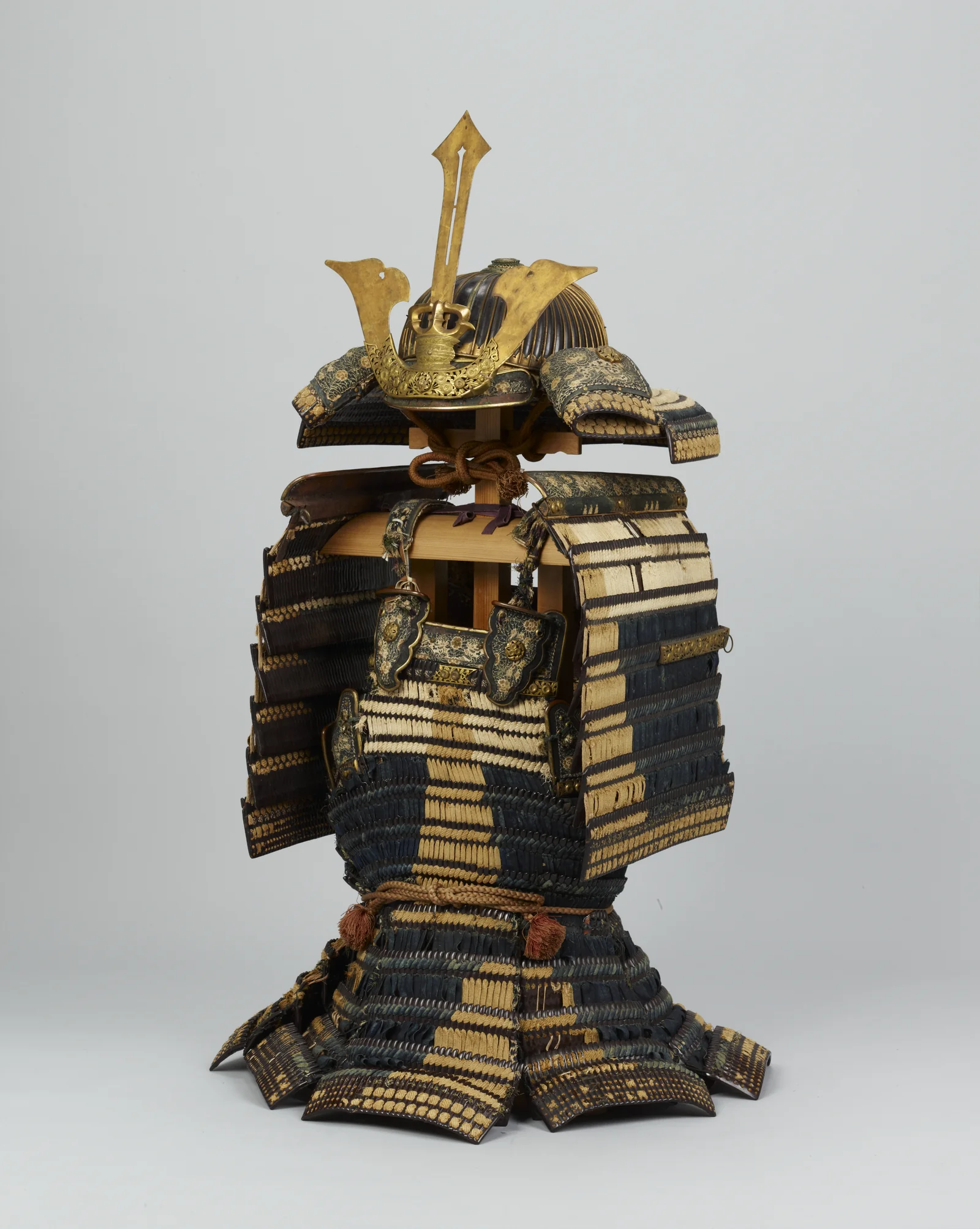
The dō-maru — "body wrap" — was the working armor of the late medieval and Sengoku periods. Lighter than the ō-yoroi it partly replaced, more flexible, easier to fight in on foot, and distinguished by its wraparound construction that opened on the right side, the dō-maru was probably the most common armor on Japanese battlefields from roughly 1300 to 1500. It marks the transition between the cavalry-oriented great armor of the Heian aristocracy and the plate-and-musket armor of the late Sengoku.
Origins
The dō-maru emerged in the late Heian period as armor for foot soldiers and lower-ranking warriors who could not afford an ō-yoroi or who fought primarily on foot. Its lighter construction and lower cost made it accessible to a broader range of warriors than the elaborate ō-yoroi could ever be. By the Kamakura period, it was widespread among rank-and-file samurai retainers and ashigaru-equivalent foot troops; by the Muromachi period, it had been adopted by senior samurai as well, particularly those who increasingly dismounted to fight.
Construction
Like ō-yoroi, the dō-maru was built from lamellar kozane scales laced together with silk cord into panels and lacquered for protection. The key structural difference was geometric: where the ō-yoroi was a four-sided box with separate plates joined at the sides, the dō-maru was a continuous wraparound construction that opened on the right side and was secured with cord ties. This conformal construction sat closer to the body and allowed greater freedom of movement.
The component armor pieces were similar to ō-yoroi — kusazuri skirt, sode shoulders, kote arms, kabuto helmet — but smaller, lighter, and less elaborate. A typical dō-maru weighed perhaps 25 to 40 pounds, against 50 to 65 for an ō-yoroi. The differences were significant: a warrior in dō-maru could march, climb, jump, and grapple in ways that a warrior in ō-yoroi simply could not.
- TypeLamellar wraparound torso armor
- OriginJapanese, late Heian period
- In Servicec. 1100 – 1600
- Total Weight~25–40 lbs
- ConstructionIron and leather scales, silk lacing, opens on right side
- ComponentsDō (torso), kusazuri (skirt), sode (shoulders), kote (arms), kabuto (helmet)
- Primary UseWorking armor for samurai retainers and foot-fighting samurai
Status and use
In the early stages of its history, the dō-maru was definitively lower-status than the ō-yoroi. High-ranking samurai wore ō-yoroi; their retainers wore dō-maru. But this status hierarchy shifted as the demands of warfare changed. By the late Muromachi and Sengoku periods, even senior samurai and daimyō were wearing dō-maru in actual combat, reserving the heavier ō-yoroi for ceremonial occasions and formal display. Surviving dō-maru from the 14th and 15th centuries include high-status examples with rich decoration that would have been the working battlefield armor of important commanders.
In Sengoku-period combat, dō-maru sat between the cheaper and simpler armor of the mass ashigaru — often a basic torso-only armor without lamellar lacing — and the elaborate tōsei-gusoku of the wealthiest commanders. It was the armor of working samurai retainers, of officers and small-unit leaders, of the great mass of professional warriors who fought the warring-states battles.
Replacement
The dō-maru was eventually displaced by the tōsei-gusoku — the "modern armor" of the late Sengoku period, which used larger plate sections and was designed against firearms. The transition happened gradually across the 16th century, accelerating after the introduction of European firearms in the 1540s. Lamellar construction simply did not perform well against musket balls; solid plate did. By 1600, the dō-maru was largely obsolete as a working armor, surviving primarily in ceremonial or traditionalist contexts.
Legacy
Surviving dō-maru are studied alongside ō-yoroi as examples of medieval Japanese armor-making. They are less famous than ō-yoroi in popular culture — the great armor's visual drama is harder to match — but historically they were probably worn in more battles by more men than any other Japanese armor type. The dō-maru is, in a sense, the workhorse of medieval Japanese armor: less spectacular than its predecessor, less technologically advanced than its successor, but the actual harness of the actual fighting men of the period.