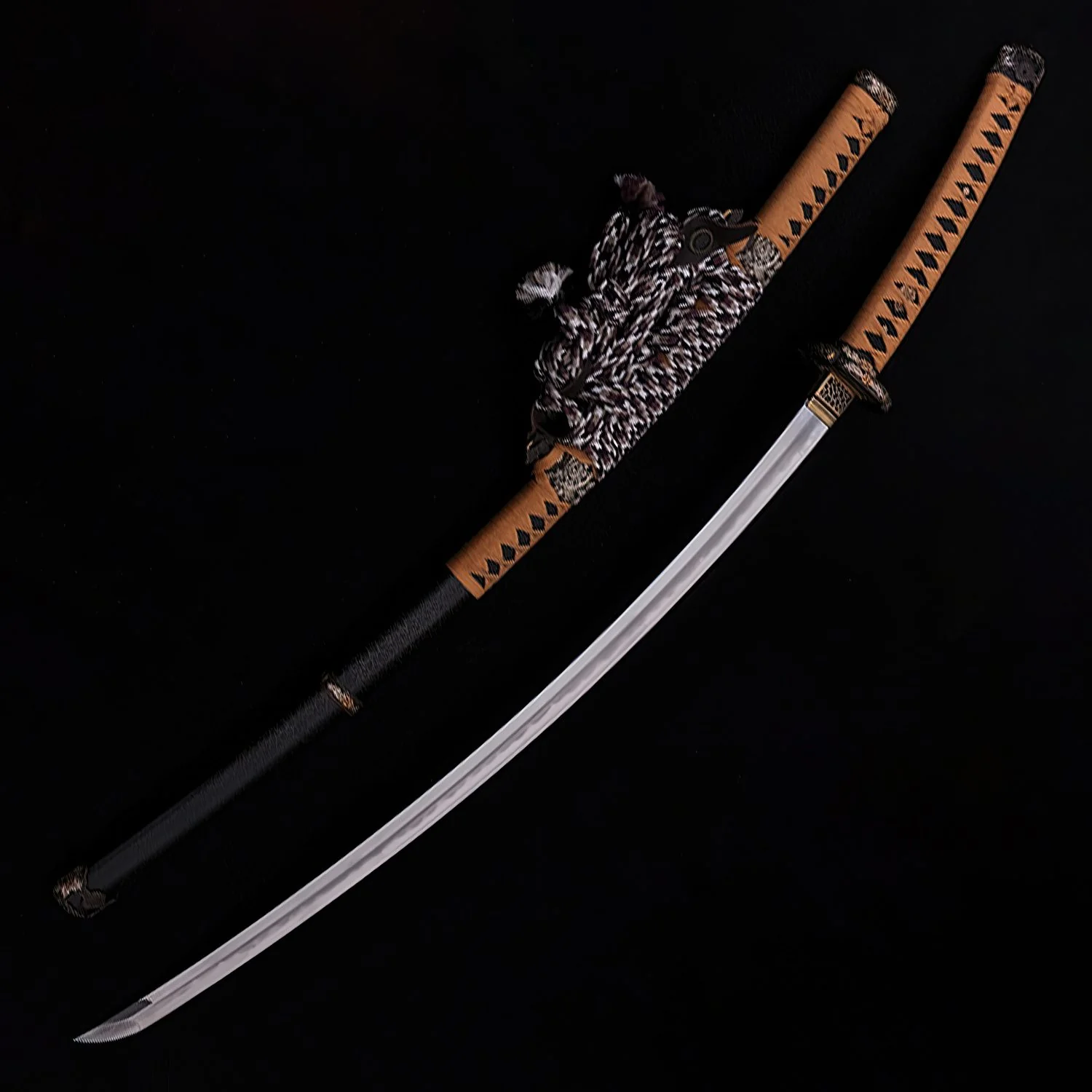
The tachi was the primary cutting sword of the mounted samurai during the Heian and Kamakura periods, roughly the years 900 to 1400. Longer and more curved than the later katana that would replace it, worn slung edge-down from the belt rather than thrust through an obi, the tachi was a horseman's sword — built for the long fluid cuts of mounted combat rather than the foot-soldier's draw-and-strike of the katana era.
Origins
The tachi developed out of the older straight chokutō blades of the Nara and early Heian periods, which had been heavily influenced by Chinese and Korean sword-making. The shift from straight to curved blades happened gradually across the 9th and 10th centuries, driven by the mounted-archer combat style of the developing samurai class — a curved blade is easier to draw cleanly from horseback and produces a slicing cut on a moving target rather than the chopping action of a straight edge.
Design
A typical tachi had a blade length of around 28 to 32 inches (70 to 80 cm), with a pronounced curvature whose deepest point sat closer to the hilt than on a katana. The construction was the classical Japanese folded-steel laminate — a hard high-carbon edge welded to a softer iron core, the whole forge-folded many times to distribute slag and homogenize the metal, then differentially heat-treated to produce the famous hamon temper line.
Tachi mountings (koshirae) were distinct from later katana fittings in several ways. The scabbard hung from cords (obi-tori) rather than being thrust through the belt. The pommel cap (kabutogane) was typically larger and more decorated than a katana's. And the orientation of the maker's signature on the tang — the nakago — indicated which way the sword was meant to be worn: tachi signatures face outward when the sword is hung edge-down.
- TypeCurved single-edged sword
- OriginJapanese, Heian period
- In Servicec. 900 – 1500
- Total Length~36–42 in
- Blade Length~28–32 in
- Weight~2.5–3 lbs
- Primary UseMounted samurai's cutting weapon, secondary to the bow
In combat
The mounted samurai of the early periods was, fundamentally, an archer. The bow was the primary weapon; the tachi was the secondary, drawn after closing or after the bow was lost. From horseback, the curved blade was used for descending cuts on opponents below — foot soldiers, dismounted enemies, peasants. Against another mounted warrior of equivalent class, fighting was as likely to involve grappling and dagger work as sword-on-sword exchanges.
On foot, the tachi could be used in two-handed cuts much like a later katana — the grip was long enough — but its length and curvature made it less ideal for the cramped infantry combat that came to dominate the Sengoku period. This is one of the reasons the tachi was eventually displaced: as samurai increasingly fought on foot in the late Muromachi and Sengoku, the shorter, less curved katana proved more practical.
Suriage and decline
From the late Muromachi period onward, many existing tachi were physically shortened — a process called suriage — to be remounted as katana. The blade would be cut down at the tang end, often destroying the original signature in the process, and refitted with katana-style mountings. This is why surviving signed tachi blades from the great Kamakura masters — smiths like Masamune, Yoshimitsu, Awataguchi — are scarcer than the original number of blades produced would suggest. Many of those blades survive as anonymous (mumei) shortened katana.
By the early Edo period (1600s), the tachi was no longer made as a battlefield weapon. It persisted in formal and ceremonial roles, and the tradition of tachi-mounting (kazari-tachi) continued for swords carried at court. But the working sword of the samurai class was now firmly the katana, and the tachi had become a historical form.
Legacy
Surviving Kamakura-period tachi blades from named masters are among the most valuable objects in Japanese material culture — kokuhō, designated National Treasures, in many cases. The technical achievements of Kamakura sword-making have never been surpassed; modern smiths working in the traditional style still treat the great Kamakura tachi as their reference standard. The form's direct descendant, the katana, owes nearly everything to the tachi tradition that preceded it.