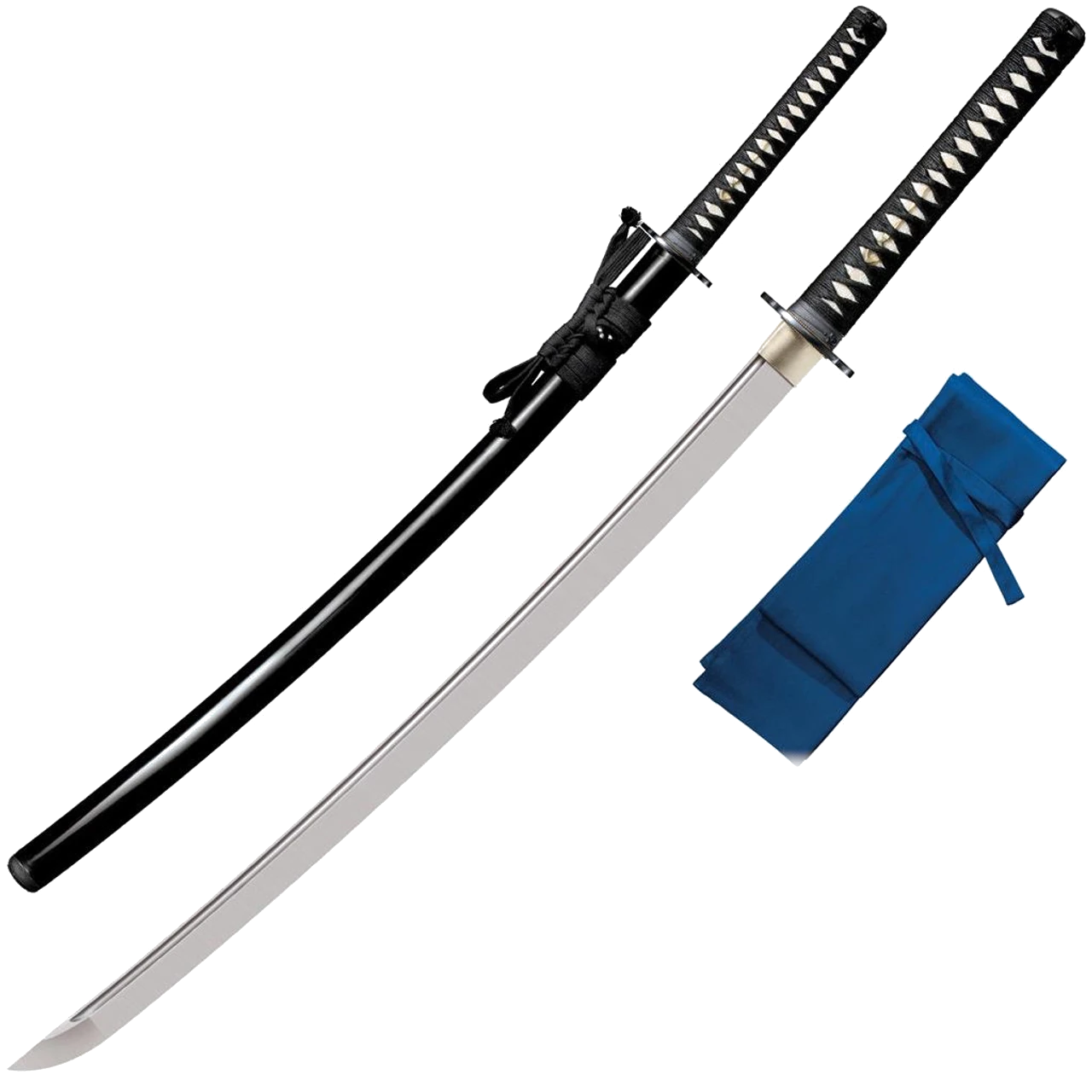
The katana is the most recognizable sword in the world, and probably the most mythologized. What distinguishes it from the tachi that preceded it is less the blade itself — the metallurgy and basic geometry are continuous — than the way it was worn, drawn, and used. Worn edge-up through the belt, the katana could be drawn and cut in a single fluid motion, which became the basis of the Japanese sword art and the symbolic gesture of the samurai class.
Origins
The katana emerged during the late Muromachi period, roughly the 15th century, as samurai warfare shifted from mounted to foot combat. The shorter, less curved blade was easier to use on foot; the edge-up belt-thrust carry was faster to draw than the cord-slung edge-down tachi. The transition was gradual rather than sudden — the two forms coexisted for a century or more — but by the early 16th century, the katana had become the standard sword of the working samurai.
Construction
A katana blade is built up from multiple types of steel. A hard high-carbon steel (hagane) forms the cutting edge; a softer low-carbon steel (shingane) forms the spine and core, providing the springiness and shock resistance that pure hard steel lacks. The two are forge-welded together in a complex laminated structure — folded and refolded many times during forging to distribute carbon evenly and remove slag inclusions — producing a blade that is hard where it needs to cut and tough where it needs to absorb shock.
The differential heat treatment is the famous final step. The blade is coated with a clay slurry — thicker over the spine, thinner along the edge — and heated, then quenched. The thinly coated edge cools rapidly and forms hard martensite; the thickly coated spine cools more slowly and remains softer pearlite. The boundary between the two zones, visible on the polished blade as a wavy temper line, is the hamon, a key signature of the smith's work and a critical part of the katana's structural performance.
- TypeCurved single-edged sword, two-handed
- OriginJapanese, late Muromachi period
- In Servicec. 1400 – 1876
- Total Length~36–42 in
- Blade Length~24–29 in
- Weight~2–3 lbs
- Primary UseSidearm and close-combat weapon; symbol of samurai class
Design
Katana blade lengths typically run 24 to 29 inches (60 to 73 cm), with a gentle curve whose deepest point sits closer to the middle of the blade than on a tachi. The grip (tsuka) is long enough for two-handed use — usually around 10 to 12 inches — but the sword can be used one-handed when needed. Total weight runs around 2 to 3 pounds, putting the katana in roughly the same weight class as a European arming sword.
Mountings (koshirae) are simpler than tachi koshirae: a wood scabbard (saya) lacquered for protection, a hilt wrapped in ray skin and silk braid, a single small guard (tsuba), and minimal external hardware. The whole assembly was designed to be carried thrust through the belt with the edge up, ready for the draw.
In combat
Sengoku-period battles were not won by katanas. The yari, the bow, and increasingly the matchlock musket killed many more men than swords did. The katana's tactical role was as a sidearm and as a close-combat weapon for the moments when the primary weapon was unavailable — broken, stuck, out of ammunition, or simply outranged. In this respect it occupied the same niche as the Roman gladius or the medieval European arming sword: the soldier's secondary weapon, drawn for the close work.
Where the katana acquired its outsized cultural status was off the battlefield. Under the Tokugawa peace, when major war ended, the katana became the primary marker of samurai class status. Samurai were legally required to wear it; non-samurai were legally forbidden to wear it. The codified sword arts (kenjutsu, later kendō and iaidō) developed in this period, and the famous duels and treatises — Miyamoto Musashi's Book of Five Rings dates from 1645 — come from this era, not from the active warring period.
End of the era
The Meiji Restoration of 1868 ended the samurai class as a legal category. The Sword Abolishment Edict of 1876 prohibited the wearing of swords in public except for military and ceremonial purposes. Many fine blades were lost to neglect or melted down during the rapid Westernization that followed. After Japan's defeat in 1945, the American occupation initially ordered all swords surrendered — including thousands of blades that were art-historically priceless — before being persuaded to exempt traditionally made art swords from the order.
Today, traditionally made katana are produced in small numbers by licensed smiths in Japan, primarily as art objects and ceremonial weapons. Surviving Edo-period and earlier blades are studied, polished, and preserved as cultural heritage. The katana retired from war, but it never quite retired.
Legacy
The katana's global cultural influence is wildly out of proportion to Japan's military significance in world history. It is the only non-Western sword to have entered general global iconography, and arguably the only edged weapon of any tradition that a non-specialist anywhere in the world can name. Its technical achievements have influenced metallurgy and design beyond Japan; its symbolic weight has shaped global perceptions of the samurai class long after that class itself disappeared.