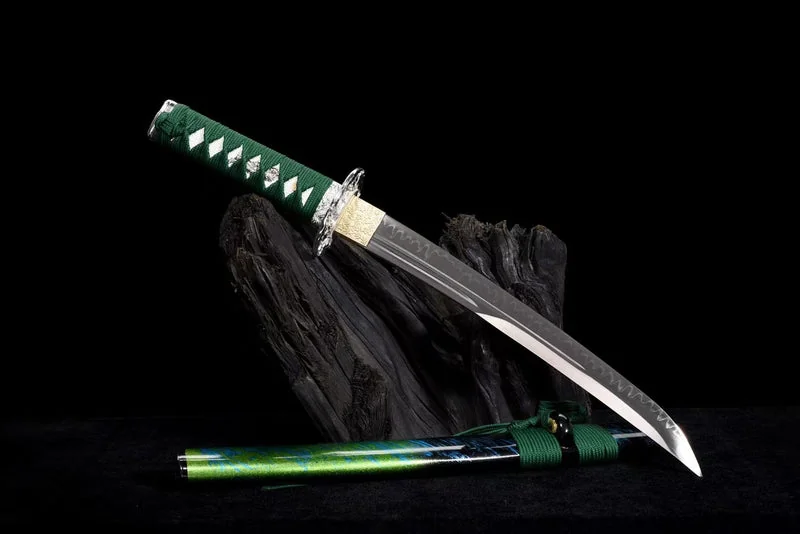
The tantō rounded out the samurai's blade kit. Under twelve inches in blade length, made by the same masters who made tachi and katana, it was the smallest of the formal sword forms and the most personal — a dagger carried for armored grappling, for last-resort defense, for everyday cutting work, and for ceremonial use. Many of the most exquisite surviving Japanese blades are tantō, where the small canvas concentrated the smith's full attention.
Origins
Tantō-form daggers appear in Japan well before the formal codification of the sword tradition. The earliest examples date to the late Heian period (12th century), when they emerged as a complement to the tachi for armored close combat — specifically, for the moment in a duel when armored warriors had grappled to the ground and needed a short stiff blade to find joints in the lacing of their opponent's armor.
Design
A tantō blade is conventionally less than 12 inches (30 cm) long. Within that constraint there is significant variety: the hira-zukuri form has no central ridge and a flat triangular cross-section; the shobu-zukuri has a leaf-like profile; the kanmuri-otoshi has a thinned upper section. Some tantō have a strong ridge for armor-piercing thrusts; others are more knife-like. The construction follows the same folded-steel laminate tradition as the larger swords, and the same smiths produced both.
Mountings vary with use. A combat tantō would have a simple wood scabbard and minimal fittings. A formal court tantō could have elaborate decorated fittings of gold, silver, and lacquer. The white-handled shirasaya-style tantō used in seppuku ritual had no guard at all, just a plain wood handle and matching scabbard.
- TypeDagger, single-edged
- OriginJapanese, late Heian period
- In Servicec. 1100 – 1876
- Total Length~12–16 in
- Blade Length<12 in
- Weight~0.5–0.75 lbs
- Primary UseArmored grappling, sidearm, ritual
In armored combat
Japanese armor of the ō-yoroi era was built up from many small lacquered scales laced together with silk. It was effective against arrows and against most cuts, but it had unavoidable weak points where the lacing met — the armpits, the groin, the throat, the gaps between the helmet and the cuirass. A short stiff blade with a strong point was the right tool for finding those gaps, and the tantō was that tool.
The classical scenario was a duel that began at distance with bows, closed to tachi range, and ended with the two warriors grappling on the ground — the heavier-armored Japanese warrior of this period was effectively immobile once on his back. The man on top would draw his tantō and attempt to penetrate his opponent's armor at a vulnerable point. This phase of combat was called kumiuchi and the tantō was its primary weapon.
Other uses
Beyond armored combat, the tantō served as an everyday utility blade for samurai and as a last-resort defensive weapon when sword carry was impossible or inappropriate. It also had a specific role in seppuku ritual: while the wakizashi was the symbolic blade of the formal practice, the actual cutting was often performed with a tantō, particularly the white-handled shirasaya form. Women of samurai families were also expected to carry a tantō (the kaiken) as both a defensive weapon and a means of self-determined death if necessary.
Legacy
Tantō blades by the great Kamakura smiths — Awataguchi Yoshimitsu, Rai Kunitoshi, and others — are among the most studied and revered objects in Japanese metallurgy. The small canvas allowed smiths to concentrate every aspect of their craft into a single piece, and the surviving examples are technical and artistic exemplars of the medieval tradition. The form continues to be made today by licensed smiths and remains part of the recognized Japanese sword tradition.