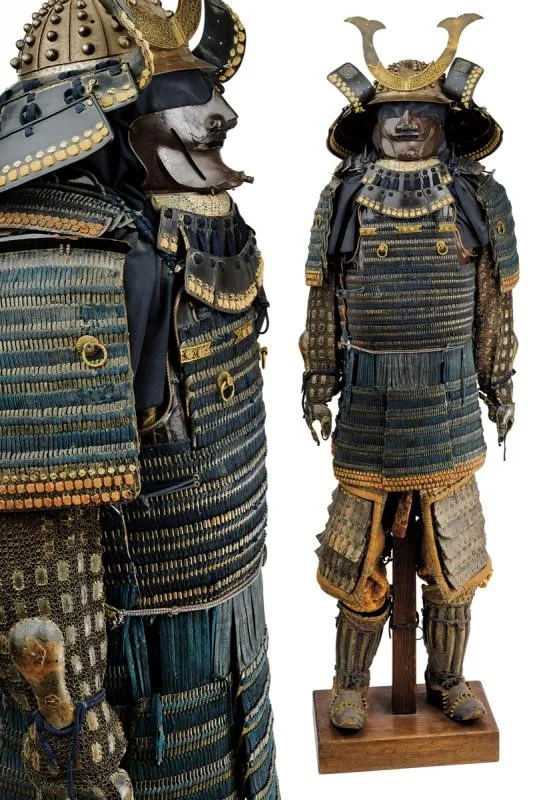
Tōsei-gusoku — "modern armor" — is the iconic samurai harness that most modern depictions of the period actually show. Built around solid plate cuirasses rather than laced lamellar scales, often featuring dramatic decorated kabuto with sweeping crests and horns, it was the response of Japanese armorers to the arrival of European firearms in the 1540s and the explosion of army sizes during the Sengoku wars.
Origins
Portuguese traders and missionaries arrived in Japan in 1543, bringing among other things the matchlock musket. Within a decade, Japanese smiths were producing matchlocks in volume; within two decades, those matchlocks were appearing on Japanese battlefields in significant numbers. The Battle of Nagashino in 1575 demonstrated their potential decisively, with Oda Nobunaga's massed musketeers destroying the traditional cavalry charge of the Takeda clan.
Lamellar armor — the construction technique behind both the ō-yoroi and the dō-maru — performed poorly against musket balls. The laced scales could be penetrated, and the silk lacing itself was vulnerable to the ball's impact even when the scales held. The response was structural: rather than building armor up from many small scales, build it from a few large plates that could deflect a ball or absorb its impact across a broader surface.
Construction
Tōsei-gusoku torso armor came in many forms. Some dō were essentially solid plate cuirasses, sometimes one or two pieces, often with the breastplate hammered to a faceted form to deflect bullets. The European-influenced nanban-dō ("southern barbarian armor") was directly modeled on imported European cuirasses. The okegawa-dō was constructed of horizontal plate strips. Even the more traditional-looking lamellar forms used much larger plates than earlier ō-yoroi or dō-maru, with simpler lacing patterns (sugake-odoshi, sparse spaced lacing, rather than kebiki-odoshi, full close lacing).
The complete tōsei-gusoku assembly continued to include the same component pieces as earlier armor — cuirass, kusazuri skirt, sode shoulders, kote sleeves, haidate thigh guards, suneate shin guards, kabuto helmet — but each piece was simpler, lighter, and more practical than its lamellar predecessor. Total weight ran roughly 20 to 30 pounds, significantly less than ō-yoroi.
- TypePlate and lamellar armor for the Sengoku period
- OriginJapanese, mid-16th century
- In Servicec. 1550 – 1700
- Total Weight~20–30 lbs
- ConstructionSolid plate or large-scale lamellar, designed against firearms
- ComponentsDō, kusazuri, sode, kote, haidate, suneate, kabuto
- Primary UseWorking battlefield armor of the Sengoku samurai and ashigaru officer class
The kabuto
The kabuto helmet of tōsei-gusoku is what most modern depictions of samurai actually show. Where earlier kabuto had been relatively simple in profile, late Sengoku kabuto became elaborate, with dramatic crests (maedate, wakidate, ushirodate) on top, sides, and back, and sometimes radically reshaped helmet bowls in the form of waves, animals, or natural forms (the kawari-kabuto, "unusual helmets"). The reasoning was tactical: as battlefields grew more chaotic and armies grew larger, distinctive headgear made commanders identifiable to their troops at a distance, much as European cavalry helmets and plumes did in the same period.
Some of the most famous kawari-kabuto include the rabbit-eared helmet of Date Masamune, the antler-crested helmet of Honda Tadakatsu, and a wide variety of horn, deer, dragon, and abstract forms. Many surviving Sengoku-period kabuto are spectacular objects in their own right, regardless of their role as functional headgear.
Decline and the Tokugawa peace
The Tokugawa peace, beginning effectively in 1603, ended large-scale warfare in Japan. Tōsei-gusoku continued to be made and worn through the 17th century — the suppression of the Shimabara Rebellion in 1637–1638 was the last major use of armor in Japanese warfare for two centuries — but as actual war disappeared, tōsei-gusoku increasingly became a ceremonial form rather than a working harness. Edo-period tōsei-gusoku is often more elaborately decorated than the Sengoku originals, with finer lacquering and more intricate crest work, even as it lost its practical function.
The Bakumatsu period (1853–1867) and the Boshin War (1868–1869) saw a brief return of armor to Japanese battlefields as the shogunate's collapse triggered the last large-scale combat in Japanese history. Some samurai of these final wars wore traditional tōsei-gusoku into combat against forces equipped with rifled artillery and breechloading firearms; the results were predictably tragic. After the Meiji Restoration, traditional Japanese armor was definitively retired.
Legacy
Surviving Sengoku-period tōsei-gusoku are extensively studied as the climactic point of the Japanese armor tradition. Major collections in Japan, Europe, and North America preserve hundreds of complete or near-complete suits, often with rich provenance traceable to specific samurai families. The form's combination of practical engineering — designed against firearms, optimized for foot combat — with elaborate visual identity — the dramatic kabuto, the family-specific decoration — makes it one of the most visually distinctive armor traditions in world history.