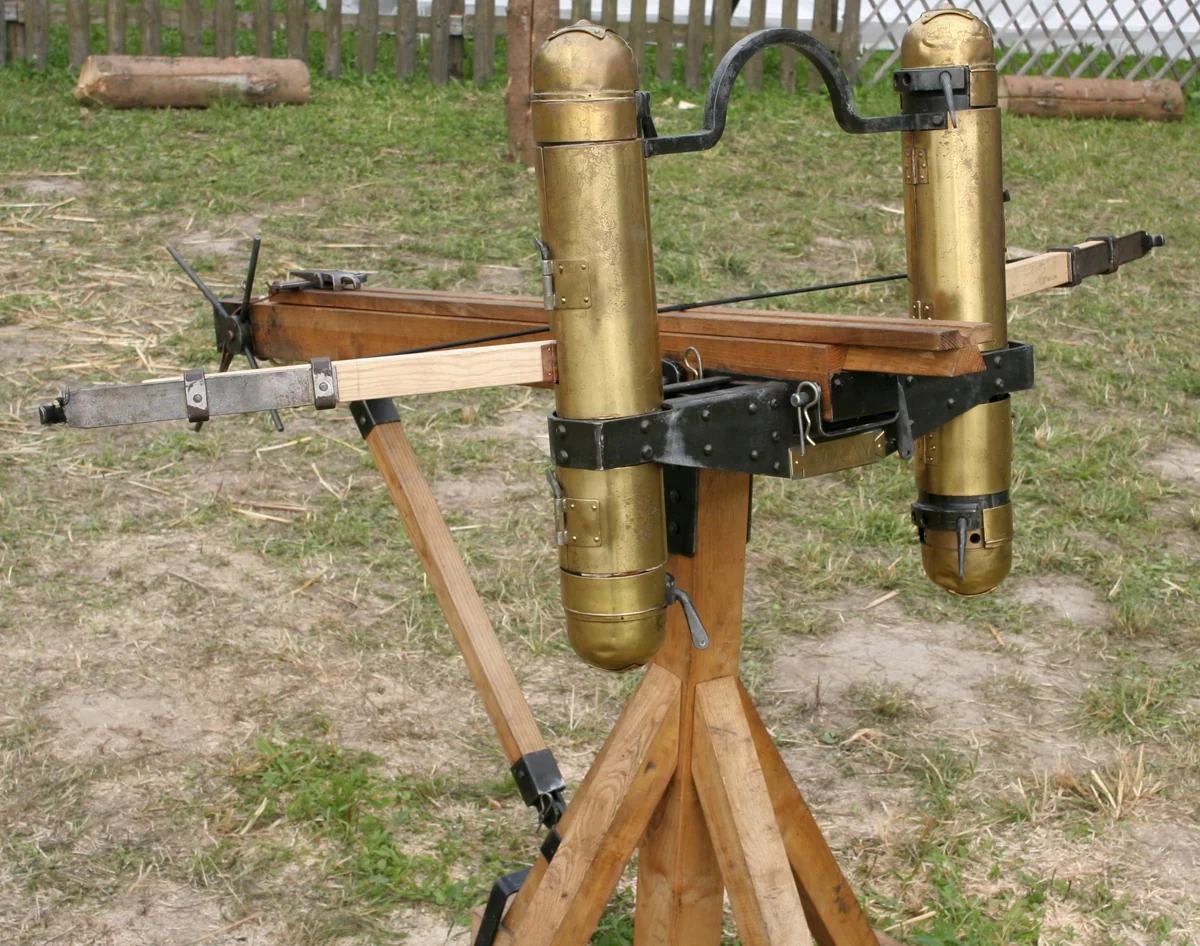
The ballista was the Roman army's heavy artillery, and it was powered by something most modern observers find remarkable: twisted hair. Two horizontal arms, each anchored in a tightly wound bundle of sinew or human hair, drew a bowstring back against enormous stored torsion energy. When released, they snapped forward and flung a stone or a heavy bolt at distances that could exceed 300 to 400 yards.
The torsion mechanism
The ballista's power came from torsion springs — bundles of organic fibres, twisted as tightly as possible and held under tension in vertical frames. The fibres of choice were sinew (animal tendons, processed into long ropes) and human hair (strong, fine, and apparently widely available; ancient sources mention hair from women in besieged cities being given to make ballista springs).
When the operator winched the bowstring back, the arms — each anchored at one end inside a torsion bundle — rotated against the springs, twisting them further. The stored energy was enormous. When the trigger was released, the arms snapped forward at speed, throwing the projectile with velocity comparable to a modern arrow.
Sizes and roles
Ballistae came in many sizes, scaled to different tasks. Smaller versions, sometimes called catapultae, threw heavy bolts the size of spears and could pick off individuals at 200 to 300 yards. Larger ballistae threw stones — projectiles weighing up to a "talent," roughly 57 pounds — capable of breaking down walls or smashing through siege towers. The very largest siege ballistae required dedicated platforms and crews of multiple men just to load.
- TypeTwo-armed torsion artillery
- OriginGreek (Hellenistic), refined by Rome
- In Servicec. 4th C. BC – 5th C. AD
- Range330–550 yds
- ProjectileStone (up to ~57 lbs) or heavy bolt
- Power SourceTwisted sinew or hair torsion springs
- CrewSeveral men; one ballista per century in Vegetius's account
- Primary UseField artillery and siege
Greek origin, Roman refinement
The ballista's technical vocabulary in Latin is full of Greek loanwords — clear evidence that the Romans inherited the design from Hellenistic engineers. What Rome added was scale and refinement. The most important improvement was the substitution of metal frames for wooden ones: an iron-framed ballista could withstand much greater torsion than a wooden one and therefore store more energy and throw heavier projectiles further. By the 1st century AD, metal-framed Roman ballistae were the most powerful ranged weapons on the planet.
Field artillery
What set Rome apart was not the design of the ballista but the integration of the weapon into the regular army. Vegetius, writing in the 4th century AD, claimed that each Roman century — roughly eighty men — was equipped with its own ballista. That number is probably an idealization, but the principle is sound: the Roman legion was an artillery formation as well as an infantry one. A Roman commander could expect to put dozens of ballistae into action at any major engagement, providing covering fire, reducing fortifications, and breaking up enemy formations at ranges no answering weapon could reach.
Carroballista
By the late Empire, a smaller and more portable version — the carroballista — was being mounted on wheeled carts and operated by the legion's artillery units. The carroballista could be wheeled into position, fired, repositioned, and fired again. It was field artillery in the modern sense — mobile, accurate, integrated into infantry tactics — and it survived in some form into the Byzantine period.
Decline
The ballista's torsion technology required skilled artisans, careful materials, and constant maintenance. As Roman manufacturing capacity declined in the late Empire, the elaborate torsion-powered machines became harder to produce and harder to keep operational. Simpler designs — including the trebuchet, which would replace torsion artillery in the medieval period — eventually superseded the ballista. But the ballista's fundamental insight, that twisted fibre could store and release enormous mechanical energy, would not be improved upon for nearly fifteen hundred years.