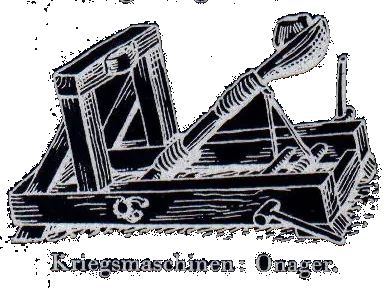
The onager was a single-armed catapult that did one thing better than any other Roman siege weapon: it threw heavy stones a long way, in a high arc, and dropped them on top of whatever it was aimed at. The name — Latin for "wild ass" — came from the violent kick the machine gave when fired. It was less precise than a ballista, slower than a scorpio, but for hurling masonry-breaking stones over fortification walls, nothing else came close.
The mechanism
An onager consists of a single heavy wooden arm — six or eight feet long — anchored at its base in a horizontal bundle of twisted rope or sinew. The torsion bundle ran across the wooden frame at ground level. The arm projected up and forward at an angle. To fire, the arm was winched down to the horizontal, a stone (or other projectile) was placed in a sling at its tip, and a trigger released the arm to swing violently upward. At the top of its arc, the arm slammed against a padded crossbar, and the stone — released from the sling — flew in a high parabolic arc toward the target.
It was a fundamentally different design from the two-armed ballista. Instead of two opposing arms pulling against each other, the onager used a single arm pulling against a single horizontal torsion spring. The result was less precise but capable of much heavier loads.
- TypeSingle-armed torsion catapult
- OriginLate Roman
- In Servicec. 3rd – 6th C. AD (longer in Byzantine use)
- ConfigurationSingle vertical arm with sling
- ProjectileHeavy stone (and unconventional payloads)
- Rate of Fire~1–2 shots per minute
- Primary UseMajor siege warfare
The kick
The onager got its name from the way it recoiled. Each shot drove the wooden frame backward several feet, and the operators had to brace it against rocks or anchor it to the ground. Without anchoring, the machine would walk away from its position with every shot. Vegetius described the operators having to "tame" the onager between shots — a half-comic image of soldiers wrestling with their own siege engine.
Rate of fire was slow — perhaps one or two shots per minute even with a trained crew. Reloading required winching the arm back down (heavy work, even with mechanical advantage), repositioning the sling, loading the stone, and re-aiming. The onager was a weapon of patient, deliberate destruction, not of rapid bombardment.
Late Roman use
Onagers appear in the historical record from roughly the 3rd century AD onward — significantly later than ballistae. They were the heavy siege weapon of the late Empire and the early Byzantine period. Roman armies on the move sometimes carried disassembled onagers in pieces, reassembling them on site; the timber alone was too heavy to transport intact across a province.
Their primary uses were in siege warfare: knocking down walls, breaking up gatehouses, clearing defenders from battlements. Less conventionally, ancient sources describe onagers being used to throw decomposing animal carcasses, beehives, and burning pitch into besieged cities — early forms of biological and incendiary warfare aimed at breaking the morale and health of trapped populations.
Byzantine continuity
The Byzantines kept making onagers long after the Western Empire fell. Byzantine military manuals from the 9th and 10th centuries still describe them in detail. The technology survived into the early Crusader period, by which time it was being challenged by — and eventually replaced by — the trebuchet, which used a counterweight rather than torsion to throw stones and could be built much larger.
The medieval mangonel
The European medieval mangonel, a single-armed stone-thrower used through the High Middle Ages, was either a direct descendant of the Roman onager or an independent reinvention of the same basic design. Either way, the line of descent is clear: when medieval knights wanted to throw a stone over a wall, they used a machine that the Romans would have recognized immediately.