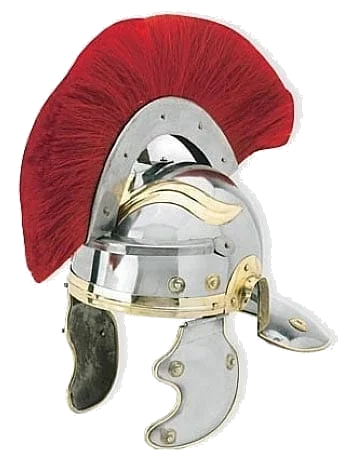
The Roman helmet evolved across more than seven centuries, and the term "galea" covers a remarkable variety of designs. Some were simple bronze bowls with rivet-attached cheek pieces. Some were sophisticated iron helmets with brass eyebrows embossed across the forehead. All did the same job: keeping the most important target on a soldier's body — his head — from being killed by the things people swung at it.
Early types: Montefortino and Coolus
The earliest Roman helmets that the army adopted as standard issue were copied from Celtic Gallic designs encountered during the Republic's expansion north. The Montefortino — named for an Italian find site — was a rounded bronze bowl with a small projecting neck guard and hinged cheek pieces. It was relatively simple to make, light to wear, and it survived the early Imperial period in slightly modernized forms.
The Coolus type, broadly contemporary, was similar but with a smoother profile and a slightly larger neck guard. Both were bronze, both originated outside Rome, and both became standard issue across the Republican legion.
Imperial Gallic and Imperial Italic
By the 1st century AD, Roman helmet manufacture had grown more sophisticated. The Imperial Gallic and Imperial Italic types — distinguished by subtle differences in profile and decoration — featured iron rather than bronze construction, broader and lower-hanging neck guards, reinforced brow ridges across the forehead, and decorative brass accents.
The brow ridge is worth noting. Some Imperial Gallic helmets had embossed brass eyebrows across the forehead — a decorative touch that also reinforced the helmet against frontal blows. The reinforcement was practical (a sword stroke down at the head naturally hit the forehead), and the decoration was characteristic of the period's design sensibility.
A typical Imperial-type helmet weighed roughly 2 to 4 pounds, fit snugly with internal padding (usually leather or wool), and was designed to deflect rather than absorb. The curvature of the bowl turned glancing blows into bruises rather than concussions.
- TypeMilitary helmet
- OriginVarious: Montefortino (Etruscan/Celtic), later Roman refinements
- In Servicec. 4th C. BC – 5th C. AD
- Weight~2–4 lbs
- ConstructionBronze (early) or iron (later) bowl with hinged cheek pieces
- Major VariantsMontefortino, Coolus, Imperial Gallic, Imperial Italic, ridge
- Rank MarkerTransverse crest (centurion); animal skin (standard-bearer)
Crests and rank
Helmets carried rank. Centurions wore a transverse crest of horsehair across the helmet — projecting from side to side — which made them visually distinct from common legionaries (who wore a longitudinal crest, if any). Standard-bearers wore animal-skin headdresses over their helmets — bear, lion, wolf — that turned them into mobile rallying points on the battlefield, visible from far across the formation.
Late Empire ridge helmets
By the 4th and 5th centuries AD, the elaborate Imperial-type helmets were giving way to simpler ridge helmets. Built from a small number of iron plates riveted together with a central reinforcing ridge, these were faster to manufacture, lighter to wear, and easier to mass-produce as the late Roman state's resources contracted. They lacked the brass decoration of the imperial types, but they did the same job. The ridge helmet would, in turn, evolve into the various early medieval European helmets that followed.
A continuous tradition
The galea, in all its forms, is a continuous tradition. Each new design absorbed lessons from the last; each new shape reflected the tactical conditions of its period. The Montefortino's cheek pieces are still recognizable in the Imperial Gallic. The Imperial Italic's brow ridge anticipates the late Roman ridge helmet's central seam. Roman helmet design did not have revolutions. It had nine centuries of patient, accumulating refinement.